Synth Waves is our column about synthesizers, sound design and the people who make electronic music. Each edition looks at what's new in the synth world and what it means for producers.
Last time we looked at how legendary instruments are preserved, in hardware or in software. This week's news is about something more practical: what you can get for nothing. Three releases from the first half of November cost no money at all, and each one comes from a different corner of the synth world.
The creator of Serum released Shrub, a stripped-down Serum that runs on the M-VAVE FM-1. UK-based DJW Audio released DW-303, an open-source, circuit-modelled TB-303. And the community behind the Deluge groovebox shipped Deluge 1.3 "Derbyshire", which it calls its biggest firmware release yet. Free, though, does not mean the same thing in all three cases.
Shrub: a small Serum for a small synth
When we covered four ways into FM, the pocket-sized M-VAVE FM-1 was already the centre of a custom-firmware scene. It now has its most prominent guest. As Synthtopia reports, Steve Duda of Xfer Records, the developer of Serum, has released Shrub, a free and stripped-down version of the wavetable synth designed to run on the FM-1.
The feature list reads like a compact Serum:
- two wavetable oscillators with Serum wavetable formats and warp modes, plus a sub oscillator and noise
- 76 filter types derived from Serum, three envelopes, four LFOs and two chaos sources
- a 16-slot modulation matrix, a seven-slot effects rack, an arpeggiator and a motion sequencer
- import of Serum 1 presets, with some conversion limits
The limits are just as clear. According to Synth News, which bases its summary on the official operation guide, Shrub plays four notes at once, with up to eight unison voices per oscillator, and uses one filter shared by all notes. It is a beta, not made or supported by M-VAVE, and the FM-1's own firmware can always be reinstalled.
You do not even need the hardware to try it. Shrub comes with a browser editor that plays the engine without an FM-1, and a VST3 version for macOS, Windows and Linux. Gearnews quotes Duda saying the plugin runs the device's own bytecode, so it uses more CPU than it seems: it is meant mainly as an editor and librarian, not as a replacement for Serum.
One detail matters for the "free" label. The altstrument firmware index notes that the Shrub site states "All rights reserved" and publishes no source code. Shrub is free to download, not open source.
DW-303: an open-source 303, circuit by circuit
DW-303 sits at the other end of that spectrum. Synthtopia reports that UK-based DJW Audio has released a free bass synthesizer and step sequencer modelled on the Roland TB-303, with the source code published under GPL-3.0-or-later.
The interesting part is the method. Instead of a generic virtual-analog engine, DW-303 models the oscillator, ladder filter, envelopes and VCA stage by stage from the original schematic. The developer says the models were then fitted against hardware measurements, including the resonance, accent and slide circuits that give the 303 its character. A Full mode runs the complete circuit simulation; an Economy mode is lighter on the CPU.
The workflow follows the original too:
- pitch first, rhythm second: notes go in pitch mode, then ties, rests and timing in time mode
- per-step accent, slide and transpose
- 64 patterns in four groups, and seven tracks for chaining them into songs
- sync to its own clock, MIDI clock or the DAW transport
According to the project's GitHub page, it is written in Rust and runs on macOS 11 or later, Windows 10/11 and Linux, in VST3, CLAP and standalone formats, with AU and AAX on macOS and LV2 on macOS and Linux. No licence key or activation is required. Bedroom Producers Blog notes that the Windows installer is not yet code-signed and may trigger a SmartScreen warning. The code licence also has a boundary: the DW-303 name and panel artwork are not covered, so forks must use their own.
Deluge 1.3 "Derbyshire": the community keeps building
The third release is free for a different reason. The Deluge is a hardware groovebox by Synthstrom Audible, and its firmware is developed in the open by the Deluge Community. Version 1.3.0, "Derbyshire", was published on 4 November and is described by its developers as their biggest release yet.
The release notes list changes in every area:
- sound engine: LFOs 3 and 4, envelopes 3 and 4, a new Warble LFO, and new effects including a Warbler, a Boss/Roland-style Dimension effect and a Digital Reverb, plus a faster, reworked Grain effect
- sequencing: Arp 2.0, note probability, iteration and fill that work independently or together, a randomizer menu, and patterns that can be saved to files or created from MIDI files
- workflow and MIDI/CV: tempo automation in Arranger View, a much more stable clock, MIDI device files that name an instrument's CCs, and interpolated CC/CV automation
The developers also say reworked sample loading and caching should make most units noticeably faster than on 1.2.1. Synthtopia's write-up points to a hands-on video by Bay Mud. The community documentation carries one practical warning: songs and presets that use community features may not load correctly on the official firmware again, so back up the SD card before updating.
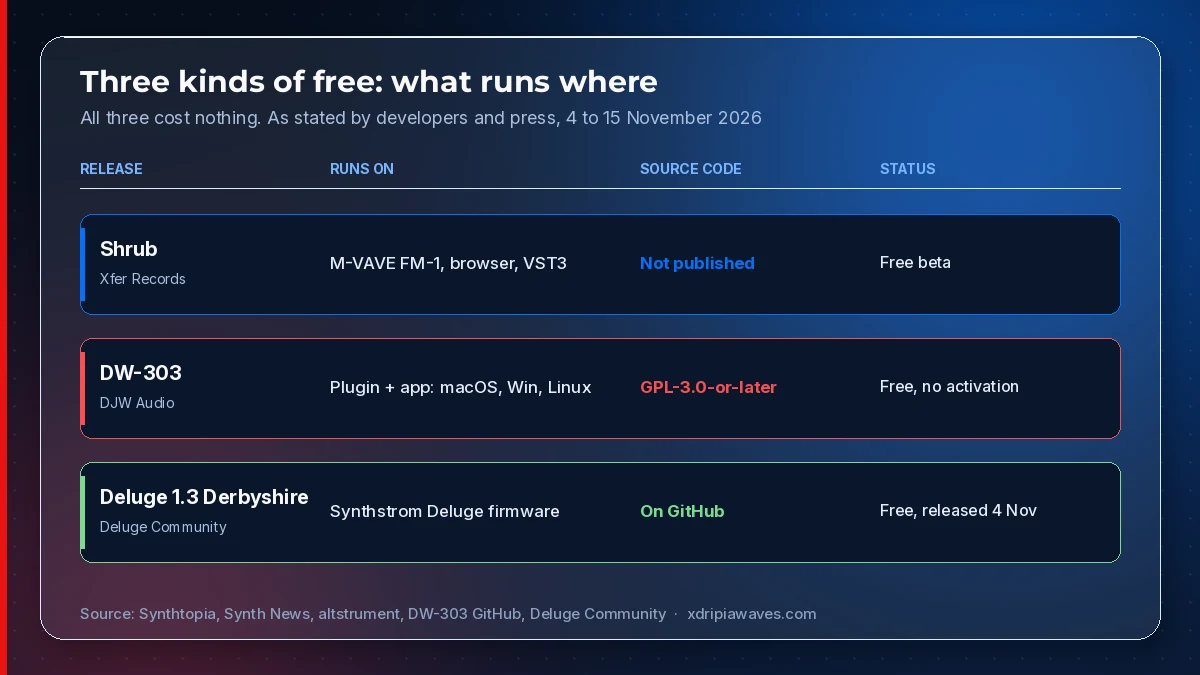
Source: Synthtopia, Synth News, altstrument, the DW-303 GitHub repository and the Deluge Community release notes, 4 to 15 November 2026.
What it means for producers
Three free releases, three different kinds of free. Shrub is a gift from a commercial developer: no cost, but closed code and a beta label. DW-303 is fully open, so anyone can study how a 303 filter is modelled or build on it, within the limits of the name and artwork. Deluge 1.3 shows what a community can do when it can work on the firmware of an instrument people already own.
For anyone starting out, the barrier keeps dropping. A browser can now play a Serum-derived engine, a laptop can run a circuit-modelled 303, and a groovebox can gain new features years after purchase. The practical advice is the same in all three cases: read the notes before you install, keep a backup, and treat beta firmware as a beta.