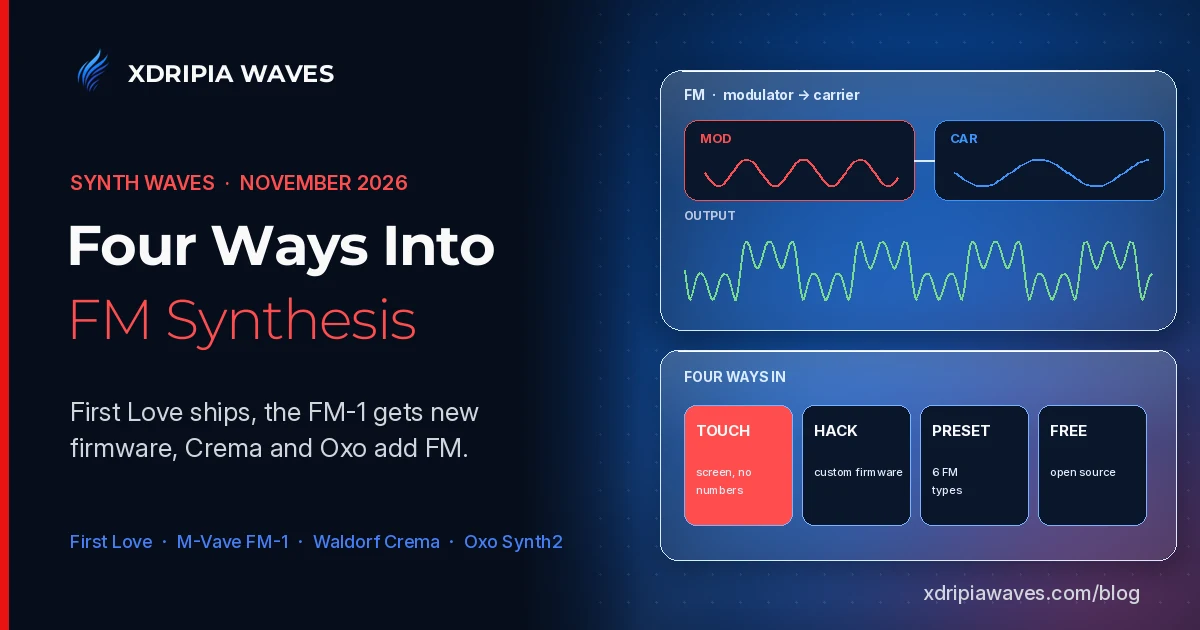
Synth Waves is our column about synthesizers, sound design and the people who make electronic music. Each edition looks at what's new in the synth world and what it means for producers.
Last time we looked at Dreadbox Alecto and the season's new drum synths. This week the thread that ties the news together is older than most of the people reading it: frequency modulation, the synthesis method behind the bells, electric pianos and glassy basses of the 1980s.
Within a few days, four very different products put FM back in front of producers. LOVE Synthesizers started shipping First Love, a touchscreen FM instrument. The pocket-sized M-Vave FM-1 became the subject of a growing custom-firmware scene. Waldorf's Crema arrived with six FM types next to its string-machine engine. And Oxo Synth2 brought a free, open-source recreation of the classic Synth1 plug-in, FM routing included, to macOS and iPad.
A quick refresher: what FM actually does
In FM synthesis one oscillator, the modulator, changes the pitch of another, the carrier, at audio rate. Instead of filtering a bright waveform down, as subtractive synths do, FM builds new harmonics from the interaction of the two. Small amounts give warmth and movement; larger amounts give metallic, bell-like or noisy tones. The trade-off has always been the interface: the results are rich, but the parameters are abstract. Each of this week's products answers that problem differently.
First Love: FM without numbers
According to Synthtopia, LOVE Synthesizers announced on 5 November that First Love, which it calls an "exploratory FM synthesizer", is now shipping. MusicTech notes that the instrument won the Best Innovation award at Superbooth 2024 and is now available in the UK, US and EU through retailers.
The main idea is the interface. First Love pairs a touchscreen with physical knobs and buttons, and, as MusicTech describes it, uses no text or numerical readouts: you shape sounds by dragging them on screen, can draw your own routing paths and sketch illustrations to save as presets. The company says it is meant to be learned "by feel and by ear".
Under that surface, the published feature list includes:
- a four-part multitimbral engine with polyphonic and monophonic operation
- FM with wave shaping, morphing envelopes, effects and extensive modulation
- live looping, riff sequencing, scale creation and microtonal tuning
- pressure-sensitive pads with velocity and aftertouch
- a battery option, built-in speakers, DIN MIDI, sync and USB
Synthtopia lists it at $699. MusicTech says the production run is limited and UK retail prices range from about £420 to £590.
M-Vave FM-1: an $80 box that keeps changing
The opposite end of the price range is the M-Vave FM-1. In a 9 November post built around a video by composer David Hilowitz, Synthtopia describes the FM-1 as "an unlikely focal point" for experimentation, and lists it at about $80 with shipping.
The interest is not only the built-in FM engine. Independent developers have written alternative firmware that turns the same hardware into different instruments, with projects covering other synthesis methods, sequencing tools and standalone music-making environments. Synthtopia links part of this to "vibe coding", meaning musicians using AI coding assistants to describe an instrument and iterate on the generated code, without deep embedded-programming experience.
It is the same pattern we covered in our open-firmware edition, only at a much lower entry price. For producers, the practical point is simple: on cheap, hackable hardware, the instrument you buy is not necessarily the instrument you end up with.
Waldorf Crema: FM as one colour among several
Waldorf takes a different route. Crema, launched at the end of October according to synth-news, is a compact desktop string and pad synth built on the architecture of the Waldorf Streichfett. FM is one of three approaches in its Texture engine:
- Strings, based on the fully polyphonic Streichfett
- 17 Waldorf wavetables, from Resonant to Vibes
- six FM types covering bells, keys, brass, bass, woodwind and organ
Per Synth and Software, wavetable and FM sounds play with 12-voice polyphony, and all 24 Texture types pass through the Streichfett Ensemble. A second Lines engine adds a virtual-analog synth with two detunable oscillators and eight voices. Crema runs on USB-C power, supports MPE, and stores 360 presets.
Waldorf's own shop lists it at €345.45; Perfect Circuit lists it at $499 in the US. Here FM is not the headline but a preset colour: the six types are curated starting points, which is the opposite philosophy to First Love's open-ended screen.
Oxo Synth2: a free classic, rebuilt
The fourth way in costs nothing. As Synthtopia reported on 9 November, Oxo Music released Oxo Synth2, a free, open-source recreation of Daichi Laboratory's Synth1, a classic virtual-analog software synthesizer.
Developer François Chabloz says the project keeps Synth1's original parameters and interface without intentionally changing the engine. It was rebuilt by measuring the original's audio output and modelling parameters one by one, using about 3 GB of measurement data. Alongside two oscillators and a sub oscillator, it offers frequency modulation, ring modulation and hard sync, up to 32 voices, and compatibility with Synth1 .sy1 patches and ZIP preset banks.
Formats
- macOS: VST3 and Audio Unit, macOS 14 or later
- iPad: AUv3, iPadOS 17 or later
- Windows VST3 in development; Linux ports welcome from the community
Four entry prices for the same idea
Laid side by side, the US prices listed by the sources above span from free to $699.
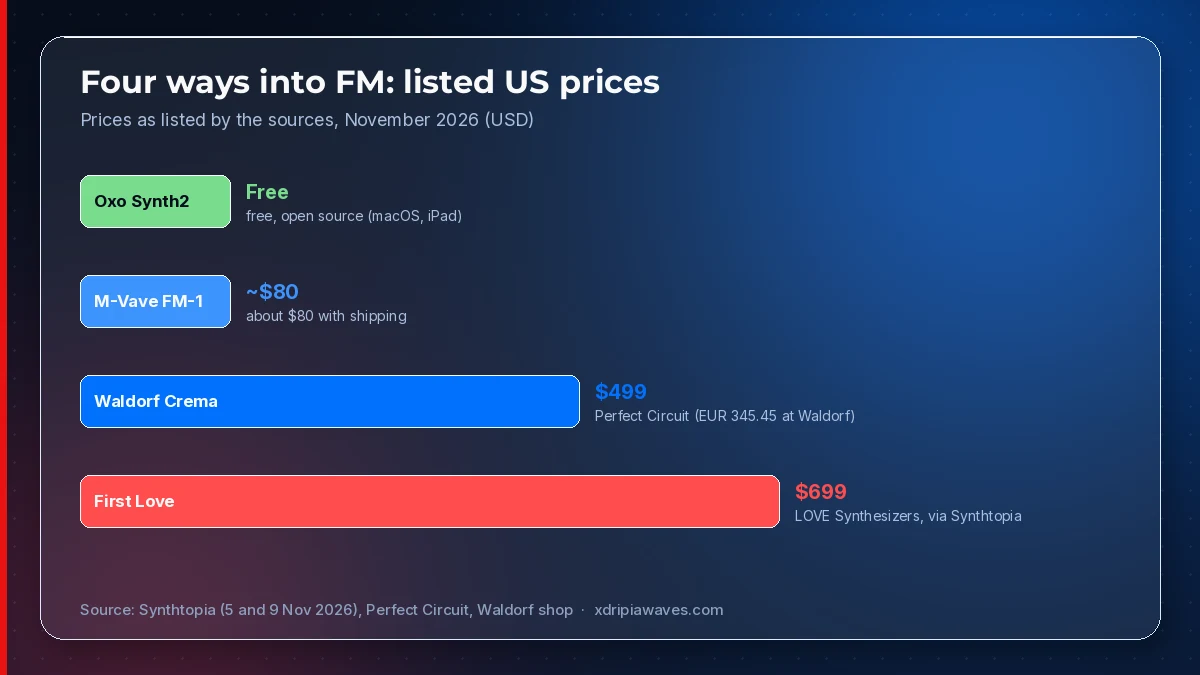
Listed US prices as reported by Synthtopia (First Love, FM-1, Oxo Synth2) and Perfect Circuit (Crema), November 2026.
What it means for producers
FM's reputation for being hard to program has not changed, but the ways around it have multiplied. If you want to learn by ear, First Love removes the numbers. If you want to tinker, the FM-1's firmware scene makes the hardware itself the experiment. If you want FM as a finished texture in a pad, Crema hands you six curated types. And if you just want to try, Oxo Synth2 puts a familiar engine on your laptop or iPad for free.
Next time in Synth Waves we will keep following the hardware that ships before the end of the year.