Synth Waves is our column about synthesizers, sound design and the people who make electronic music. Each edition looks at what's new in the synth world and what it means for producers.
Last time we rounded up the polysynths arriving before year-end and promised a closer look at Behringer's open-firmware hardware. In the eight days between October 26 and November 2, that story grew well beyond one company. Behringer published code for two instruments, Akai said it will open two of its samplers to community firmware, and Polyend released the source for its whole Tracker range.
Here is what each company has actually published or promised, where the limits are, and what it means if you own, or plan to buy, one of these machines.
Behringer: hardware first, firmware by the community
Kick
On October 26 Behringer showed a prototype called Kick, a sampler and groovebox whose layout closely follows the Akai MPC One. Synth Anatomy lists 16 RGB pads in eight banks, four assignable knobs, a jog wheel, a touch strip, a camera for gesture control, MIDI, USB and four CV/gate jacks. Behringer gives a target price of $150, with no release date.
The unusual part is the software. Music Tribe, Behringer's parent company, put the code in a public GitHub repository before the hardware exists in shops. It has four parts:
- Kick, the application, which runs Music Tribe's JAM DAW.
- AudIO, the audio engine library.
- ComProtocol, the protocol between the software and the pads, knobs and screen.
- A Buildroot Linux tree for the embedded system the device boots.
The first three are licensed AGPL-3.0-or-later and the Linux tree keeps Buildroot's GPL-2.0. In its announcement, quoted by MusicRadar, Behringer argues that "with AI, even people without programming experience can turn their ideas into new features and firmware."
There are practical limits today. The repository's own notes say the build does not work out of the box: factory samples and a licensed font were removed, there is no prebuilt cross-compilation SDK, and the Linux image is a development build with a root account without a password and SSH enabled. Treat it as a starting point for developers, not as a finished firmware.
SP1200X and beyond
Three days later Behringer announced the SP1200X, a replica of the E-mu SP-1200 drum machine. According to Synth Anatomy, Behringer is aiming for $200 and says the firmware will be open source. The unit is still in development, and price and availability are to be announced.
Music Tribe's GitHub organisation also holds a repository for a 64-channel multi-track sequencer with a touch screen, 16 step encoders and eight CV/gate outputs, and Behringer says more open hardware will follow.
Akai: an opening, with conditions
Akai answered within days. On October 27 it teased the SampleKey, a compact keyboard sibling of the MPC Sample, and said its firmware would be open to the community. On October 28 it extended that to the MPC Sample itself. Short videos showed community builds running FM, wavetable and virtual-analog synths, plus one complete custom operating system.
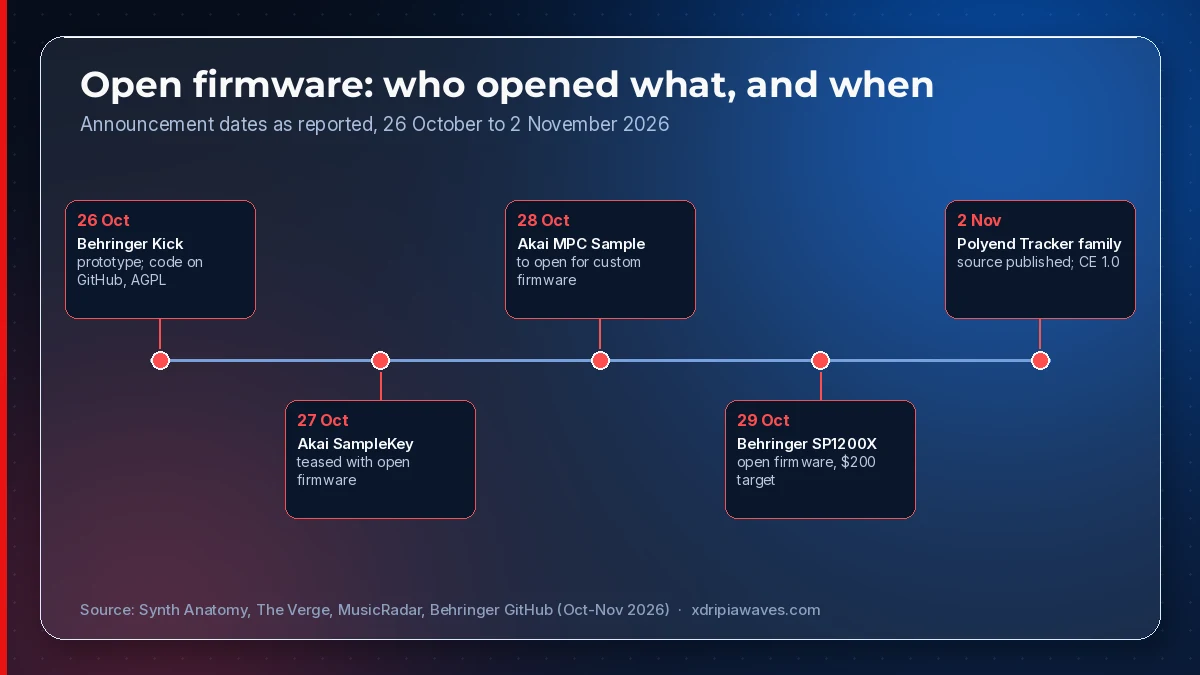
Timeline of announcement dates as reported. Source: Synth Anatomy, The Verge, MusicRadar, Behringer GitHub.
The details matter here. inMusic CEO Jack O'Donnell told The Verge that the company will seed early devices to developers, open-source some software and provide an SDK. That is not yet the same as publishing the full firmware source, and the full scope has not been confirmed. Until Akai publishes code and terms, "open" here means an invitation to a developer programme.
Polyend: source, a safety net and new features
On November 2 Polyend went further than a promise. It published the firmware source for the original Tracker, the Tracker+ and the Tracker Mini on GitHub, together with an official Tracker Community Edition 1.0, as reported by Synth Anatomy.
Two things stand out. First, Polyend added a recovery system so that a faulty custom build should not permanently disable the instrument, which removes the biggest fear of flashing your own firmware. Second, the update is useful even if you never touch the code:
- All three models can stream long stems, loops and field recordings from the microSD card.
- New micro-move and volume fields record timing and velocity per hit, and new chance conditions can, for example, bring in a fill every fourth pass.
- Six new sample-editor plugins arrive, along with a development kit for effects and generators.
- Tracker+ and Mini gain two synth engines, CHIP and DIRT, plus a kit for building new engines.
One caution: readers in Synth Anatomy's comments point out that the repository uses a non-commercial licence derived from PolyForm, which would make it source-available rather than open source in the strict sense. Read the licence file before you build anything you plan to sell.
What it means for producers
For owners, open firmware can extend the life of an instrument: features the manufacturer never planned, fixes for long-standing workflow annoyances, entirely new engines on hardware you already have. Polyend's CEO Piotr Raczyński framed it the same way, saying owners can "try it on the unit you already own."
The open question is responsibility. MusicRadar's Si Truss warns that brands could ship hardware in a minimal state and leave the community to finish it. The sensible test before buying is simple: judge the instrument on its official firmware today, and treat community builds as a bonus, not as a reason to buy.
Practical rules if you want to try a custom build:
- Check that a recovery or restore method exists before you flash.
- Back up your projects and samples first.
- Read the licence, especially if you plan to share or sell what you make.
- Prefer builds with public source over binaries of unknown origin.
Coming up in Synth Waves
Next time we will look at the new drum synths of the season, including Dreadbox Alecto and Behringer's RD-765. Tell us what you are waiting for at @xdripiawaves.
Sources
- Synth Anatomy: Behringer Kick with open-source firmware
- Music Tribe Open Source: Kick repository
- Music Tribe Open Source: multi-track sequencer repository
- MusicRadar: Behringer Kick and vibe-coded firmware
- Synth Anatomy: Behringer SP1200X
- Synth Anatomy: Akai opens the MPC Sample to custom firmware
- The Verge: Akai embraces vibe-coded mods
- Synth Anatomy: Polyend Tracker family goes open source
- Polyend: Tracker Community Edition on GitHub