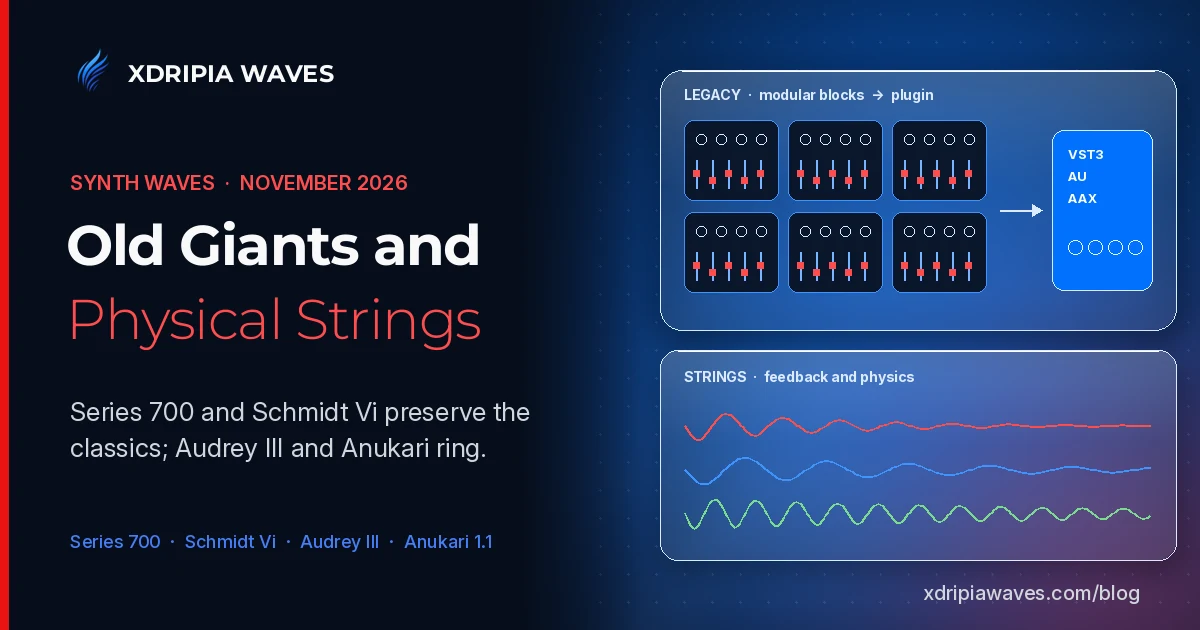
Synth Waves is our column about synthesizers, sound design and the people who make electronic music. Each edition looks at what's new in the synth world and what it means for producers.
Last time we followed four routes into FM synthesis. This week the news splits into two threads that turn out to be closely related. One is about preservation: how you keep a legendary instrument alive when the original is rare, expensive or about to go out of production. The other is about physical behaviour: synths that build sound from strings, feedback loops and simulated objects rather than from classic oscillators.
On the preservation side, Analogue Solutions announced the Series 700, a recreation of Roland's System 700 modular, and Schmidt Synthesizer released Schmidt Vi, a plugin version of its Eightvoice polysynth as hardware production ends. On the physical side, Synthux Academy opened orders for Audrey III, a three-voice feedback drone synth, and Anukari 1.1 added resonating strings, tubes and breath to its 3D physics synthesizer.
Series 700: the System 700, block by block
According to the press announcement published by Synth and Software on 11 November, the Analogue Solutions Series 700 recreates Roland's System 700, which the announcement describes as the most expensive synthesizer Roland ever made. The original appears in synth-pop history: producer Martin Rushent's System 700 is credited on the sleeve of The Human League's 1981 album Dare.
Rarity is the starting point. On its Series 700 introduction page, Analogue Solutions says original systems fetch over £150,000 on the second-hand market, and that partial systems are the norm because missing blocks are close to impossible to find.
The company's approach is deliberately conservative:
- same size and layout: every block matches Roland's dimensions, with custom-made knobs, slider caps, switches and potentiometers
- original circuits: almost every circuit is reproduced from the original schematics, with changes only where parts are discontinued
- one addition: a basic single-channel MIDI-to-CV converter, mainly for syncing the sequencer to MIDI
Six blocks are available, from the main console and analog sequencer to VCO, VCF/VCA, interface and phase shifter/delay blocks. Block 2, a 701 keyboard controller, is being developed separately.
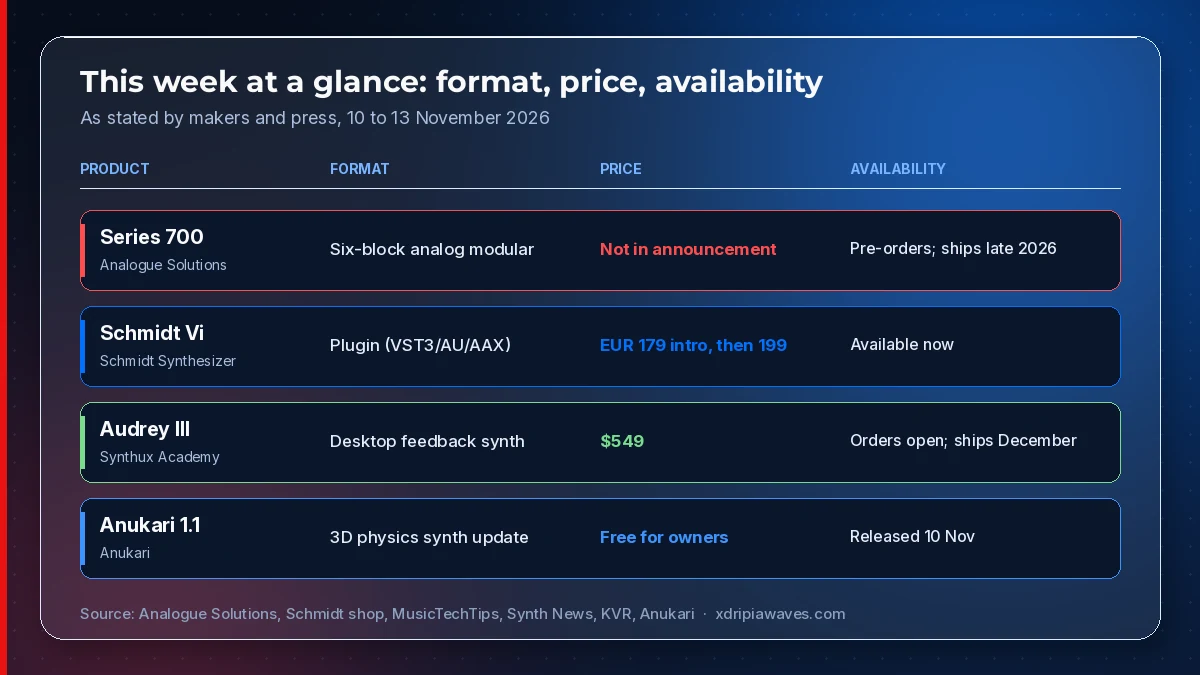
Systems are sold complete, though buyers could start with the main block or fill gaps in an incomplete original. Pre-orders are open, with shipping planned for late 2026. The announcement does not list a price.
Schmidt Vi: when the hardware ends, the plugin continues
The second preservation story runs in the opposite direction. Synthtopia reports that Schmidt Synthesizer has released Schmidt Vi, a software recreation of the Schmidt Eightvoice, the large-format analog polysynth introduced at Musikmesse in 2012. It was developed with UJAM, which analysed and modelled the original analog signal path. An early prototype was shown at Superbooth in May 2026.
The reason is stated plainly: Schmidt says rising manufacturing costs and technological developments have made hardware production increasingly difficult, and it will discontinue it. MusicTechTips adds that the Eightvoice ends once the remaining Classic units and The Final Series, a last run of 20 units, are sold.
The architecture is carried over in full:
- four oscillators, including Oscillator 4 with complex waveforms from multiple ring modulations
- two Moog-style multimode filters, two Oberheim-style dual filters and a final 12 dB low-pass filter
- 16 LFOs and nine envelopes, placed in the sections they modulate rather than in a central matrix
Software also adds what the hardware lacked: knob displays that show actual values, a randomizer, MPE support and multiple pitch-wheel and aftertouch destinations. Owners of the hardware can use it to control the plugin.
According to the Schmidt shop, Schmidt Vi costs €179 including taxes and requires an iLok account. MusicTechTips says that is an introductory price before it rises to €199, with VST, VST3, AU and AAX formats for macOS and Windows.
Audrey III: three strings feeding back
The physical thread begins with Synthux Academy, a Dutch non-profit. As Synth News reports, Audrey III is a desktop synth built on neither classic oscillators nor samples, but on three string-like feedback loops. Synthux describes it as "three guitar players feeding back together on huge amps".
Each voice runs a small burst of noise through a very short delay line that loops back through filters. The loop length sets the pitch, and the feedback amount decides whether a note decays like a plucked string or sustains into saturation. That is the principle behind Karplus-Strong synthesis, one of the simplest physical modelling techniques.
The key changes from the single-voice Audrey II:
- three voices, so it can hold a three-note chord or play arpeggios from MIDI
- a stereo Feed input that sends drums, vocals or another synth into the strings so they resonate with it
- drone mode by default, plus tape echo, reverb and a tempo-locked pump effect
It runs on USB-C power, including from a power bank. Synthux lists it at $549, shipping in December.
Anukari 1.1: strings, tubes and breath
Anukari takes the same idea into three dimensions. KVR Audio reports that version 1.1, released on 10 November, is the first major update since 1.0 in June. Anukari builds sound from a real-time physics simulation of masses and springs.
Version 1.1 adds:
- resonators: strings, bars, plates, membranes, tubes and bells that can be struck, bowed, rubbed or blown
- a mouthpiece exciter that, per the Anukari manual, blows like a flute jet, a clarinet reed, brass lips or a harmonica reed
- new spring types, the Modulosphere modulator and more than 1,000 factory presets
It also adds MCP support, so an AI assistant the user already runs can build instruments inside Anukari; no AI is built in. According to the press release, the update is free for existing owners.
Source: Analogue Solutions, Schmidt Synthesizer shop, MusicTechTips, Synthux Academy via Synth News, KVR Audio and Anukari press release, 10 to 13 November 2026.
What it means for producers
The two threads meet in one question: what part of an instrument is worth keeping? Analogue Solutions answers with circuits and panels, reproduced as closely as possible. Schmidt answers with a model of the signal path that will outlive the hardware. Audrey III and Anukari skip the nostalgia and model the physical behaviour directly, from feedback loops to bowed plates.
A full Series 700 is a studio installation, while Schmidt Vi and Anukari run on a laptop, but the direction is the same. The sound of an instrument is increasingly defined by how it behaves rather than by the box it comes in.