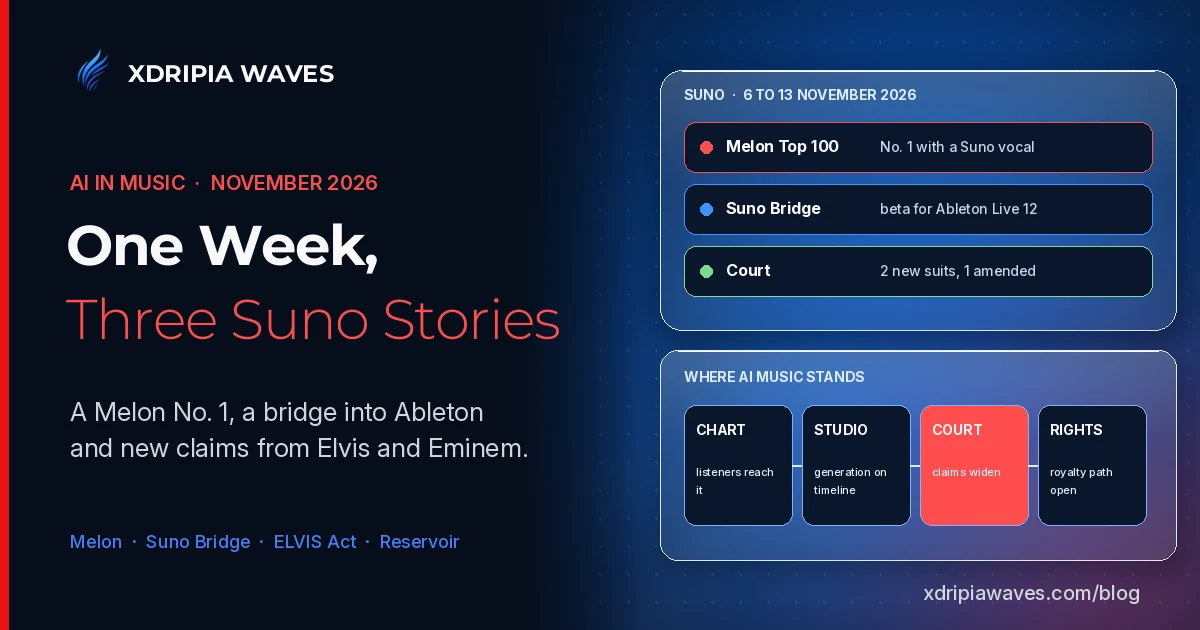
In our last AI edition we followed the metadata that tells a streaming service whether AI was involved in a track. This week one company sat at the centre of almost every story. Between 6 and 13 November, Suno picked up two new lawsuits and a bigger third claim, shipped a bridge into Ableton Live, and saw a track with a Suno-generated vocal reach the top of Korea's main streaming chart.
Taken together, the three threads show where AI music stands at the end of 2026: more useful inside real sessions, more visible to ordinary listeners, and more exposed in court.
A Suno vocal reaches No. 1 on Melon
On 13 November, "Did You Become the Adult You Dreamed Of?" by the AI project Meomuru reached No. 1 on Melon's Top 100 at 5 p.m. KST, ahead of new releases from K-pop acts, as Yonhap reported. It is the first song made with AI to top that chart.
Human lyrics, generated voice
The project's own description, quoted by Star News, says the vocals were generated with Suno, while planning, lyrics and production direction were handled by the people behind it, the Glory Wave team of composers Lee Yong-seok and Choi Seong-hyeok. The project calls AI "a modern instrument".
A slow climb, not a launch spike
The song came out on 23 June. According to JKN, it first entered the Top 100 at No. 96 on 14 September and rose steadily as background music for short-form videos. Melon's listener data, cited by Yonhap, puts people in their 30s at 36% of listeners, followed by those in their 40s at 30%.
The Asia Business Daily adds a detail that matters for creators: the song is not registered with KOMCA, Korea's main music copyright society, and the team reportedly receives distribution income but no royalties for lyrics, composition or arrangement. KOMCA had announced registration standards for AI-assisted works in August, then withdrew them.
Suno Bridge puts generation on the Ableton timeline
The same day, Suno opened the beta of Suno Bridge, a standalone Mac app that runs next to Ableton Live 12 and writes new instrument and vocal parts straight onto the arrangement. The launch post says the output follows the session's tempo, key, chords and groove.
How it works
- You set a loop range in Live's Arrangement View, for example bars 9 to 16.
- In Bridge you pick an instrument type and describe the sound you want.
- The generated clip lands on the selected track as a regular audio file, ready for your own plugins, warping and routing.
According to the help centre, each generation costs 10 credits, and Bridge requires a Premier subscription. Suno says the app was developed independently of Ableton and plans support for more DAWs and for Windows.
What leaves your laptop
The part producers should read twice is the sync step. Per Suno's Bridge page, opening a session uploads the chosen Ableton project and its audio files to your Suno account so the model can hear the context. Bridge only uploads the project you select and asks before including files it cannot reach, but an unreleased session now also lives on a hosted service. To Their Credit reports that uploads are filtered for copyrighted material, and flagged material is not ingested.
Three legal fronts in one week
While the product news landed, the court docket grew.
Elvis Presley Enterprises
Rights holders of Elvis Presley's music sued Suno on 6 November in the Northern District of California. As The Verge explains, the complaint relies in part on Tennessee's ELVIS Act, which targets AI voice cloning. A Copyright Now summary counts 859 works listed in the exhibits.
Eight Mile Style
Eminem's publisher filed the same day over 269 compositions. The complaint puts statutory copyright damages at $40.35 million, with further counts for circumventing access controls and removing copyright management information. Eminem himself is not a party.
Reservoir raises its claim
Reservoir, which sued Suno and Anthropic in October, amended both complaints on 11 November. Music Business Worldwide reports the Suno case now lists 1,368 works, up from 1,050, and that the pleaded totals across both cases come to just over $445.7 million.
Suno's response to The Verge was that it does not allow prompts for specific artists' names and songs and screens uploaded audio and lyrics for misuse.
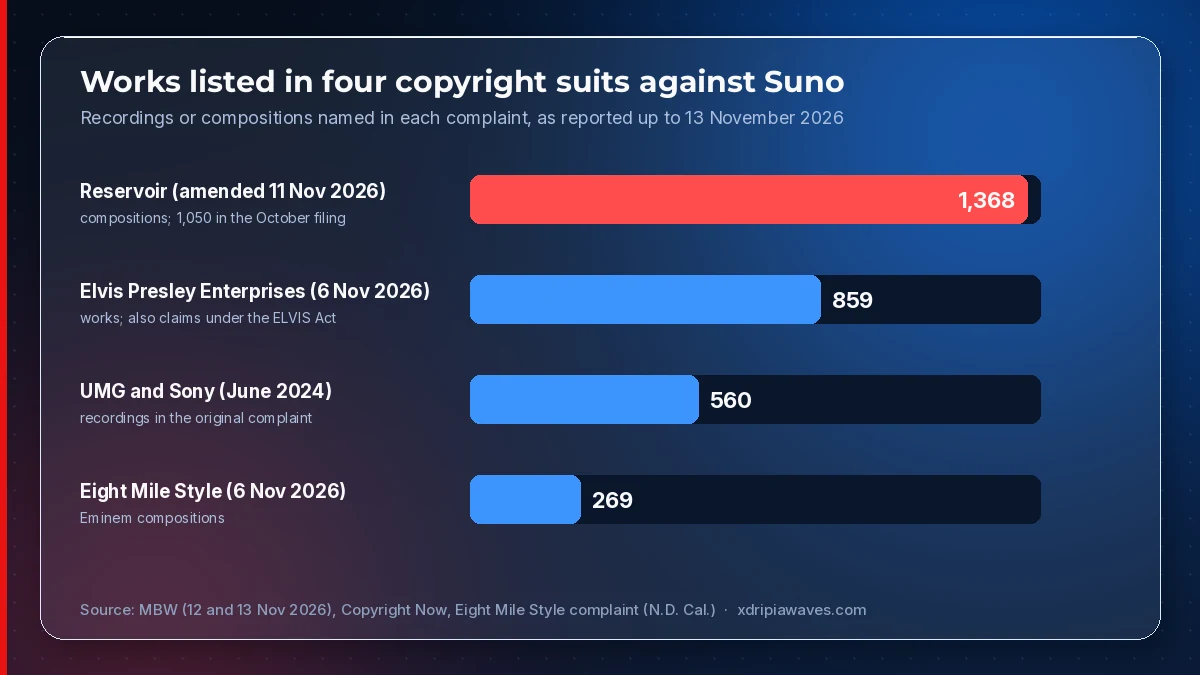
Source: Music Business Worldwide (12 and 13 November 2026), Copyright Now, Eight Mile Style complaint, N.D. Cal. No. 3:26-cv-13399.
The older case keeps moving
In the case Universal and Sony filed in June 2024, a 10 November discovery conference, covered by Digital Music News, turned to whether the majors' older artist contracts actually give them the right to license recordings for AI training. Counsel for the labels said no determination has been made that they lack those rights. Separately, MBW reports that NVIDIA's venture arm, an investor in Suno, asked the court to block the labels' demand for its testimony.
What this means for creators
- Disclose your process. Meomuru stated clearly which part was AI and which part was human. That clarity is becoming the norm, and it shapes how a track is received.
- Check the royalty path before you release. A chart-topping AI-assisted song can still sit outside a collecting society. Know which rights you can register where you live.
- Treat uploads as uploads. Tools like Bridge are convenient, but they move session audio to a third-party service. Decide which projects you are comfortable syncing.
- Watch the courts, not just the features. The outcome of these cases will shape which models stay available, and on what terms.
We will keep following both sides of this story: the tools that reach into the studio, and the rules that decide what they may learn from.