
In our last AI edition Spotify was filtering AI spam and licensing fan remixes. This week the courtroom side caught up. On October 21 the publisher Reservoir sued Suno and Anthropic, a day after Suno answered the second lawsuit from Universal and Sony, and a fight over streaming data showed what both sides think the damages argument will turn on. At the same time, Universal licensed an AI service for gamers, and new tools reached producers with clearer answers on where their training data came from.
Reservoir sues Suno and Anthropic
Music Business Worldwide reports that Reservoir filed two complaints in the US District Court for the Northern District of California. Against Suno, it says 1,050 compositions were copied to train the models without permission, including Joni Mitchell's "Both Sides Now", Johnny Cash's "Ring of Fire" and Madonna's "Papa Don't Preach". Against Anthropic, it says the lyrics of 853 compositions were used to train Claude, and that Claude reproduces them on request.
Both complaints ask for actual damages and profits or, alternatively, statutory damages of up to $150,000 per work willfully infringed, plus two counts under the Digital Millennium Copyright Act for circumventing access controls and removing copyright management information.
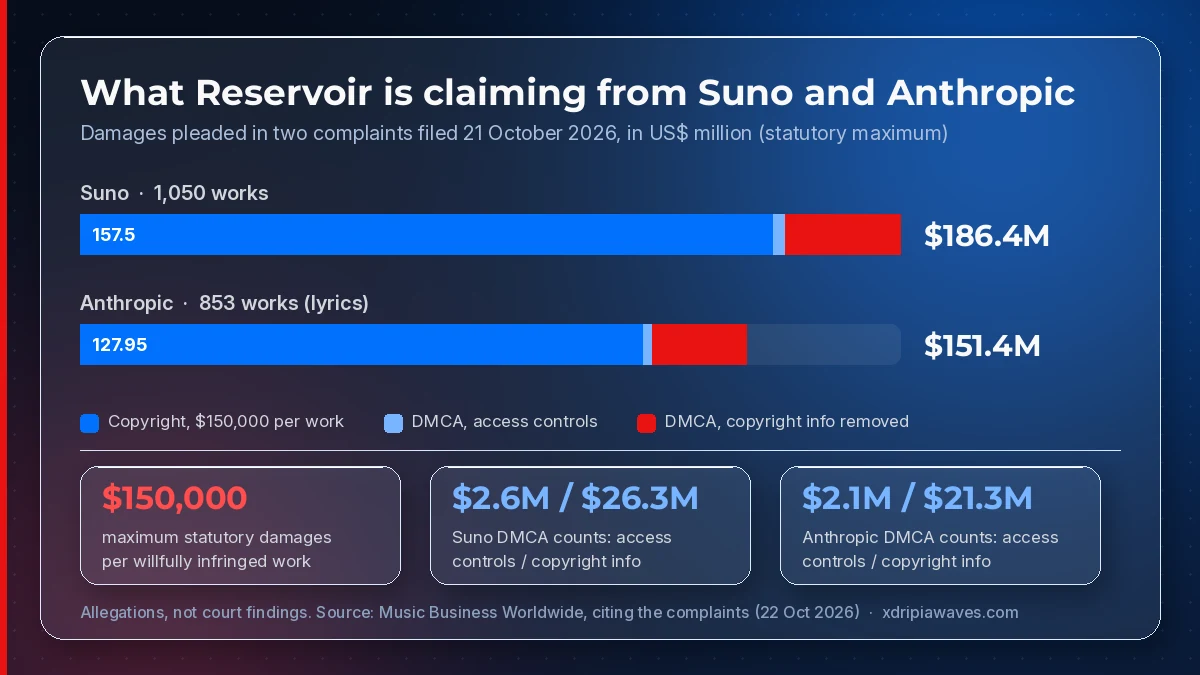
Source: Music Business Worldwide, 22 October 2026, citing Reservoir's complaints. Statutory maximums as pleaded; these are allegations, not court findings.
Two arguments in the Suno complaint stand out:
- Licensing as evidence. Suno's deals with Warner Music Group, BMG and Believe, the complaint argues, show it "has all but admitted that there is a functioning market for licensing music and sound recordings for training data."
- Guardrails that bend. Reservoir says Suno blocks a prompt naming Reba McEntire but accepts one asking for a country song "in the style of Reba McIntyre", misspelled.
The complaint also relies on Suno source code that a hacker obtained and 404 Media reported on in July. When that report came out, Suno said the incident mainly involved "outdated source code that is no longer in use." The claims are allegations; no court has ruled on them. As Digital Music News notes, Suno already faces suits from Universal and Sony, Round Hill, Gerencia 360, KODA, SOCAN and independent artists.
Suno's answer and the fight over data
What Suno admitted
In its answer to the labels' second lawsuit, filed on October 20 in Massachusetts, Suno admits that it "has not deleted all of the sound recordings it has used to train its AI models", according to MBW. Suno says this matches the labels' own earlier demand that it keep its training datasets.
That suit, filed on September 18 over 60,202 recordings, claims that training the new v6 models on outputs of earlier models "launders" the original infringement. Beyond Copying summarizes the rest of the answer: Suno denies its model is designed to replicate existing recordings, argues that any copying is fair use, and admits that since January 2026 users can include an artist's name in a prompt, which the service turns into a description of a musical style.
Streaming data as the battleground
The labels argue that AI music dilutes their market share and royalties. To test that, Suno and Udio have filed motions to compel the Mechanical Licensing Collective (MLC), the US body that collects songwriting royalties from streaming services, to hand over monthly, label-by-label performance data from 2021 onward for services including Spotify, Apple, Amazon, YouTube and TikTok, Digital Music News reports.
The MLC calls the request "vague, ambiguous, and overbroad" and says it does not collect data from record labels. Its response to Udio's motion is due on October 30. Whatever the court decides, the request shows how central one unknown number has become: how much AI-generated music actually takes from human artists on streaming services.
A licensed use: music that follows the game
On October 22, Universal Music Group announced a licensing deal with TYGER, a service that uses AI to adapt songs to gameplay in real time. Selected recordings and songs from UMG's catalogs will come to TYGER's paid on-demand tier, with some also on its free, ad-supported tier. UMG is the first major music company to license the service.
According to MBW, TYGER runs alongside supported games without integration by the studios, on PC, console and mobile. It is the other half of this week's picture: the same industry suing over unlicensed training is signing deals where the use is defined and paid for.
New tools for producers
- discoDSP WavePrompt (October 22) is a free app for macOS and Windows that generates loops, sung vocal phrases and full songs from text prompts. It runs the YuE2 model locally on the user's GPU, with no account and no uploads, and exports MIDI with every render (Audio Plugin News).
- Just 4 Noise Just 4 Kicks generates kick drums from prompts and then lets you shape them with envelopes, EQ, compression and drive. Its maker says it trained the model on recordings it made itself, so the output is cleared for commercial use; it costs €79 (MusicTech).
- AiHud Notation Copilot (October 22) adds a chat panel to MuseScore Studio 4: you type an edit, such as transposing a part or voicing a melody for a section, and it applies that change as a single undo step. The score is sent to an online service to compute the edit, which its developer states openly (MuseScore).
What it means for creators
The line between licensed and unlicensed AI is now being drawn in court filings as much as in product launches. For creators, two practical points follow. When you pick an AI tool, check what its maker says about training data, as Just 4 Noise does. And when a rights holder offers you an AI opt-in, read who the partner is and how the use is paid, because those deals are exactly what the courts are being asked to weigh.