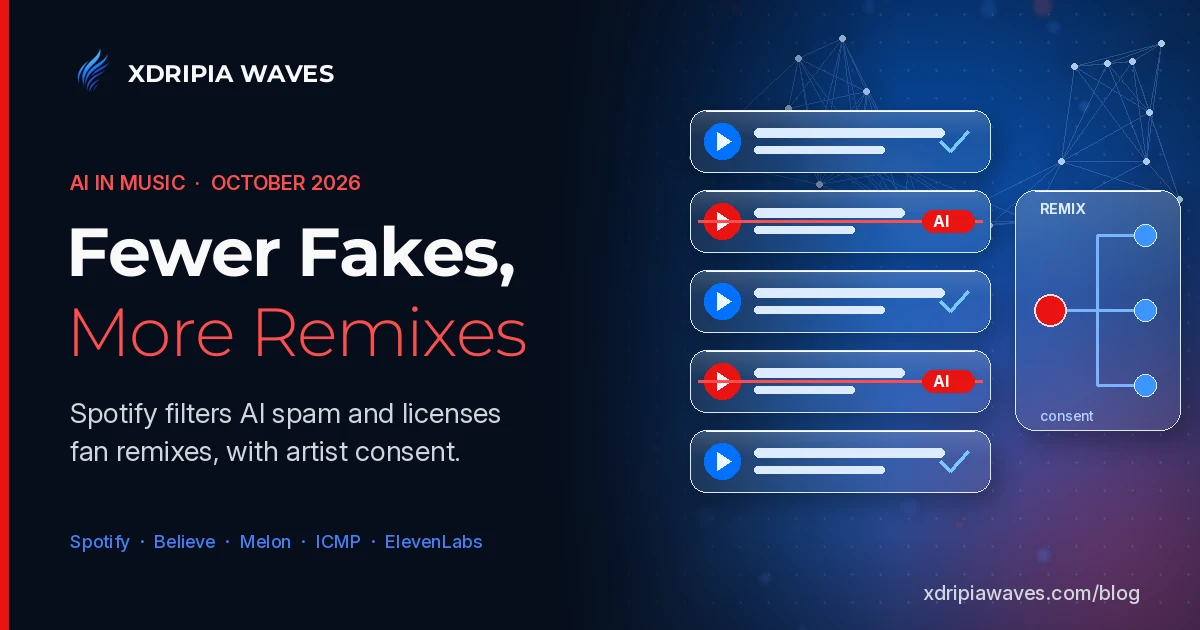
In our last AI edition we looked at how platforms are starting to label AI music. This week the biggest of them went further. On October 20 Spotify published a one-year progress report on AI spam and, the same day, signed another licence for a fan remix tool built on AI. One move keeps machine-made filler away from listeners; the other invites fans to make new versions of songs, with the artist's consent. Elsewhere, a Suno-assisted song climbed a Korean chart, a publishers' group warned Australia about weakening copyright, and new tools reached producers.
Spotify's year of filtering
In its post One Year In: Putting Human Artistry First, Spotify says it has taken more than 50 million "slop and spam" tracks out of recommendations this year. That is in addition to more than 75 million tracks removed from the service altogether for serious or repeated violations of its rules.
Spotify says no single signal is enough. It combines listener engagement and feedback, upload patterns, metadata and several third-party AI detection tools, and it admits that detection "has limitations" that will grow as generative AI improves. It also looks for tactics such as mass uploads, duplicates, SEO manipulation, spammy playlist networks and artificially short tracks.
The report lists the tools built over the past year:
- AI Credits, launched in April: artists now submit "tens of thousands" of credits a day showing which roles and instruments used AI.
- Verified by Spotify: more than 300,000 artists are verified, covering more than 99% of what listeners search for; more than 70% of them are independent.
- AI Persona badges: thousands of AI-generated artist identities are labeled and kept out of editorial and algorithmic recommendations by default.
- Artist Profile Protection: artists in the beta can review releases that list them before they appear; Spotify plans to open it to all artists by the end of the year.
- The 1,000-stream royalty threshold: tracks with a high probability of being AI-generated are 10 times more likely to fall below it.
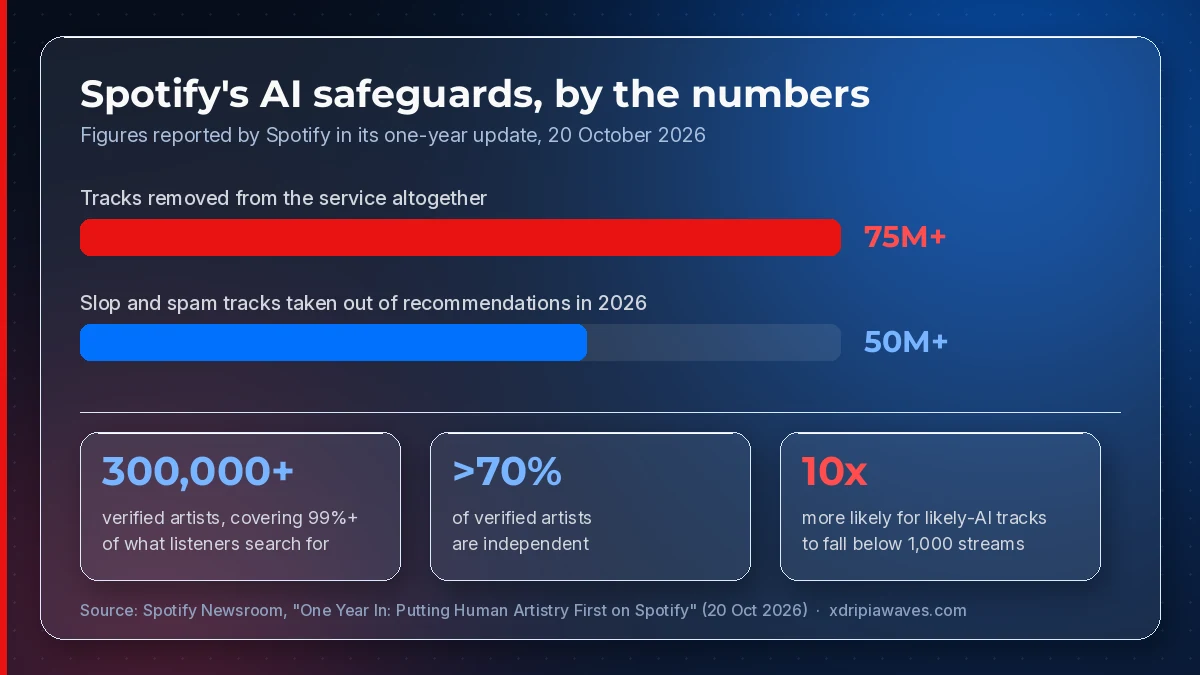
Source: Spotify Newsroom, 20 October 2026. Figures as reported by Spotify.
The figures come from Spotify itself, and Billboard reported them the same day. They describe filtering, not a ban: AI-assisted music made by identifiable artists stays on the service, and disclosure is how it is meant to be recognized.
Licensed fan remixes
Believe and TuneCore join
Hours later, Spotify announced a licensing deal with Believe, which also covers its distributor TuneCore, for its upcoming AI remix tool. Variety reports that it follows agreements with Universal Music Group, Merlin and Kobalt. The tool is still unnamed and has no release date.
According to Music Week, it is designed for remixes and covers rather than entirely new works. It is planned as a paid add-on for Spotify Premium, streams of the remixes generate royalties for the artists and rights holders behind the originals, and every remix links back to the original track.
Consent in two steps
Believe and TuneCore will use a two-step consent process. Artists first choose whether to be considered for AI-related programs at all; only those who opt in are then offered the Spotify partnership, and they decide whether to take part. Believe frames this as its four principles of consent, control, compensation and transparency.
The same company also partners with Suno: Variety recalls that Believe signed with the generator just over a month ago to help power its label-backed v6 model. For artists, the practical point is that "AI programs" now cover very different uses, and each opt-in deserves a separate decision.
AI songs on the charts, and the law
A Suno-assisted hit in Korea
The Dong-A Ilbo reports that "Have You Become the Adult You Dreamed of Being?", by the creator Meomure, reached No. 3 on Melon's TOP100 and No. 2 on YouTube's Top 100 Popular Songs chart in South Korea. A human wrote the concept and lyrics; Suno reportedly generated much of the melody and the vocals.
The rules lag behind. In August the Korea Music Copyright Association introduced guidelines to register works with identifiable human contributions, then withdrew them 22 days later after the National Assembly and the government asked for broader consensus. An audit released in March found AI may have been used in 5,200 of 8,540 songs (60.9%) newly entrusted to the association in 2024 by 29 individuals.
Australia under pressure
The International Confederation of Music Publishers told the Guardian that AI companies are pressing Australia to loosen copyright for training. Its managing director, John Phelan, said 62 countries had considered changes but none of the other 61 had introduced a commercial text and data mining exception. A parliamentary committee has asked the government to "examine current copyright settings" while keeping creators in control and paid.
A label built on both
In India, Variety reports that the new label Raagverse released its first album, "Janaa Hai Toh Jao", on October 20. Each song starts with lyrics by Mamta Javkar, and AI is one of several production tools, with people making the creative calls.
New tools for producers
- ElevenLabs Instant Soundtracks (October 15) scores an uploaded video and adds sound effects at detected timestamps. Through the API, the music and effects can come back as separate files (ElevenLabs).
- Initial Audio Difro Melody AI (October 20) is a standalone app that runs locally and generates melody variations from your own MIDI. It is free for up to 50 generations a month, with a $49 Pro version (Audio Plugin Guy).
- W. A. Production InstaComposer 4 (October 16) generates melodies, chords and full arrangements procedurally, from rules and parameters; its makers stress it is not about handing music-making over to AI (KVR Audio).
What it means for creators
The direction is getting clearer. Platforms are separating disclosed, consented AI use from anonymous mass uploads, favoring the first and filtering out the second. If you use AI in your work, the useful habits are the same everywhere: credit it accurately, verify your artist profile, and read each opt-in on its own terms before you accept it.