In our last AI edition we looked at new ways into a generated song: MIDI files in Suno and a music generator inside YouTube's Replace song tool. This week the news is about what happens after the song exists, and specifically about the small piece of data that says whether AI was involved.
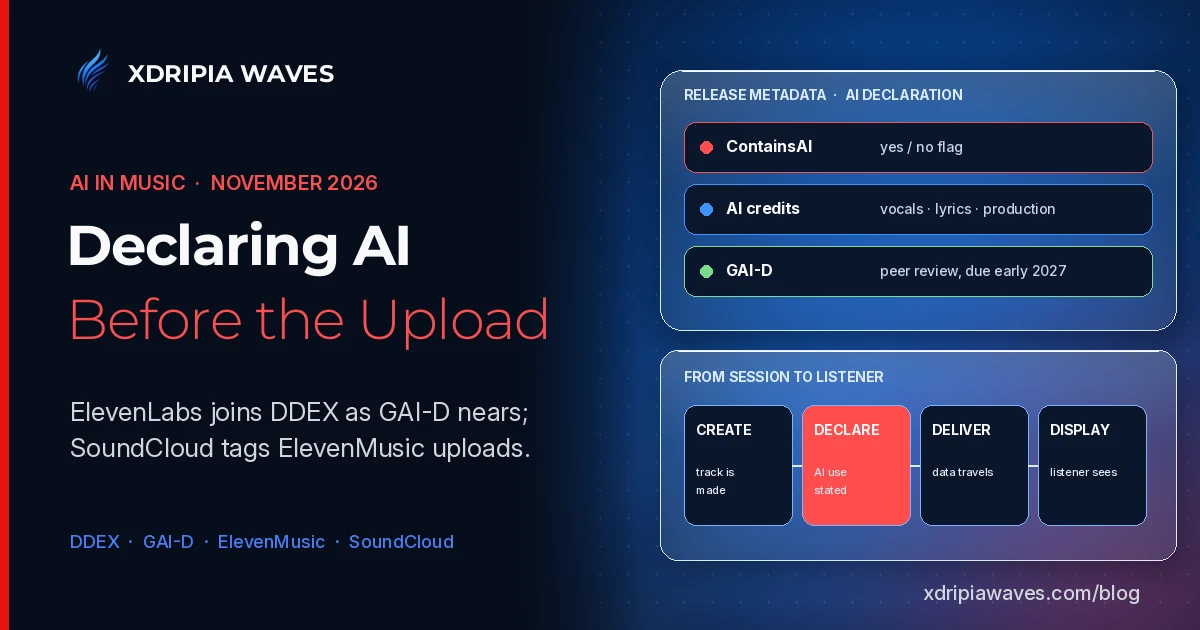
Two announcements on 5 November point at the same question. DDEX, the body that writes the data formats labels, distributors and streaming services use to exchange release information, announced that ElevenLabs has joined as a full member. The same day, ElevenLabs and SoundCloud opened a direct publishing route from ElevenMusic to SoundCloud, with a disclosure attached to every track sent that way.
Why a standards body matters here
Most listeners never see DDEX, but they see its output. When a track appears on a streaming service with the right title, credits and rights holders, that information usually travelled in a DDEX message from a label or distributor. AI disclosure now travels the same way.
What already exists
According to ChorusWire's explainer, DDEX's release-notification data dictionary already includes a ContainsAI flag: a recording-level yes or no. It does not say which part of a track used AI, or how.
Spotify uses a more detailed approach. In a September 2025 post it said it would support an AI disclosure standard for music credits developed through DDEX. ChorusWire reports that an update to that post describes a beta launched on 16 April 2026, in which AI contributions such as vocals, lyrics or production appear in Song Credits on mobile when an artist has disclosed them through a label or distributor. Spotify's own caveat is the important part: the absence of an AI credit does not mean AI was not used, and not all distributors support disclosure yet.
What is still being written
DDEX's AI Working Group held its first in-person meeting in Nashville on 9 and 10 September. It has finished collecting member comments on the committee draft of the Generative AI Declaration Standard (GAI-D), which now goes through peer review, with publication expected in early 2027, according to the DDEX announcement. The draft text has not been published, so which fields it adds is not yet public.
ElevenLabs at the table
DDEX described ElevenLabs as the first AI company to join its membership, which counts more than 150 members, including Spotify, Apple, Google, Amazon and the three major labels, Digital Music News reported. ChorusWire later corrected its own coverage on that point: Voice-Swap had announced full membership on 24 September as, in its words, the first dedicated AI voice company in the process. At the time, Digital Music News reported that Voice-Swap intends to contribute on "voice-model identity, consent and authorisation metadata, usage-scoped permissions, provenance and rights reporting".
Membership does not oblige anyone to ship a field. DDEX standards can be implemented under a free licence without joining. What membership gives an AI company is a seat in the working groups where the declaration format is decided, next to the services that will read it.
SoundCloud: the label is applied at upload
The second announcement is practical. In ElevenLabs' own description, a user connects a SoundCloud account under Linked Accounts, opens an original track made in ElevenMusic, adds a description, genre and tags, and clicks "Save to SoundCloud". The track goes straight to the user's profile, with no export step.
According to The Next Web and Unite.AI, tracks sent this way carry platform-specific disclosures identifying ElevenMusic as their creation source, and remain subject to SoundCloud's existing content policies, including ownership and rights requirements. The Next Web adds that SoundCloud prohibits AI-generated content that misleads audiences about its origins, including impersonation of other artists.
The commercial terms, as reported by TechCrunch and ElevenLabs:
- SoundCloud Artist Pro members get three months of ElevenMusic Pro, then $9.99 a month unless cancelled.
- ElevenMusic Pro allows up to 1,000 songs, 500 stem splits and five custom styles or vocals per month.
- ElevenLabs says users have created more than 25 million tracks with its models.
It follows the Moises integration announced on 21 October, which also publishes back to SoundCloud. Neither company has shown what the disclosure looks like on a track page or said how these tracks are monetised.
Declaration versus detection
The reason this matters is volume. Deezer, which detects fully AI-generated tracks rather than waiting for a declaration, has reported at intervals how many it receives each day.
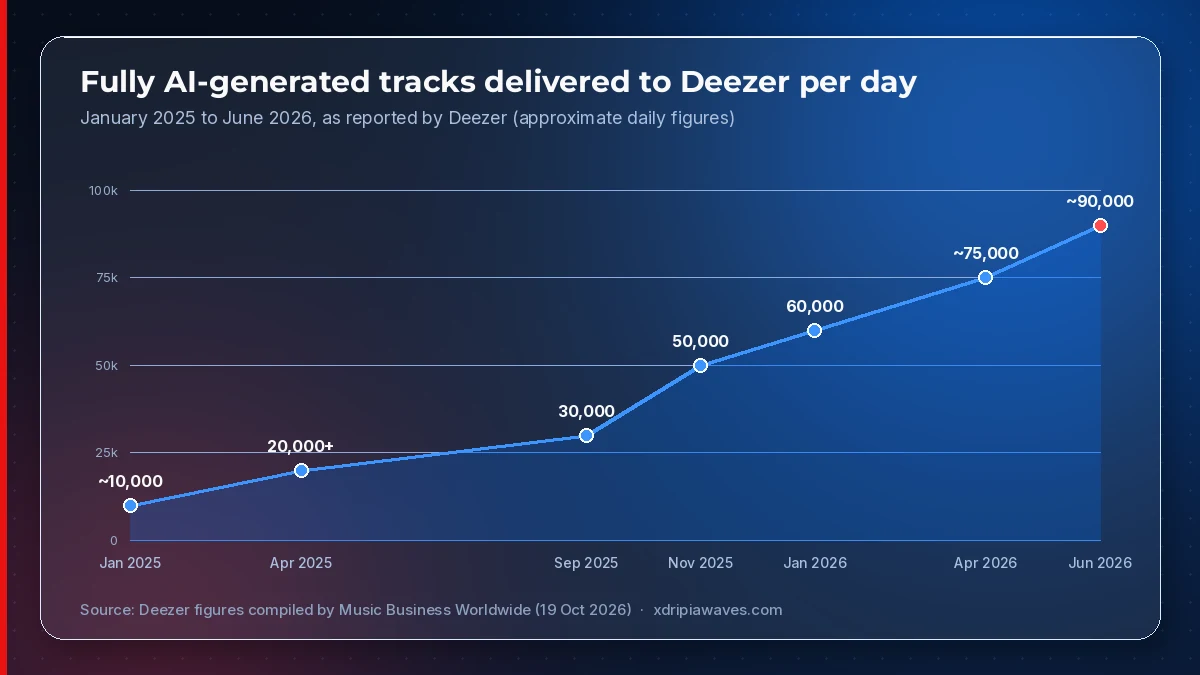
Source: Deezer figures as compiled by Music Business Worldwide, 19 October 2026.
As Music Business Worldwide summarised, that is a ninefold increase in around 17 months, and on peak days more than half of all new music delivered to the platform. Deezer says these tracks account for only 1% to 3% of streams, and that up to 85% of the streams they generated in 2025 were fraudulent.
The two approaches answer different questions. A declaration tells you what the artist or distributor says. A detector tells you what a classifier found, and Deezer's own detection targets fully AI-generated music rather than partial AI use. At these volumes, neither is enough alone, which is why the data format matters: a declaration that is never written into the file cannot be shown to anyone downstream.
What this means if you release music
- Ask your distributor whether it supports AI disclosure fields. Spotify says not all do yet.
- Declare the part, not just the fact. A yes or no flag is the minimum; credit-level detail such as vocals or production is what reaches listeners on Spotify.
- If you publish from ElevenMusic to SoundCloud, expect the source disclosure to be attached. It does not replace your own responsibility for rights in lyrics, melodies or voices.
- Watch GAI-D in early 2027. Once it is published, it is the format to check your distributor's disclosure options against.
Sources
- DDEX: ElevenLabs joins as first AI company (5 November 2026)
- Digital Music News on ElevenLabs and DDEX (5 November 2026)
- Digital Music News on Voice-Swap and DDEX (24 September 2026)
- ChorusWire: how DDEX AI music credits work (7 November 2026)
- Spotify: Strengthening AI protections (25 September 2025, with later update)
- ElevenLabs: Share your ElevenMusic creations to SoundCloud (6 November 2026)
- TechCrunch on ElevenMusic and SoundCloud (5 November 2026)
- The Next Web on ElevenMusic and SoundCloud (5 November 2026)
- Unite.AI on ElevenMusic and SoundCloud (5 November 2026)
- Music Business Worldwide on Deezer's AI toggle (19 October 2026)