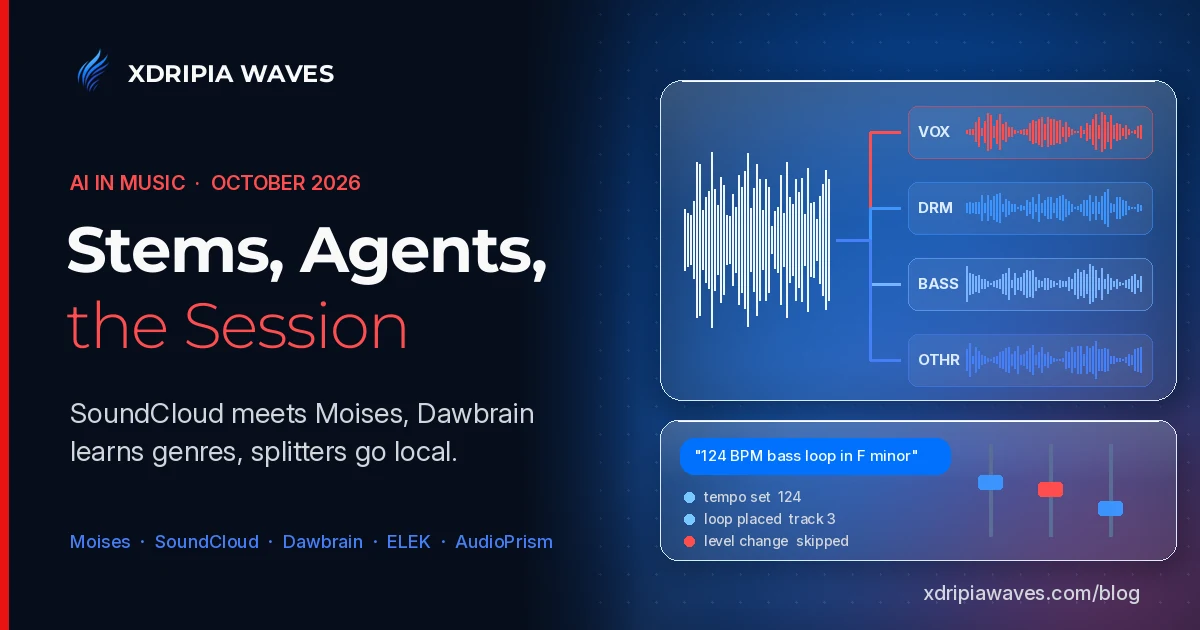
In our last AI edition the news came from courtrooms and licensing desks. This week it comes from the session itself. Over the past two weeks a streaming platform wired its catalogue into an AI production suite, an Ableton Live assistant learned to write parts by genre, and three stem-separation tools shipped, two of which never upload a file. None of them generate a finished song from a prompt; they work on music you already have.
SoundCloud opens a route into Moises
On October 21, Moises and SoundCloud announced an integration that lets artists connect a SoundCloud account and bring eligible tracks into Moises on mobile or web. Music Ally described it as a promotional deal with a technical integration attached.
What the integration does
According to the announcement, artists can:
- Import their own SoundCloud tracks into Moises.
- Practice with stem separation, chord detection and lyric detection.
- Produce in Moises Studio, the company's web-based audio studio: mix, master, or "reimagine" a track with contextual stem generation, and invite collaborators in real time.
- Ask Moi, which Moises calls an agentic production assistant, to set up sessions, mix and master to stated requirements, and explain techniques.
- Publish finished tracks directly back to SoundCloud.
Moises Pro subscribers get a two-month trial of SoundCloud Artist Pro, and SoundCloud Artist Pro members get two months of Moises Pro.
The training statements
Both companies put their training positions in writing. SoundCloud states that it does not use artists' music to train generative AI models without their explicit consent. Moises states that its models are trained exclusively on licensed and authorized music, not on content users upload or create within the platform, and that its tools are designed to support musicians rather than generate complete songs.
The monetization fine print
The round trip ends with "eligible artists" monetizing "qualifying music", and SoundCloud's own rules define what qualifies. Its help centre says monetization is only available for original content you own all the rights to, that unofficial covers, remixes, mashups and DJ sets are not monetizable, and that tracks must run between 30 seconds and 10 minutes. Monetization is not switched on automatically, and review usually takes up to five business days. A track rebuilt from separated stems of someone else's recording does not become original content because the tool made it easy.
An assistant that writes parts inside Live
Dawbrain, an AI co-producer that works on Ableton Live projects, published an update on October 21. The changelog says:
- Drums, basslines, chords, melodies and song forms now follow a requested style, from techno and house to trap, afrobeat and jazz, and can take a mood such as "dark" or "dreamy".
- Sample search ranks results by tempo and key, so a request like "a 124 BPM bass loop in F minor" returns the closest matches first.
- Drum kits can be built from samples already on disk, including folders Live's browser does not list.
- Reference listening compares a sound, such as a kick, against the same element in a reference track and can adjust toward it.
- Safer changes: the assistant avoids sudden large jumps in track level unless asked, and when a request fails partway it reports which changes already reached Live.
That last item is the one to note. An assistant that edits a live project needs an audit trail, and a partial failure that leaves no record of what changed is a real cost in a session.
Stem separation moves onto the desktop
Three separation tools were released in the same two weeks. Two run locally on the open-source Demucs model; the third is built around many specialised modes.
ELEK
SubverseLab released ELEK on October 12 as a standalone app and plugin (VST3 and AU on macOS 11 or later on Apple Silicon; standalone and VST3 on Windows 64-bit). It offers four-stem separation, vocal removal and a key and BPM reading with a confidence value. The engine is HT-Demucs, run over overlapping windows with a cross-fade, and nothing is uploaded. Stems come back as 24-bit WAV, sample-aligned to the original. SubverseLab quotes about three and a half minutes to split a four-minute track on an Apple M2 with 8 GB of memory. The price is $25, with a $7 launch price until 1 December 2026.
AudioPrism
digitalDrummer reported on AudioPrism on October 24: a Windows-only application that uses Demucs to split recordings into drums, bass, vocals and everything else. Processing is local, with no account, subscription or per-minute charge. An NVIDIA GPU gives the fastest results, with CPU processing as a fallback. The suggested uses: isolate a drum part to study it, or remove it to build a play-along track.
Clumi AI Pro
Clumi AI announced Clumi AI Pro on October 15. It goes the other way: more than 30 separation modes, from a six-stem default (vocals, drums, bass, guitar, piano, other) to drum kits, lead and rhythm guitar, synths, strings and winds. It also separates speech, music and effects, supports files up to 60 minutes and 1,000 MB, and adds denoise and reverb removal. Exports are MP3 or WAV.
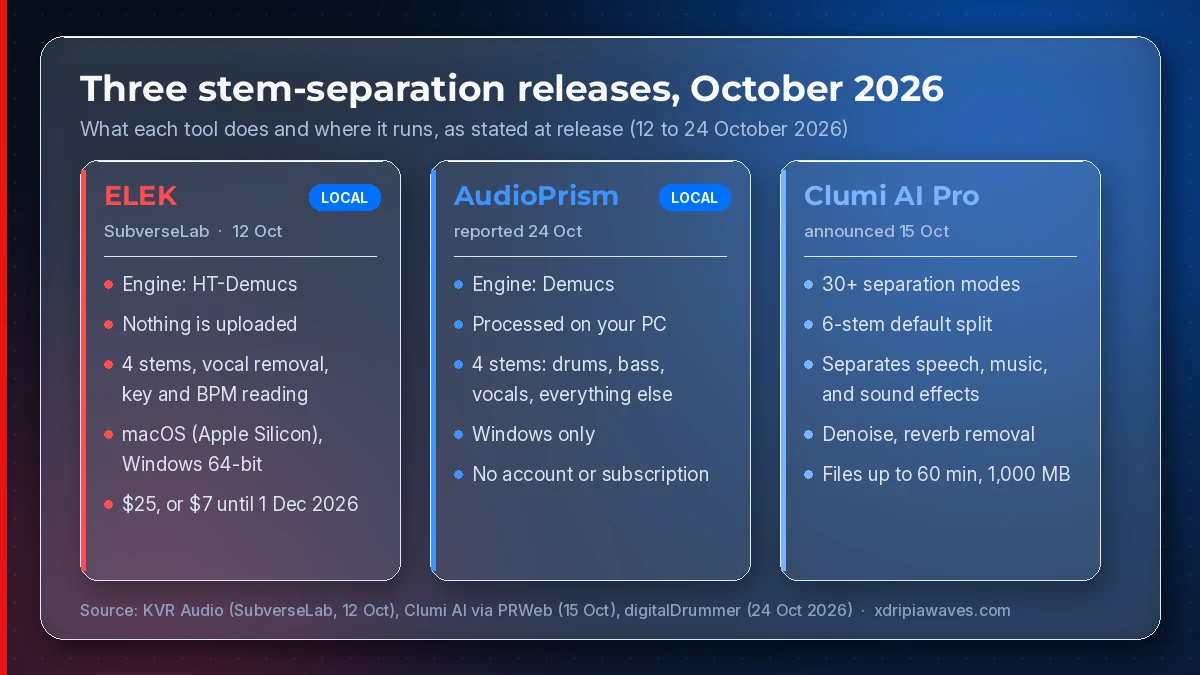
Source: KVR Audio (SubverseLab, 12 Oct 2026), Clumi AI via PRWeb (15 Oct 2026), digitalDrummer (24 Oct 2026).
What it means for creators
The common thread is that AI is being sold as a set of utilities around a human performance rather than a replacement for it. That makes the practical questions narrower and easier to check:
- Where does the audio go? ELEK and AudioPrism state that processing stays on your machine. For unreleased demos or client sessions, that is a concrete property, not a slogan.
- What was the model trained on? Moises and SoundCloud have published statements. The ELEK and AudioPrism announcements do not describe the training data behind Demucs, so check the model documentation before assuming anything.
- Who owns the output? Separation does not transfer rights. SoundCloud's monetization rules exclude unofficial remixes and covers regardless of how they were made.
- What did the agent change? Assistants that edit projects should report their actions. Dawbrain's partial-failure reporting is the kind of feature to look for in any tool of this type.
The tools are getting smaller, cheaper and closer to the session. The paperwork around them is not getting any shorter.
Sources
- Moises and SoundCloud Partner to Bring AI-Supported Creation, Collaboration and Distribution Together, Moises Newsroom, Oct 21, 2026
- Startups roundup: Moises x SoundCloud, Corite shutdown, FestIndex, Music Ally, Oct 22, 2026
- Start Monetizing with SoundCloud for Artists, SoundCloud Help Center
- Parts that fit your genre, sharper listening, pinned chats, Dawbrain changelog, Oct 21, 2026
- SubverseLab releases ELEK stem separation app, KVR Audio, Oct 12, 2026
- AudioPrism puts stem separation on the desktop, digitalDrummer, Oct 24, 2026
- Clumi AI Launches Pro Advanced Stem Splitter with 30+ Specialized AI Modes, PRWeb, Oct 15, 2026