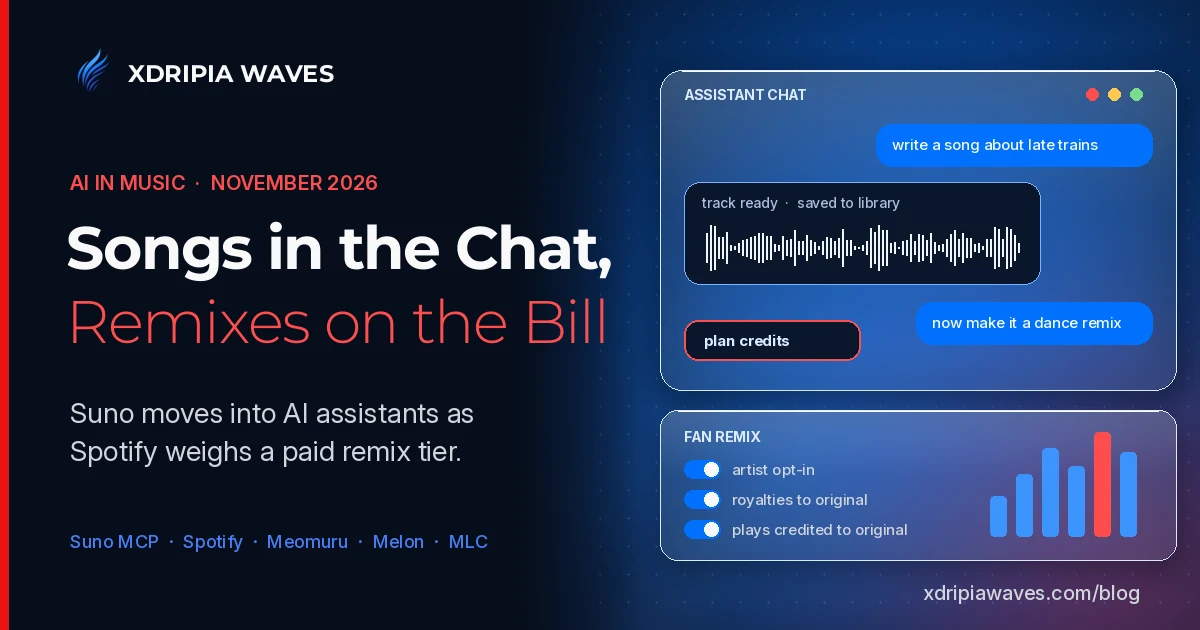
In our last AI edition the questions were about what happens after the render: attribution, output rights and pay for session players. This week the generators move closer to where people already work and listen. Suno now runs inside AI assistants, Spotify reportedly has a launch window and a price for fan remixes, and a song with a Suno-generated voice sits near the top of South Korea's main streaming chart. Meanwhile, the court calendar around Suno keeps filling up.
Suno moves into the assistant
On October 28, Suno announced Suno MCP in its release notes, as reported by Music Business Worldwide. MCP, the Model Context Protocol, is an open standard that lets AI assistants connect to outside tools and services.
What it does
According to Suno's announcement, as summarised by MBW and Music Ally:
- Where it runs: Claude, ChatGPT, Gemini, Claude Code and Cursor, plus other MCP clients configured by hand.
- What it makes: songs developed in conversation, full tracks built from an uploaded voice recording or loop, and covers, extensions and mashups of songs already in a user's Suno library.
- How it is billed: every song uses credits from the user's Suno plan and is saved to their Suno library. No API key is needed; setup means logging in to Suno and granting permission.
- Who can use it: all plans, including the free tier, through an early-access sign-up.
Rights follow the plan, not the chat
AI Musicpreneur points out that the rights to a song depend on the Suno plan, not on the assistant used to make it. Since Suno's September 3 terms update, it writes, songs downloaded on a paid plan can be used commercially, while free-plan songs are for personal use only.
MBW also spotted a sign-in portal for Suno's developer API. Suno told MBW the API remains in beta, will launch first with a select set of partners, and did not name any of them.
Spotify puts a window and a price on fan remixes
When Spotify licensed Believe for AI remixes in October, it gave no launch date. On October 30, the Financial Times reported one, as relayed by MBW:
- Timing: a launch in the first quarter of 2027, possibly unveiled around the Grammy Awards on February 7, 2027.
- Price: Spotify is weighing USD $4 to $5 per month on top of existing subscriptions.
- Scope: paying subscribers could make their own versions of songs by artists who have opted in, for example reworking a folk song as a dance track.
- Royalties: under the proposed plan, royalties from fan remixes would go to the artists behind the original songs, and plays could be credited to the original tracks on Spotify's charts.
Spotify declined to comment to the FT, and the paper's sources said neither timing nor pricing is final. Spotify and Believe have described the tool as built for remixes and covers, not entirely new works, which is the line that separates it from prompt-to-song generators like Suno.
A Suno voice near the top of Melon
The clearest sign that this is no longer niche comes from Seoul. "Have You Become the Adult You Dreamed Of?" by the project Meomuru (also romanised Meomureu) uses vocals generated with Suno. It was created by Glorywave, the songwriting and production duo Lee Yong-seok and Choi Sung-hyuk, who have written for established Korean singers for more than a decade, according to the South China Morning Post.
How the track was made
Reports from allkpop and TopStarNews describe a hybrid workflow:
- The duo wrote the lyrics and set the production direction.
- Suno produced the melody, arrangement and vocal.
- The team edited the material in conventional production software, sometimes re-recorded melodies or restructured the song, then mixed and mastered it themselves.
The song was released on June 23 and disclosed its use of Suno in its Melon album notes. Chosunbiz reported it at No. 3 on the Melon Top 100 on October 20, up from No. 93 on the September monthly chart, and the SCMP reported on November 1 that it had reached No. 2 earlier that week. Listener reactions, as allkpop notes, range from being moved by the song to refusing to play it once they learn how it was made. The open questions are the familiar ones: how to split credit and royalties between human lyrics and generated melody and voice.
The court calendar fills up
Suno's legal fight with Universal Music Group and Sony Music produced three filings in a week:
- A request to pause. On October 30, Suno asked a Massachusetts federal judge to pause the labels' second lawsuit until key rulings arrive in the first, Law360 reported. The first case covers 560 recordings; the second covers 60,202.
- Apple. In an October 27 filing, Suno opposed Apple's bid to block a deposition subpoena. It wants live testimony on Apple's licensing talks with the two labels, whether Apple has assessed running Apple Music without their catalogs, streaming fraud, and Apple's communications about Suno. A hearing is set for December 1, according to MBW.
- The MLC. The Mechanical Licensing Collective has until November 2 to oppose Suno's motion to compel label-specific stream-volume data going back to 2021, and Suno then has until November 16 to reply, Digital Music News reported. The proposed schedule still needs the judge's approval.
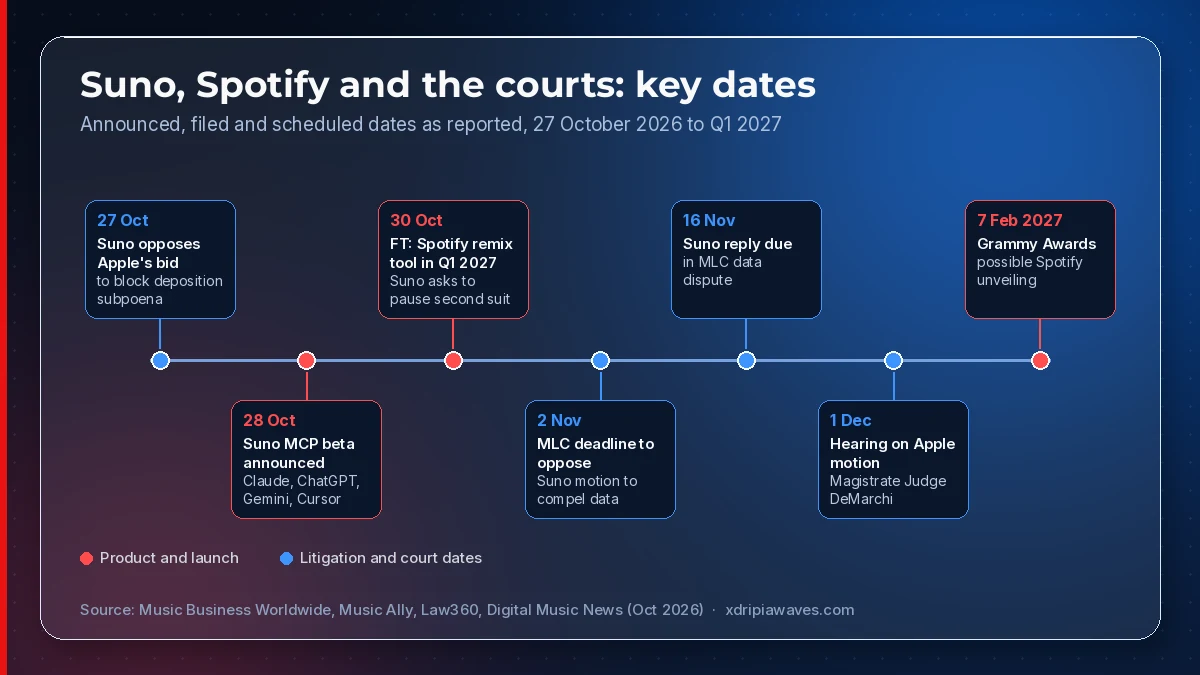
Dates as reported by Music Business Worldwide, Music Ally, Law360 and Digital Music News, October 2026. Spotify's timing is a Financial Times report, not confirmed by Spotify.
The thread running through these filings is market harm: Suno is trying to show that AI audio has not cost the majors money, and the labels argue the opposite.
What to watch
- Suno MCP access: how quickly early access widens, and whether rights holders respond to Suno running inside assistants whose makers face their own lawsuits.
- Spotify's pricing: whether a paid remix tier lands in Q1 2027 and which labels opt their artists in.
- Credits on charts: whether Korean platforms or rights bodies set rules for disclosing and paying out on AI-voiced hits.
- December 1: the hearing on Apple's motion, and the MLC data fight before it.
Sources
- Suno's new MCP tool lets users make songs inside ChatGPT, Claude, and Gemini, Music Business Worldwide, Oct 30, 2026
- Suno launches MCP server to 'create music right from the chat', Music Ally, Oct 29, 2026
- Suno MCP Server: Make Songs in Claude, ChatGPT, Gemini, AI Musicpreneur, Oct 29, 2026
- Spotify plans Q1 2027 launch for AI covers and remixes tool, Music Business Worldwide, Oct 30, 2026
- South Korea's latest chart sensation has a secret: the singer isn't human, South China Morning Post, Nov 1, 2026
- Meet MEOMURU, the AI music project behind a song that hit no. 3 on Melon, allkpop, Oct 2026
- AI Vocal Project Meomureu Jumps 3 Spots to No. 17, TopStarNews, Oct 20, 2026
- AI-made song tops Korea charts as YouTube, Spotify adopt AI labels, Chosunbiz, Oct 20, 2026
- AI Music Startup Wants Labels' Second IP Suit Paused, Law360, Oct 30, 2026
- Suno fights to make Apple testify, Music Business Worldwide, Oct 30, 2026
- Suno Plows Ahead With MLC Subpoena, Sets Response Deadline, Digital Music News, Oct 30, 2026