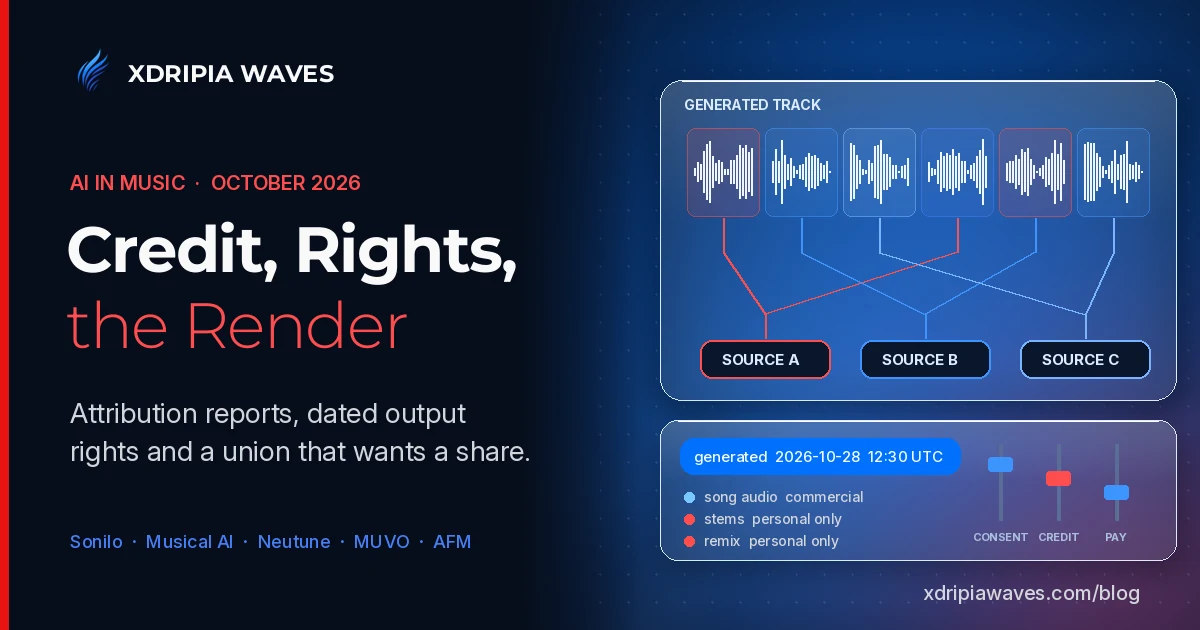
In our last AI edition the tools moved into the session. This week the questions move to what happens after the render: who can be traced inside a generated track, what you are allowed to do with the file, and whether the session musicians on the original recordings see any of the money.
Attribution moves into the generator
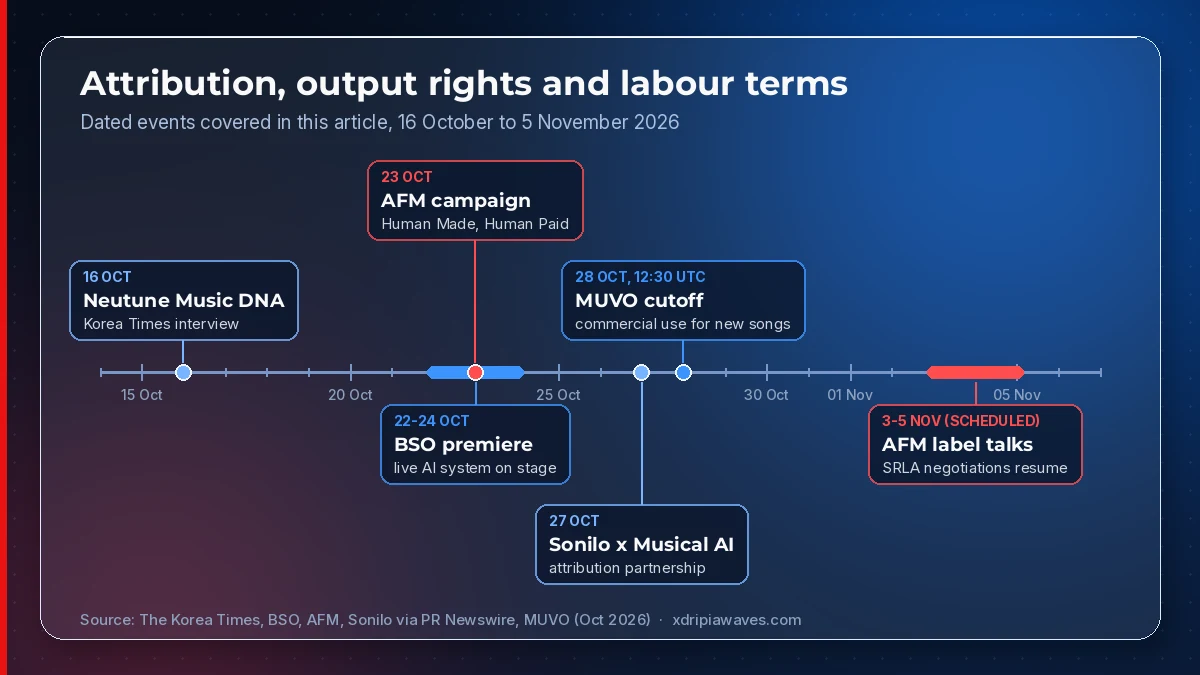
On October 27, the video-to-music company Sonilo announced a partnership with Musical AI, a Canadian rights technology company that provides consent management and attribution for generative music.
What the partnership does
According to the announcement:
- Sonilo generates music and sound effects from video footage, text, or both, using models built around licensed source material.
- Musical AI will analyse Sonilo's generated outputs and measure how licensed recordings and compositions contributed to each one.
- The reporting goes to Sonilo's licensing partners, to account for usage and support compensation for the songwriters, artists and rights holders behind the source music.
The release says Sonilo is finalising master recording and publishing agreements with major rights organisations, but names no partners and gives no payment terms.
Blocks, not tracks
A related approach comes from Seoul. In an interview with The Korea Times published on October 16, Neutune CEO Lee Jong-pil described its Music DNA service, which scans new music for material drawn from existing works. Neutune splits songs into blocks by instrument (bass, drums) and by section (intro, verse) to measure individual contributions. Lee's argument is that a list of source songs is not enough for settlement: users now generate a track, take it apart and rework individual parts.
Lee said the technology is "already settled" and that the slow part is consent from rights holders. He also said voice and likeness are harder to track than copyright in the music itself. Music Business Intelligence adds a necessary caveat: these are company claims, and a technical match still has to connect to reliable ownership records, permissions and agreed payment terms.
Output rights now have a timestamp
On October 28, the generator MUVO published new commercial-use terms for its song audio. The grant is narrow and precise:
- Covered: new vocal-song and instrumental audio, including M4A and WAV copies, whose original generation was confirmed on or after 28 October 2026, 12:30 UTC.
- Allowed: distribution, monetisation, sale or licensing, editing, and use in advertising, sponsored content or client projects. No subscription, extra royalty or attribution to MUVO is required, and complimentary-credit users qualify.
- Not covered: older MUVO content, songs from other providers, remix audio, stems and generated instrument parts, artwork, music videos and karaoke exports. These stay personal and non-commercial.
The cutoff is tied to the original generation request. A job confirmed before the cutoff keeps the old restrictions even if it finishes afterwards, and a new export or edit does not move an old song past it. MUVO also states that commercial permission does not guarantee exclusive copyright, registration, freedom from third-party claims, or acceptance by a distributor.
For anyone using generated audio in client work, the practical consequence is record-keeping: the generation timestamp of each file now decides what you may do with it.
The session musicians' claim
The American Federation of Musicians, which Rolling Stone puts at more than 80,000 members, launched a campaign called Human Made, Human Paid. The AFM posted its announcement on October 23. The campaign sets three principles for any use of musicians' work in AI training or generation:
- Consent: the right to permit or refuse the use of their work for AI training.
- Credit: transparent recognition of their performances.
- Compensation: payment when their work generates value in AI systems or licensing deals.
The context is the Sound Recording Labor Agreement with UMG, Sony, Warner and Hollywood Records. The campaign FAQ says talks are stalled after four bargaining rounds and resume on November 3 to 5. Separately, as Beyond Copying summarises, the union filed a lawsuit on June 5 arguing that licensing recordings to Suno and Udio is a "new use" under the agreement that requires notifying the AFM and paying musicians. The labels reject that reading and have asked the court to dismiss the case, which has not been decided.
The point for producers is that attribution systems, like those above, mostly measure compositions and master recordings. The performers on those masters are a separate party with a separate contract, and the AFM wants that contract to address AI directly.
Source: The Korea Times, AFM, Boston Symphony Orchestra, Sonilo via PR Newswire, MUVO (October 2026).
A live system on an orchestral stage
Not every development was contractual. From October 22 to 24 the Boston Symphony Orchestra performed the world premiere of Tod Machover's "already and not yet", conducted by Kent Nagano. According to MIT News, the piece uses a "Live AI" system built at the MIT Media Lab by PhD candidate Manaswi Mishra. The Media Lab describes how it works: microphones pick up individual musicians and sections, and the system plays variations through surround speakers in the hall. "If no audio gets in, no audio gets out," Mishra said.
Unlike the generators above, the system has no catalogue to attribute and no output file to license; its only input is the performance in the room.
What it means for creators
- Keep generation records. MUVO's terms show that rights can depend on when a file was generated. Save timestamps and job identifiers with your project files.
- Read the exclusions. Stems, remixes and instrument parts are often outside a commercial grant even when full songs are inside it.
- Ask how attribution is reported. Sonilo and Neutune describe measuring contributions; neither has published how that data turns into payments.
- Watch November 3 to 5. The AFM talks may show whether AI terms for performers are settled by contract or left to the court.
Sources
- Sonilo and Musical AI Partner to Ensure AI Music Empowers Creators and Rewards Rights Holders, PR Newswire, Oct 29, 2026
- Korean startup targets 'legal AI music' via copyright tracking, The Korea Times, Oct 16, 2026
- Neutune Builds Component-Level Tracking for AI Music Rights, Music Business Intelligence, Oct 16, 2026
- Commercial use for eligible new MUVO songs, MUVO, Oct 28, 2026
- AFM Launches "Human Made, Human Paid" Campaign, AFM, Oct 23, 2026
- Human Made Human Paid FAQ, AFM campaign site
- The Largest U.S. Musicians Union Is Demanding AI Protections, Rolling Stone
- AFM launches the "Human Made, Human Paid" campaign, Beyond Copying, Oct 21, 2026
- already and not yet: A world premiere by Tod Machover, Boston Symphony Orchestra
- Tod Machover's new symphony plays with AI while reflecting on democracy, MIT News, Oct 21, 2026
- As AI fears rise, a composer puts it on stage at Symphony Hall, MIT Media Lab