Synth Waves is our column about synthesizers, sound design and the people who make electronic music. Each edition looks at what's new in the synth world and what it means for producers.
Last time we promised an edition about performance: sequencers, MIDI controllers and the tools that help synths work on stage. The past three weeks gave us plenty to choose from, from budget keyboard sequencers to a dedicated live controller and a long-awaited analog step sequencer. Here is what arrived, and how each type of tool fits into a live setup.
Keyboard controllers that sequence
The small keyboard with a built-in sequencer has become a standard first purchase. Two October releases show where the category is going.
Behringer Jam and Jam Play
MusicRadar reports that both models are 32-key USB MIDI keyboards with velocity and channel aftertouch, dual touch strips and four assignable rotaries. Each has a 64-step, four-channel polyphonic sequencer with ratcheting, swing and gate randomization, plus an arpeggiator and a Chord Play mode that remembers chords of up to 16 notes. Three CV/gate outputs and analog sync make them useful for modular rigs. Jam Play adds 128 instrument voices and 10 drum kits, so it can be played without a computer. Behringer has not confirmed pricing; MusicRadar notes Thomann pre-order prices of €99 and €179.
Akai MPK Mini Plus II
Akai's second-generation MPK Mini Plus has an upgraded 37-key keybed, eight RGB pads and a full-colour display. The sequencing side brings a refreshed arpeggiator, Scale and Chord modes, and generative tools named Glitch, Mutate, Strum, Freeze and Follow. MusicRadar points out one trade-off: the 5-pin MIDI input and analog sync connections of the first model are gone, leaving a MIDI output, a sustain jack and three CV/gate outputs. It is available now at $169.
Dedicated sequencers
A separate sequencer frees the synths from their own pattern limits and gives one clock to the whole rig.
Phantom Instruments S49
The S49, presented in a demo series on October 22, is a 16-track MIDI step sequencer with eight CV and eight gate outputs. Each step stores pitch, velocity, probability, ratchet, gate length and a CC value. Performance features include mute groups, armed mutes, fills and an accent mode, and it can generate Euclidean patterns. Phantom lists a pre-order price of €399 (full price €549), with a limited batch shipping in 2027.
Midicake UNA
UNA takes a different approach. According to Synthtopia, it uses the chords you play as the harmonic source for three coordinated tracks: chord and rhythm, melody and bass. A split mode lets one hand supply chords while the other plays a solo line. The Early Bird Edition costs $519, with the first 150 units due between December 2026 and January 2027.
Behringer 1601
Behringer first announced its version of the 1976 ARP 1601 five years ago. Synth Anatomy reports that it is now listed on Behringer's website: an analog CV sequencer with one row of 16 steps or two rows of 8, three gate buses, a built-in quantizer and, unlike the original, MIDI and USB-MIDI. Price and availability have not been announced.
Våld Labs Vekte 1.3.0
On the software side, KVR Audio reports the first commercial desktop release of Vekte, a generative MIDI sequencer with 16 slots, each usable as a melodic sequencer, drum sequencer or arpeggiator, and 41 generative algorithms. It runs as a standalone app, VST3 and AUv3, for €34.99 until October 31 (regular €44.99).
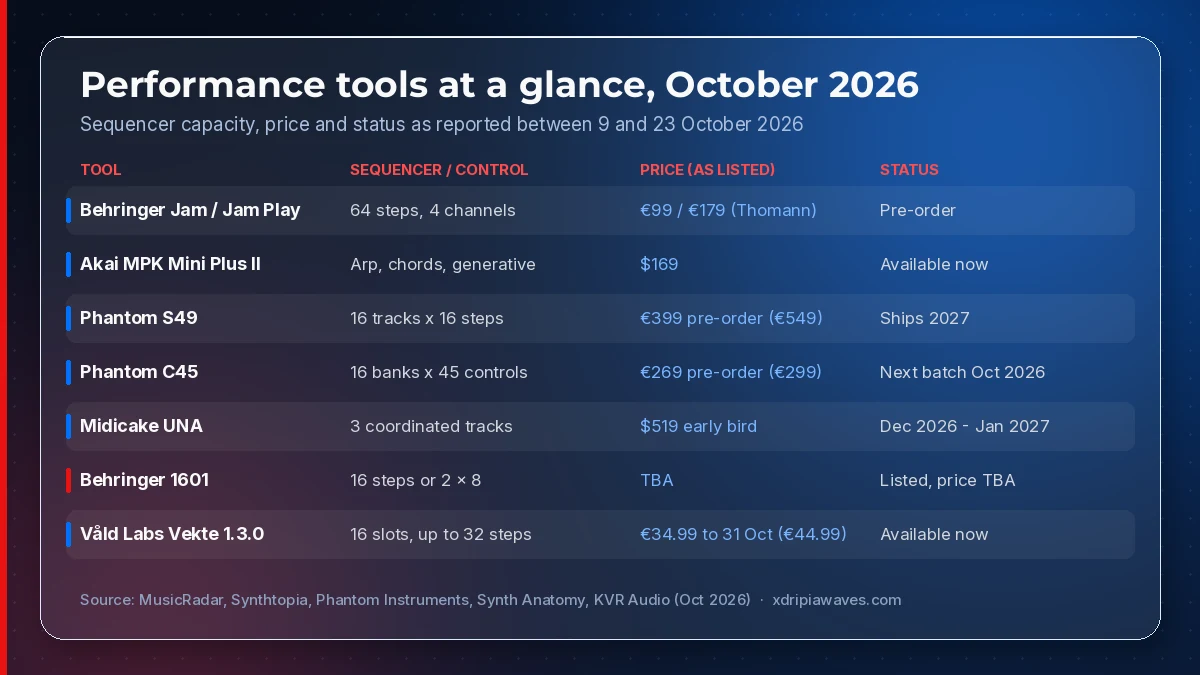
Specifications and prices from MusicRadar, Synthtopia, Phantom Instruments, Synth Anatomy and KVR Audio.
Hands-on control for the stage
Phantom Instruments C45
The S49's companion is built for one job: live control without menus. The C45 holds 16 banks of 45 controls, each with 24 knobs, four faders, 16 RGB buttons and a push encoder. Every control can be routed to USB, MIDI Out, MIDI Thru or all three, and units can be chained for more channels. Phantom lists €269 on pre-order (standard price €299).
Looping and scenes
Two other updates target the moment a track is built in front of an audience. 1010music's free blackbox 2 firmware 1.1.0 adds 16 scenes, sequencer automation, "record from anywhere" loop capture and MIDI remote controls for record, clear and play, so a footswitch can run the looper. Kaiq Electronics' Memory Loop Slicer does a similar job in software: an always-on four-bar buffer that captures, slices and rearranges audio, with the original and processed signals on separate outputs. It costs $99 until November 30 (regular $129).
Practical tips for a live rig
- Pick one clock master. Decide which device sends MIDI clock and set everything else to follow. Most timing problems on stage come from two devices trying to lead.
- Use probability and mutes, not more patterns. Probability, ratchets and mute groups, all present on the S49 and UNA, create variation from a few patterns you know well.
- Check your connections before you buy. The MPK Mini Plus II no longer has MIDI in or analog sync; the Jam models do. If a controller has to receive clock, this matters.
- Map for the set, not the studio. Use banks or scenes per song, as the C45 and blackbox 2 allow, and keep the same function in the same place across songs.
- Keep a simple fallback. A generative engine like UNA or Vekte can go somewhere unexpected; know which control brings it back to a stable pattern.
What this means for performers
Two directions stand out. Sequencing is moving into cheap keyboards, and generative tools are becoming standard. At the same time, small makers like Phantom Instruments are building controllers around a single live use case. For most players, the best option is still a small, reliable setup they can operate without looking at a screen.
Coming up in Synth Waves
Next time we'll look at the people behind the machines: artists and their live rigs. Got a setup we should feature? Tell us at @xdripiawaves.
Sources
- Behringer unveils Jam and Jam Play, MusicRadar, Oct 9, 2026
- Behringer Jam & Jam Play ready for pre-order, Synth Anatomy, Oct 9, 2026
- Akai Launches MPK Mini Plus II, Synthtopia, Oct 22, 2026
- Akai's MPK Mini Plus II is here, MusicRadar, Oct 22, 2026
- Phantom Instruments S49 Universal MIDI Sequencer & C45, MATRIXSYNTH, Oct 22, 2026
- S49 product page and C45 product page, Phantom Instruments
- Midicake UNA combines generative sequencing with hands-on MIDI control, Synthtopia, Oct 19, 2026
- Behringer 1601: the ARP-inspired hardware sequencer is finished, Synth Anatomy, Oct 23, 2026
- Våld Labs releases Vekte 1.3.0, KVR Audio, Oct 19, 2026
- 1010music blackbox 2 firmware 1.1.0, Synth Anatomy, Oct 11, 2026
- Kaiq Electronics releases Memory Loop Slicer, KVR Audio, Oct 18, 2026