Synth Waves is our column about synthesizers, sound design and the people who make electronic music. Each edition looks at what's new in the synth world and what it means for producers.
Last time we promised a sound design edition built around granular processing and wavetables. October made that easy. In three weeks we counted a granular hardware instrument, four granular plugins and new wavetable synths in both hardware and software. Here is what arrived, and how to get more from each technique.
Granular: tiny slices, big textures
Granular synthesis cuts a sound into very short overlapping pieces, called grains, and plays them back in new orders, speeds and positions. The main controls are almost always the same: grain size, grain density, the position in the source, and some form of randomness (often called jitter or spray). Learn those four and most of the new tools below become familiar.
Oddment ODD-1 and ODD-1V
According to Bedroom Producers Blog, Oddment has started shipping the ODD-1 Microsonic Lab, a desktop granular instrument that also samples, processes live audio and builds loops. Oddment's product page lists three performance modes (SYNTH, LIVE and LOOPS), two layers with four playheads each, binaural spatialization of each grain and a 2 GB factory library. The hardware costs $999 and includes the plugin.
The plugin, ODD-1V, runs the same audio code as the hardware, so patches move between the two. Oddment sells it at an early-access price of $149 until the end of 2026, then $199, and notes that the interface is still in beta and that LOOPS mode is expected by November.
Delta Sound Labs Stream Pro
First shown at NAMM 2026 under the name XStream, Stream Pro is now out for $99, Synth Anatomy reports. It can sample live audio straight into its engine and offers two modes: Single mode for evolving textures, and Multi mode, which makes samples playable across the keyboard with eight independent playheads. Sound On Sound adds that it includes an HRTF-based 3D spatialization engine that treats each note as a spatial object, with binaural processing.
Decent Samples Grainwerk
Audio Plugin Guy covers Grainwerk, released as a playable synth and as an effect for live audio on a track. Its Density mode triggers up to 200 grains per second, and the read position can move independently of pitch or sync to the host tempo. It lists at $59, with an introductory price of $29 and a free demo.
Baby Audio HyperWarp
HyperWarp is a granular effect rather than an instrument. In its press release, Baby Audio says incoming audio is broken into grains and rebuilt according to a sequence you draw on a graph, through one of seven effect profiles. Speed shifts, stutters and reverses become shapes on a timeline. It was released on October 6 at $49 (introductory), with a regular price of $99.
Blinksonic HOLODRIFT
The newest arrival combines granular sampling with spectral resynthesis. Synth Anatomy describes eight slots, each with a four-voice granular engine, fed into a resynthesis stage, plus a library of 1,360 sounds mapped by timbre. Blinksonic states openly that the plugin started as a Reaktor instrument and was converted with the help of AI, a theme we saw in our firmware edition. The introductory price is €119 (regular €159) until October 30, 2026.
Wavetables: scanning through motion
Wavetable synthesis plays a sequence of single-cycle waveforms and moves through them with a position control. The movement, not the individual waves, is what gives wavetable sounds their life.
Roland n/vision
The first wavetable model in Roland's Boutique series, which we covered last time alongside the JUPITER-08, has two wavetable layers, a wave-shaper and up to 56 voices. Synthtopia's feature list also highlights motion recording, a step LFO and a shimmer reverb mode. It costs $549.99.
On the software side
KVR Audio reports that WAV3+CORE, a free Windows VST3 synth, offers six wavetable oscillators that morph between four waves, a harmonic EQ and 16 wave effects such as Fold, Warp and SelfSync. It also has an optional feature that builds a patch from a text description using the user's own AI model or API key. And Toybox Audio's Buzz Zone 3.0, a free update, adds 16 oscillator modulation modes, including FM, AM, hard sync and eight phase distortion modes.
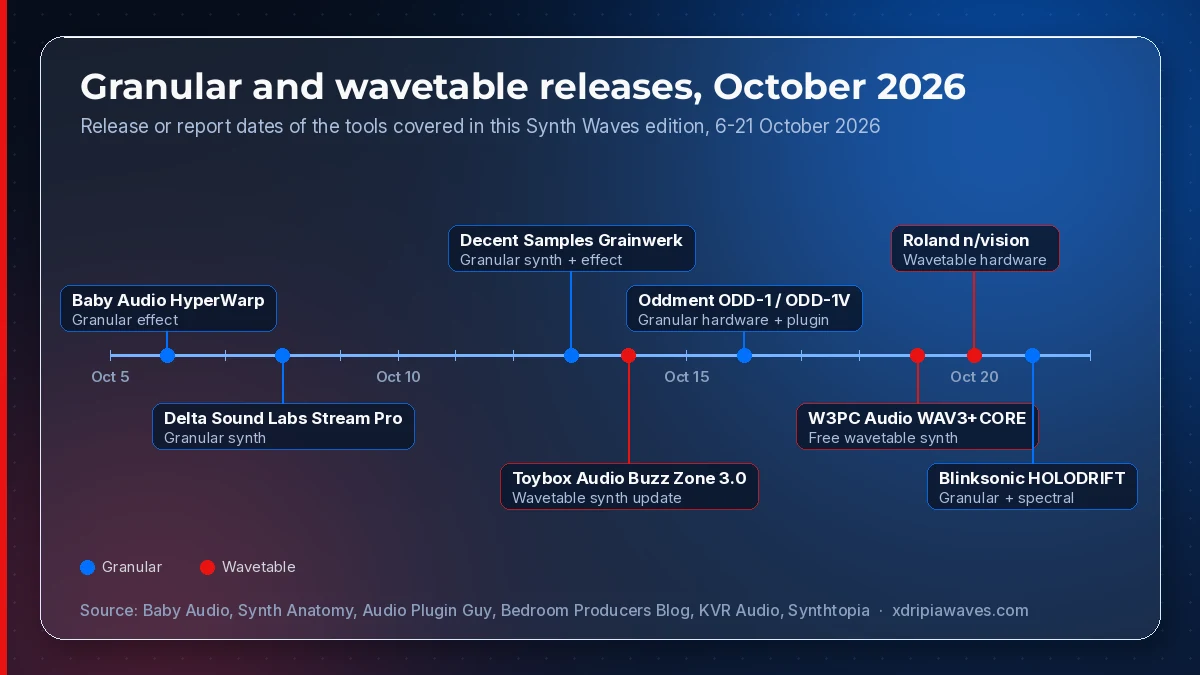
Release and report dates from Baby Audio, Synth Anatomy, Audio Plugin Guy, Bedroom Producers Blog, KVR Audio and Synthtopia.
Practical sound design: getting more from both
These are starting points that work on almost any of the tools above:
- Start with long, simple sources. A sustained vocal, a bowed note or a field recording gives a granular engine more to work with than a busy drum loop.
- Change one control at a time. Move grain size from very short (buzzy, pitched) to long (recognizable fragments) before touching density or randomness.
- Add a little randomness, then stop. Small amounts of position jitter and pitch spread turn a static loop into a pad; large amounts quickly become noise.
- Modulate the wavetable position slowly. A slow LFO or envelope on position usually sounds richer than a fast sweep. Try different rates on each layer when the synth has two, as the n/vision does.
- Use live input. ODD-1, Stream Pro, Grainwerk and HOLODRIFT all accept incoming audio, so you can process a guitar, a voice or another synth as you play.
- Watch the spatial controls. Binaural and 3D options on ODD-1 and Stream Pro can sound wide on headphones but behave differently on speakers. Check your mix on both.
What this means for producers
Granular tools used to be either free and complex or expensive and niche. October's releases cover the range: a free wavetable synth, a granular plugin with a $29 introductory price, mid-priced instruments around $100 to $150, and a $999 hardware unit that shares its engine with its plugin. The common direction is clear: more live input, more spatial processing and simpler controls on top of deep engines.
Coming up in Synth Waves
Next time we'll turn to performance: sequencers, MIDI controllers and the tools that help synths work on stage. Got a technique or a release we should cover? Tell us at @xdripiawaves.
Sources
- Oddment ships the ODD-1 Microsonic Lab and releases ODD-1V plugin, Bedroom Producers Blog, Oct 16, 2026
- ODD-1 product page and ODD-1V product page, Oddment
- Delta Sound Labs Stream Pro: a spatial live granular MPE synthesizer plugin, Synth Anatomy, Oct 8, 2026
- Stream Pro from Delta Sound Labs, Sound On Sound, Oct 14, 2026
- Decent Samples has released Grainwerk, Audio Plugin Guy, Oct 13, 2026
- Press Release: HyperWarp by Baby Audio, Baby Audio
- Blinksonic Holodrift, Synth Anatomy, Oct 23, 2026
- Blinksonic Software has released HOLODRIFT, Audio Plugin Guy, Oct 21, 2026
- Roland n/vision expands Boutique line into wavetable synthesis, Synthtopia, Oct 20, 2026
- W3PC Audio releases WAV3+CORE, KVR Audio, Oct 19, 2026
- Toybox Audio Buzz Zone 3.0, Synth Anatomy, Oct 14, 2026