Synth Waves is our column about synthesizers, sound design and the people who make electronic music. Each edition looks at what's new in the synth world and what it means for producers.
Last time we looked at the sequencers and controllers built for the stage, and promised to turn to the people who use them. This edition does exactly that. October brought several interviews and rig walkthroughs, and five of them give five different answers to one question: how do you make machines feel live?
Hardware only, no laptop
Active Systems: one sequencer at the centre
In Attack Magazine's How I Play Live series, Active Systems describes a set with no computer on stage. A Sequentix Cirklon drives everything, four Intellijel Atlantix modules handle the bass and a 909 keeps time, with a 1010music sampler for loops and a Soundcraft mixer for reverb, delay and EQ.
A few details stand out:
- Patterns, not tracks. Each of the two "songs" in the set at Lost was built from around 100 patterns, chosen by trial and error during long jams.
- One bassline, four voices. The same bass part runs through all four Atlantix modules, and the mix between their oscillators changes the character from clean sub to aggressive.
- A duplicate rig. After the Lost show, the artist built a near-copy of the setup as a backup, swapping the 909 for a TR-09 or TR-8S.
- Preparation takes weeks. Routing, cutting cables short and tying everything down takes a couple of weeks per hour-long set.
The most useful story is a failure: at Houghton, a long transition sample had vanished from the sampler, so the change of project was covered with new patterns written live and the Atlantix modules on very long envelopes.
Shakmat's François: modular built for touring
In a Sonicstate walkthrough filmed in Beijing on October 26, François from Shakmat shows the rig he uses for all his live sets. It combines Shakmat drum modules (Battering Ram, Lancer's Lash, Archer's Rig) with Ballista Blast voices, Bishop's Miscellany for sequencing, an Elektron Octatrack loaded with material sampled from the modular, a mixer-based dub workflow and tape delay and reverb pedals.
The rig grew out of earlier versions that proved too large and heavy for touring. The technical point is Select Bus: it uses the Eurorack power-bus pins to send MIDI-style preset changes, so several modules switch together. Sonicstate reports that new firmware for Ballista Blast and Bishop's Miscellany adds channel, bank and preset messages over this bus. Recall is a hard switch, not a morph, and the firmware is due in late November.
Smaller cases, fewer cables
Anthony Baldino: from three cases to one
Speaking to Perfect Circuit on October 7 about his new album CONVEYOR, Anthony Baldino explains how he scaled down. He used to tour with two Tiptop Audio 252 cases and a skiff, patching every kick and snare from scratch at the venue from pages of notes. Today he plays from a single 12U MDLR case. Kicks and snares are sampled into a 4ms STS, and a Pamela's New Workout replaces several separate random and LFO modules with up to eight outputs in one module.
Sampling your own sounds keeps the character and removes most of the setup risk.
Laptop at the centre, hands on top
TOURING: the same songs, different rigs
The Munich and Berlin trio TOURING, interviewed in Attack Magazine's How We Play Live, works the other way. Ableton Live is the backbone and each song can be triggered via MIDI, so the order can change. On top sit modular gear, pedals and hands-on synths such as the Moog Sub 37 and Bass Station II.
They split the set into two layers. The composition (harmony and melody) stays fixed. The interpretation stays open: reverb on the vocal, choice of bass sound, how far the filter opens. The rig also changes with the venue. Smaller club shows get a compact setup with more MIDI control and less analog sound generation; bigger stages with time for soundcheck get more instruments.
Apparat: a band built around scenes
In an Ableton rig rundown published ahead of the band's autumn European tour, Apparat show a live band with Ableton at the heart of the tempo and each song set up as a scene. The video covers the click track, a side-chained synth sound, and cello through a pedalboard, with everyone on stage playing a bit of everything.
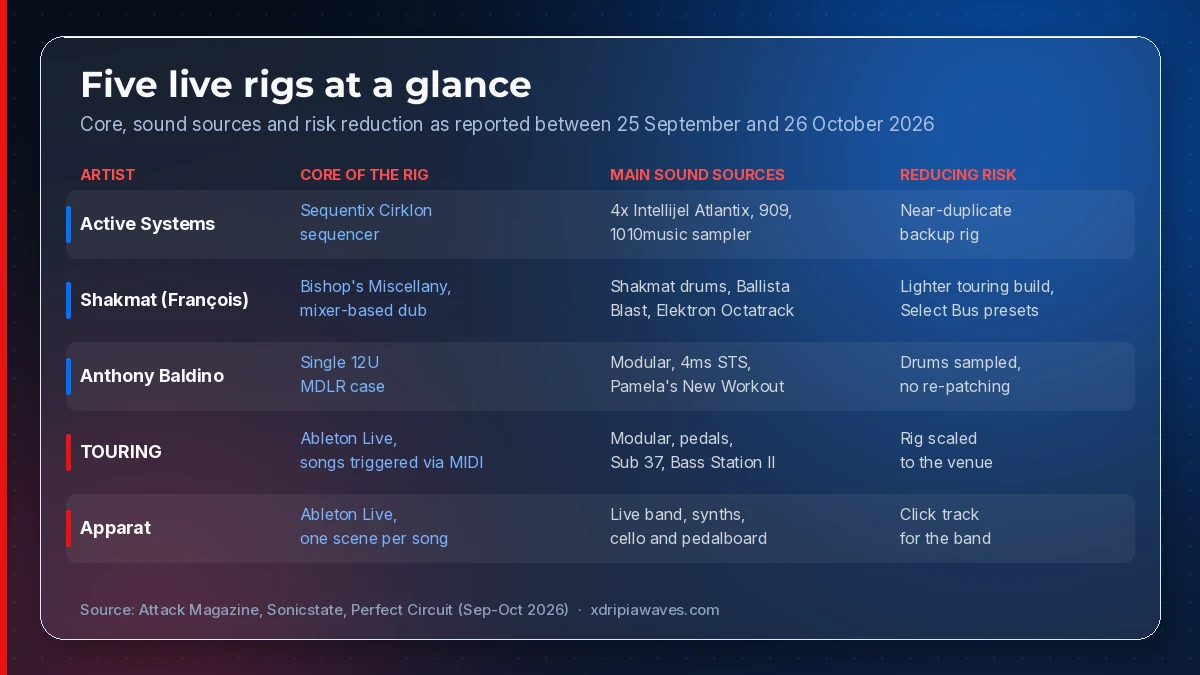
Sources: Attack Magazine, Sonicstate, Perfect Circuit, as reported between September 25 and October 26, 2026.
What these rigs have in common
The five setups share a few habits that apply to any live set:
- One clear brain. A Cirklon, Bishop's Miscellany or an Ableton session owns timing and structure.
- Every voice has a job. Active Systems says it is hard to get lost because each instrument has a clear purpose in each section.
- Sample what is fragile. Baldino's drums in the STS and Shakmat's modular material in the Octatrack keep the sound while cutting setup time.
- Plan the failure. A duplicate rig, a bypass plan for compressors, or simply checking every file before leaving home.
- Scale to the venue. TOURING adds or removes instruments based on stage size and soundcheck time, without changing the songs.
Also on our radar
Two releases on October 27 are worth noting for live players. Native Instruments launched Massive XL, the third generation of Massive, with polyphonic aftertouch support, custom wavetables and a Preset Generator that turns an audio slice into an editable patch; it costs €199/$199, with an introductory €99/$99 until December 31. And Synth Anatomy reports that the Behringer Polyeight, an eight-voice analog polysynth based on the Korg Polysix, is finished and available for pre-order at €519.
What this means for performers
There is no single right way to play electronic music live. The laptop-free rig and the Ableton-centred band both work because the artists decided what is fixed and what is open, then built the rig around that. If you are planning your first set, start with that question rather than with a shopping list.
Coming up in Synth Waves
Next time we'll look at the new polysynths arriving before the end of the year, from the Polyeight to the latest Boutique models. Have a rig we should feature? Tell us at @xdripiawaves.
Sources
- How I Play Live: Active Systems, Attack Magazine, Oct 9, 2026
- Beijing 26: Shakmat François Shows the Secrets of his Live Rig, Sonicstate, Oct 26, 2026
- Conveyor: an Interview with Anthony Baldino, Perfect Circuit, Oct 7, 2026
- How We Play Live: TOURING, Attack Magazine
- Apparat's Live Setup, Sonicstate, Sep 25, 2026
- Massive XL is here, MusicRadar, Oct 27, 2026
- Native Instruments Introduces Massive XL, Sonicstate, Oct 27, 2026
- Behringer Polyeight ready for pre-order, Synth Anatomy, Oct 27, 2026