Synth Waves is our column about synthesizers, sound design and the people who make electronic music. Each edition looks at what's new in the synth world and what it means for producers.
Last time we looked at the Plug-Out SDK, Memorymoog Plus firmware and Aalto 2, three cases of instruments getting a second life through new code. This week the theme is close but the question is different: how do you keep a classic sound when the original hardware is rare, expensive or fragile?
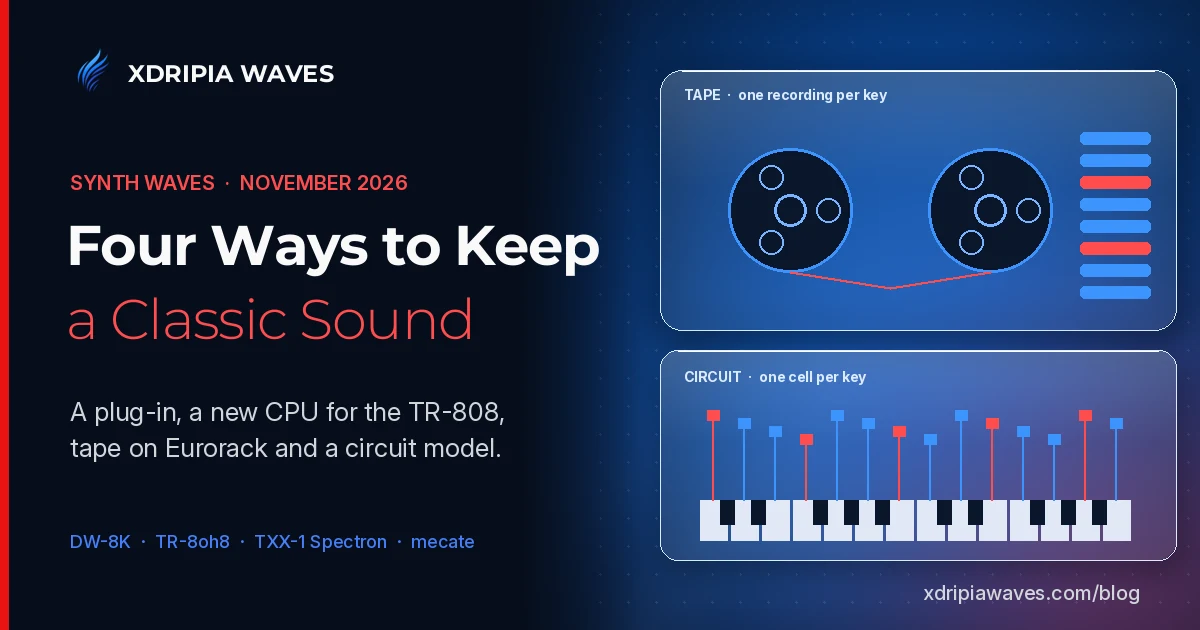
Four releases and demos from 22 to 24 November give four different answers. One recreates a 1985 polysynth as a plug-in. One replaces the processor inside an original drum machine. One turns tape-based instruments into a Eurorack oscillator. One rebuilds a 1970s string machine from its schematics.
DW-8K: a 1985 hybrid as a plug-in
Korg's DW-8000 combined digital waveforms with an analog filter. According to Cherry Audio, the original was an eight-voice polysynth with two oscillators per voice, an analog low-pass filter and a built-in digital delay, programmed through a single data slider. The company's product page says it sold for approximately US$1,300.
What changes in the recreation
Cherry Audio says it analysed the original waveforms and rebuilt them with additive synthesis as 64-bit versions, instead of the 8-bit samples in the hardware. On top of that sit two stereo layers with up to 16 voices per layer, six-stage filter and amplifier envelopes, an eight-slot modulation matrix, polyphonic aftertouch and MPE per layer, and per-layer arpeggiators and sequencers. Synthtopia lists more than 400 new presets plus all 128 original factory sounds, and import of original programs from SysEx files and cassette backups.
DW-8K costs $69 for macOS and Windows in standalone, AU, VST, VST3 and AAX formats, with a free 30-day demo. It is also part of the $799 Synth Stack 7 bundle.
TR-8oh8: new brain, original circuits
Tubbutec's TR-8oh8 goes the other way. It is not a new instrument but a replacement CPU and MIDI interface for an original Roland TR-808, and the sound circuits stay untouched. The occasion here is a video demo from Tubbutec that Synthtopia covered on 24 November.
What the upgrade adds
According to Tubbutec, the kit adds:
- 11 additional instruments that trigger the existing 808 circuits in new ways, including an alternative kick, maracas, a felt cymbal, a tunable second cowbell and a configurable clap
- velocity-sensitive MIDI input and output, with freely assignable notes
- 128 patterns in four banks, 12 storable tracks, and four dynamic and four probability levels per step
- twelve tools, among them a beat reslicer, a drum arpeggiator, 13 ratchet and flam modes and a Grains mode that turns the drum circuits into a bassline source
Installation means swapping the original CPU. Tubbutec says no case drilling is needed, because MIDI can use the existing DIN socket or the pedal-switch sockets. The shop page lists it from €229 before VAT and shipping; Synthtopia reports it as out of stock and open for pre-order.

Source: Cherry Audio, Tubbutec, 20CC and Anode Labs product pages; Synthtopia, 22-24 November 2026.
Spectron: tape instruments as an oscillator
The Mellotron and Chamberlin played a tape recording for each key. 20CC's TXX-1 Spectron, a 16 HP Eurorack module, takes that idea into modular synthesis. According to the 20CC product page, it arranges per-key recordings of vintage tape instruments so that, as pitch changes, playback moves between recordings and behaves like a continuously tunable voltage-controlled oscillator.
Beyond playback
There are two independent decks, each with its own 1V/octave and gate inputs and audio output, and more than 20 tapes covering strings, brass, woodwinds, choirs, keyboards and guitars. Two controls go beyond a sampler: FM, where one deck modulates the phase of the other, and Sync, which resets the playback position at each cycle boundary. Built-in envelopes, an LFO, a four-voice pseudo-polyphonic mode and CV tape selection complete the module.
Spectron costs $350. 20CC says it is available now in the US, with orders placed now expected to ship on 27 November, and other territories to follow. Synthtopia covered the release on 24 November.
mecate: a string machine from its schematics
Anode Labs' mecate recreates a 1970s Italian string machine. The developer says each stage was modelled from the service manual's schematics and calibrated against recordings of a real unit: the key cells are simulated at component level, the brass filter as a four-pole transistor ladder and the ensemble as bucket-brigade delay lines.
The practical consequence is that each key has its own simulated cell, so every held note sounds, with no voice count and no voice stealing. The panel has brass, piano, clavichord, cello and violin on a split keyboard, with bass on the bottom keys, and each section can go to its own output.
mecate costs €4.99 on macOS and Windows and $4.99 on iPad; the Linux version is free. Synthtopia reported the release on 23 November.
What it means for producers
The four approaches answer different needs:
- Software emulation (DW-8K) is the cheapest way to the sound and adds what the hardware lacked, but it is a reinterpretation.
- An upgrade inside the original (TR-8oh8) keeps the authentic circuits and needs an original TR-808 and an installation.
- A new format (Spectron) borrows the source material and makes it patchable, which is a different instrument, not a replica.
- Circuit modelling (mecate) aims at the machine's behaviour rather than its recordings.
Before choosing, check what you actually want from the classic: the exact sound, the workflow, or the character as a starting point for something new.
Two more items from the week. Developer Matthew Fecher released Super 909 Drums, a free TR-909 take for iOS and Mac. And Behringer has published a product page for the CS Mini, a small analog synth inspired by Yamaha's CS series. Synth News notes that the product page and the quick start guide still disagree on the oscillator count, and that no price or release date has been announced.