Synth Waves is our column about synthesizers, sound design and the people who make electronic music. Each edition looks at what's new in the synth world and what it means for producers.
Last time we looked at DYNAMO, Laniakea Pro and the new SynthMaker, three tools about where synthesis lives. This week the theme is what happens to an instrument after its first life: a discontinued Roland platform opened up by reverse engineering, a vintage Moog with rewritten firmware, a 2010 plug-in rebuilt from scratch and a drum engine moved into new hardware.
All four stories appeared between 18 and 21 November. None of them is a brand-new concept. Each one takes a design that already exists and gives it more voices, tighter timing or a new body.
Roland Plug-Out, opened by reverse engineering
Roland's SYSTEM-1 and SYSTEM-8 were built around Plug-Out, a system that let owners load software recreations of instruments such as the SH-101 and Jupiter-8 into the hardware. Roland decided which engines could run. According to Synthtopia, developer Emilio Norrmann has now published a free, open-source project that documents the underlying DSP architecture and provides tools to build entirely new Plug-Outs.
What is in the toolkit
The GitHub repository, released under the MIT licence, includes an install tool that replaces the VST plug-in's installer, a DSP microcode assembler, disassembler and scheduler, a bit-exact emulator of the DSP and a C/C++ compiler called s1cc that turns code into DSP microcode. The documentation runs to seven volumes.
What already runs on the hardware
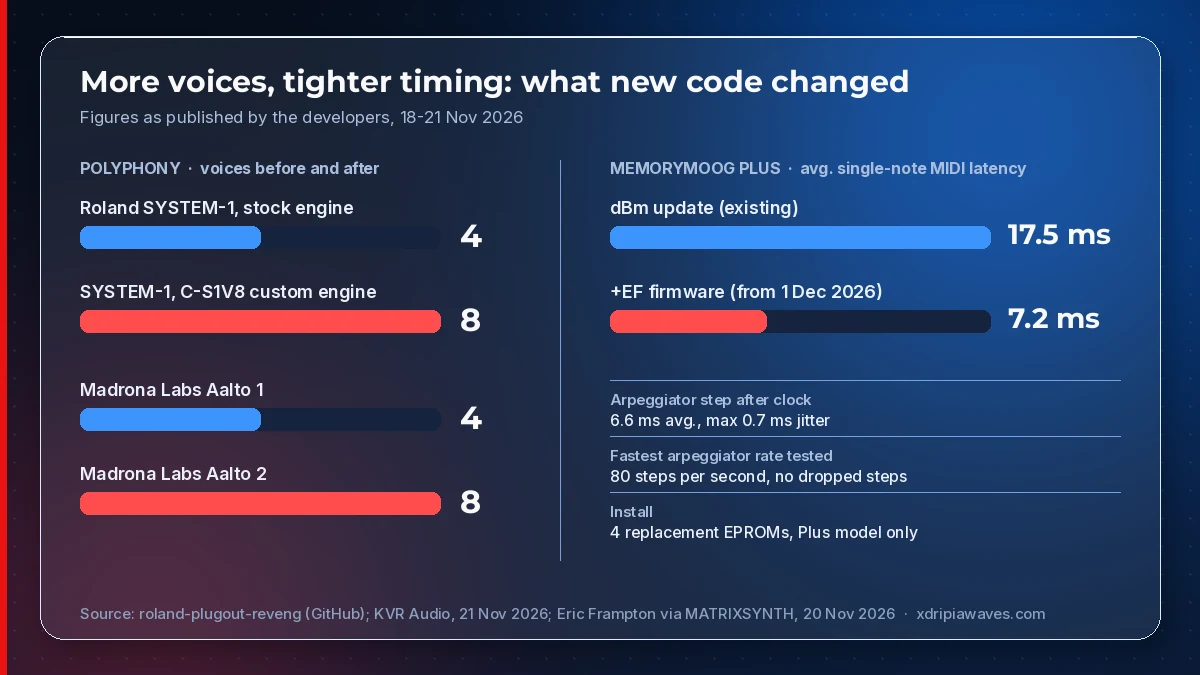
The headline result is C-S1V8, an engine that plays eight voices on the SYSTEM-1, twice the stock four. On the SYSTEM-8, an engine called C-V4 runs eight voices without any Roland microcode. The limits are clear, though: Synthtopia notes that the SYSTEM-8 engine so far produces only a sawtooth with gate control, and that full filters, envelopes, LFOs and effects remain future work. Ports of Mutable Instruments' CSAW oscillator, a six-voice string engine and wavetable experiments have also been tested on the devices.
The release targets developers, not end users. Loading unofficial firmware is not supported by Roland, as See Rock Live points out.
Memorymoog Plus: timing, rewritten
The Memorymoog Plus has a reputation for loose timing. Musician Eric Frampton says he has been "cursing at" it for almost 40 years, and in a post shared by MATRIXSYNTH he describes six months of research, testing and measurement that ended in +EF, a firmware rewritten from scratch. He credits modern tools, including an AI assistant, for making the work possible.
The measured numbers are the interesting part. Frampton reports an average single-note latency over MIDI of 17.5 ms with the existing dBm update and 7.2 ms with +EF. Arpeggiator steps now fire on average 6.6 ms after the clock, with at most 0.7 ms of jitter, and the arpeggiator no longer drops steps at 80 steps per second, the fastest rate he tested. Synthtopia summarises this as up to 2.5 times faster note-ons over MIDI.
Other additions include SysEx patch transfer, channel aftertouch mapped to a selectable destination and MIDI clock sync for the arpeggiator. Some things were removed to make room, including cassette save, the sequencer and program chains.
Before you order
Frampton's site lists the firmware as a paid upgrade available from 1 December 2026. It needs a Memorymoog Plus in proper working order and does not work on a non-Plus model or with third-party MIDI interfaces. Installation means replacing four EPROMs, and MIDI pitch bend and foot-pedal control require the separate dBm hardware modifications.
Source: roland-plugout-reveng on GitHub, KVR Audio (Aalto 2, 21 November 2026) and Eric Frampton via MATRIXSYNTH (20 November 2026).
Aalto 2: same patch, new engine
Madrona Labs first released Aalto in 2010. KVR Audio reports that version 2 was rewritten from the ground up while keeping the original design, and that every Aalto 1 patch loads in it. "People seem to agree it's a good design, so we worked hard not to screw it up," says founder Randy Jones.
Polyphony doubles from four to eight voices. The low-pass gate gets a refined vactrol model, nearly every parameter gets its own syncable LFO and MIDI learn, and there is now undo, parameter locks and MTS-ESP tuning. A second stereo pair adds quadraphonic output with 2D panning. Aalto 2 is also the first Madrona Labs synth to run on Linux, and it adds CLAP alongside VST3 and AU.
Aalto 2 costs $99, or $69 during a launch sale that runs until 5 December. Aalto 1 owners can upgrade for $39. Synth News notes that there is no AAX version, so it will not load in Pro Tools.
CyDrums′: a drum engine in a new body
Sonicware's CyDrums′ (read "CyDrums Dash") takes the wavetable drum engine of the original CyDrums and puts it into a compact, battery-powered format with more hands-on controls. Synthtopia lists eight tracks, 23 sound structures, 32 wavetables, sampling through line input or USB, a built-in speaker and operation from six AA batteries.
The Sonicware product page lists a preorder price of $299 until 31 December, with a regular price of $399 and shipping in early January.
What it means for producers
The common thread is longevity. A SYSTEM-1 can, in principle, run engines Roland never shipped. A Memorymoog Plus can follow MIDI clock with far tighter timing. Patches made for Aalto 1 open in a new engine with twice the voices.
The practical advice is to read the conditions. The Plug-Out tools are for developers and unsupported by Roland. The Memorymoog firmware needs healthy hardware and a technician for the EPROM swap. Aalto 2 skips Pro Tools. If you already own one of these instruments, though, this week's news is a reason to keep it.
For something free to try today, Steinberg released Chromaspheres, a HALion instrument that turns your own samples into wavetable, granular and spectral sounds and runs in the free HALion Sonic 7 player.