In our last Graphics column the question was whose style a tool learns from. This week one of the largest design platforms gave a partial answer for its own model. On October 22 Canva released Craft, its first in-house image generator, and published a summary of the data it was trained on. Two days earlier, a small editor called ArcBrush shipped a major update built on the opposite premise: no generative AI at all.
For musicians and labels who commission covers, posters and motion assets, both releases are useful. One shows what a mainstream model was built from. The other shows that professional image work can still be done with deterministic tools.
Canva trains its own image model
Canva describes Craft as the first foundation model "built and trained from scratch" by Canva Research. It is available to all Canva users in Dream Lab and to developers through the public API, with an MCP integration for AI assistants listed as coming soon.
Plan first, render second
The main technical claim is a two-stage architecture. A planning model first writes out the composition: which elements appear, where they sit, their relative scale, the visual hierarchy and any text. A separate rendering model then produces the image at up to 2K resolution in more than 30 aspect ratios. Canva says the plan also makes it easier to split outputs into editable elements with its Magic Layers feature, and that prompts work in any language, with text rendered in 55 languages.
The rankings are the vendor's framing
Canva says Craft debuted fourth on the crowdsourced DesignArena leaderboard and ranked first in the People & Portraits and Landscapes & Nature categories. TechRadar notes that the three models ahead of it came from OpenAI. The developer announcement adds practical detail: because Craft plans before it renders, a job takes roughly 50 to 60 seconds end to end and uses the account's AI credits.
What Craft was trained on
Canva's launch post says the training data "includes millions of human-made templates" from its content library. More detail sits in a separate document: the public summary of training content for Craft-1 2K, dated October 22 and prepared under Article 53(1)(d) of the EU AI Act. The European Commission provides a mandatory template for these summaries, which is why they list sources in fixed categories.
According to Canva's summary:
- the corpus contains more than 1 billion images and more than 10 trillion text tokens;
- sources include public datasets such as Common Crawl and Hugging Face collections, commercially licensed data, private third-party datasets, synthetic images and Canva-owned templates;
- a crawler named ImageBot/1.0 collected publicly accessible web images from approximately May to September 2026, and Canva says it respects robots.txt and AI-specific opt-out signals;
- user content and interactions "may be used" for training "where permitted and consistent with users' privacy controls";
- Canva is not a signatory to the EU Code of Practice for general-purpose AI models.
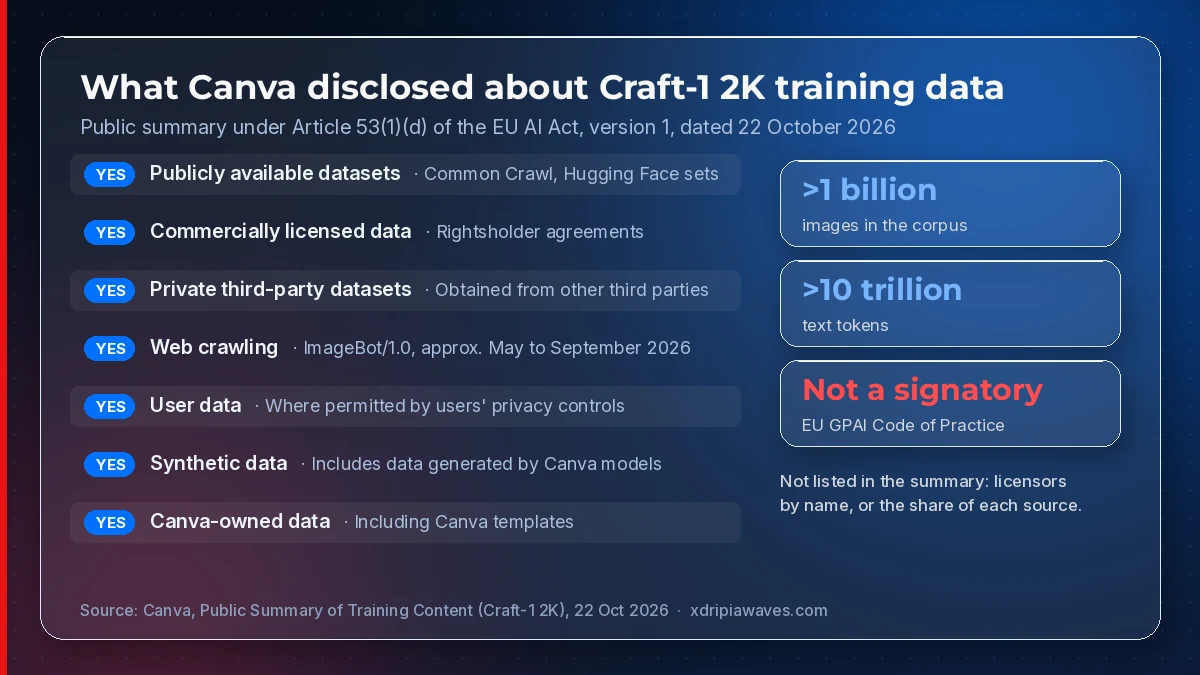
Source: Canva, Public Summary of Training Content (Craft-1 2K), 22 October 2026.
The summary does not name individual licensors or show proportions between sources. For an artist whose portfolio sits on a public website, the practical point is that machine-readable opt-outs are the mechanism Canva says it honours for crawled images.
The other direction: a tool without generative AI
On October 20 ArcBrush released version 1.7 of its node-based image editor for Windows, macOS and Linux. Instead of a layer stack, every operation is a node in a graph that stays editable, so one source image can feed every colour variant, size and format in a single export.
What 1.7 adds
- 18 new nodes, for 117 in total, including texture sets on a single wire, trim sheets, a 3D Render node and a physically based Lens Blur;
- a Pixel Art editor and Path Warp;
- the 32-bit float pipeline, OpenColorIO colour management and 16-bit, OpenEXR and HDR export, now free for personal and non-commercial use.
Commercial use requires a one-time $49 Pro licence; Studio is $99 per seat per year. The company states that ArcBrush "never generates images, and images are never used to train models". Its press kit says the only features that send image data over the network are two optional cloud nodes, Remove Background and Upscale.
Digital Production has been using ArcBrush for its own gallery preparation and calls it fast for repetitive jobs, while noting it has not yet stress-tested the new material tools.
Faster local hardware
On October 15 Adobe and NVIDIA expanded their partnership to optimise Photoshop, Premiere and Substance 3D for NVIDIA's new RTX Spark chip. The companies claim up to 2x faster AI processing, editing, colour and effects, and say Photoshop was rearchitected around GPU-accelerated compositing. These are vendor figures without published test conditions.
3D scenes from a chat window
On October 21 Spline launched a plugin for ChatGPT and Codex. ChatGPT builds or edits interactive 3D scenes and 2D UI in real Spline files, and the user can adjust objects in the editor panel between prompts. Each action counts toward the plan's MCP tool-call limits. One of the example prompts is an interactive 3D music player, a reminder that release pages and visualisers are also part of a campaign.
What it means for visual work around music
The week offers a clearer choice than usual. Generative tools are getting more structured and are starting to document their sources. Deterministic tools are positioning the absence of AI as a feature. Neither is automatically right for a given project, but both now come with enough public information to make the choice deliberately:
- read the training summary before relying on a model for commercial artwork;
- check the robots.txt and AI opt-out settings on your portfolio site;
- for repeatable work such as format variants and colour versions, a node-based pipeline can produce identical results every time;
- treat speed and ranking claims as vendor statements until independent tests appear.
What to watch next
Canva says Craft-fast and Craft-ultrafast variants and reference-image features are on the way. Adobe MAX runs November 10 to 12, where Adobe and NVIDIA have said they will show more. And as more image models reach the EU market, more training summaries should appear in the same format, which will make comparisons easier.