In our last Graphics column we looked at image models that promise to change only what you ask for. This week the conversation moved one step further, from precise edits to taste. Three launches on October 20 all claimed to work in your style, with your fonts, your colours and your product left intact. In the same days, illustrators reminded everyone that style is also something that can be taken.
For musicians and labels both sides matter. A release needs covers, posters and social cards that look like one project, and the artists who draw those visuals need to know where their own style ends up.
A design model that thinks in layers
On October 20, Coco Labs introduced Vyb, which it calls "the first design model that understands a user's taste". The idea is old-fashioned in a good way: instead of producing one flat image, Vyb builds a design in layers, so "text stays text, graphics stay vectors, and photos stay pixels".
Why layers
Coco Labs argues that flat image generation degrades the material you bring. It notes that ChatGPT Image 2.5 generates images at 8.3 megapixels, while recent iPhone cameras capture at 48 MP and professional setups at 150 MP. A layered design keeps the original photo at its own resolution and the type as real type.
To make this work, the company created its own design language, Cocolang, and a data pipeline that teaches the model how real designs are put together layer by layer. Designs can be exported to tools such as Figma, and Vyb can call image generators and editing tools when a design needs new material.
The vendor's own numbers
Coco Labs published benchmarks against ChatGPT Image (gpt-image-2.5), Muse and Recraft v4.1. These are the company's own tests, not independent results:
- Fonts: on 145 randomly chosen Google fonts, Vyb's lettering matched a programmatic rendering at 90.3%, against 76.0% for ChatGPT Image, 50.9% for Muse and 46.2% for Recraft. The measurement itself tops out at 94.4%.
- Colours: asked for an exact hex colour, Vyb's average maximum channel error was 0.00 out of 255, against 3.94, 5.67 and 27.19 for the others.
- Edits: over 200 edits, Vyb changed 11.9% of pixels on average, while the other models changed between 91.8% and 98.9%.
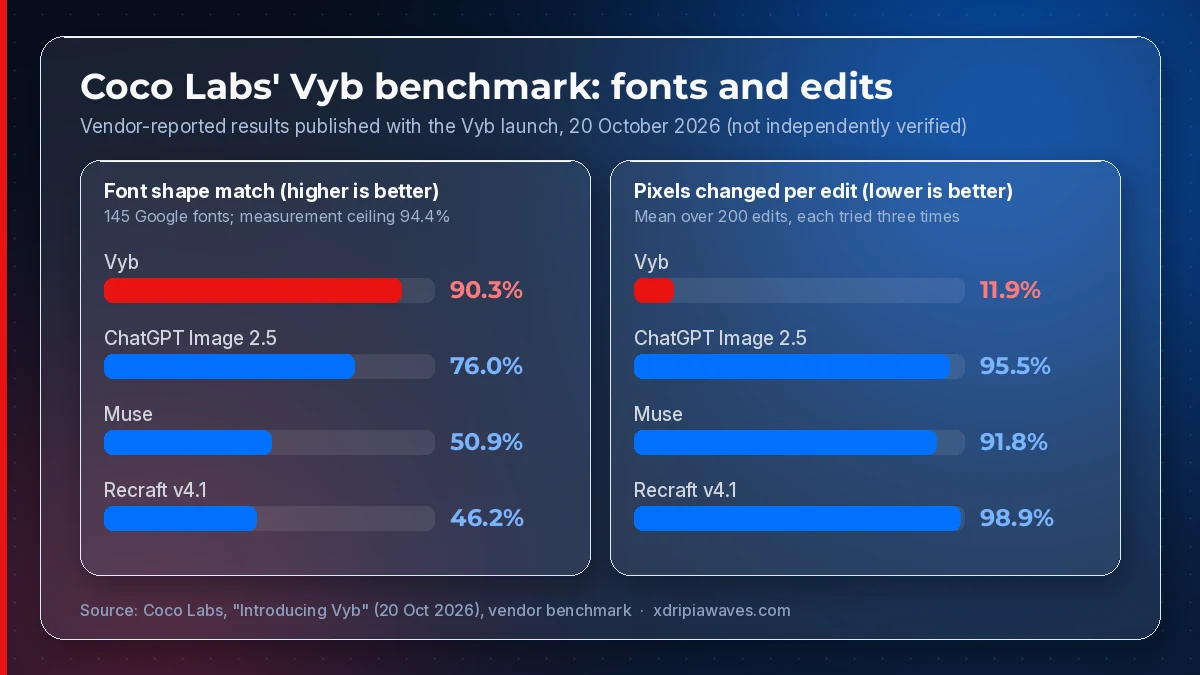
Source: Coco Labs, Introducing Vyb, 20 October 2026. Vendor-reported benchmark, not independently verified.
There is a trade-off the company states openly: an independent LLM reviewer judged that Vyb carried out the requested edit 94.7% of the time, about five points below ChatGPT Image. Coco Labs says this often happens when Vyb declines an edit that would make text unreadable.
Style references and brand memory
Luma Style Match
Also on October 20, Luma showed Style Match, also called Art Style Match. As Creators Toolbox reports, you start from your own image, add one to four reference images, and the tool restyles the picture while keeping the product and the composition in place. Luma has not said which plans include it or how many credits a result costs.
For a band, the practical use is clear: test several art directions on the same merch photo or record sleeve before committing to one, instead of describing a look in a prompt and hoping the object survives.
Gemini remembers your brand
The same day, Google announced new Gemini tools for small businesses. Businesses can define their brand style by uploading their website, brand kit, fonts or colour palettes. Paired with Nano Banana 2.1, which Google calls its latest image generation model, Gemini keeps that style and uses it for later visuals without the guidelines being uploaded again. Google also lists connections to apps including Adobe, Canva, Dropbox and Shopify, and says the tools roll out globally "in the coming days".
Illustrators push back
The Gruffalo case
The other side of "your style" came from Germany. Axel Scheffler, the illustrator of The Gruffalo, told Die Zeit that he is considering legal action over AI-generated images in the style of his work, DPA reported on October 17. Asked for a Gruffalo, ChatGPT produced images that Scheffler described as "quite clearly my character, only the backgrounds look completely different to how I draw them". He said he would ideally team up with other artists and is talking to his publishers about support.
He is not alone. Penguin Random House has already sued OpenAI over the work of author and illustrator Ingo Siegner, and OpenAI said it was investigating the allegations.
Rules still being written
In Australia, the National Association for the Visual Arts asked for enforceable protections after Prime Minister Anthony Albanese said "We want to protect copyright." NAVA is calling for consent, attribution and payment when artists' work is used to train AI, and offers artists a letter template for their MP.
In Singapore, the Ministry of Law and IPOS are consulting on AI and the intellectual property regime. The copyright questions cover AI training, responsibility for infringing outputs and how to recognise human creativity in AI-assisted works. The deadline was today, October 22, but the ministry has extended it to November 5, 2026.
What it means for visual work around music
The tools are converging on one promise: keep the artist's material intact and work around it. Layers, reference images and stored brand kits all serve that goal, and they make AI more useful for the repetitive part of a release campaign.
The open question is the reverse case, when someone else's style is the reference. Until courts and lawmakers answer it, a few habits help:
- keep your own fonts, palettes and source files organised, because these tools work best with real assets;
- treat vendor benchmarks as claims and test with your own material;
- when you commission artwork, agree in writing whether it may be used as a style reference or uploaded to a generator.
Taste is becoming a feature that software can store. It is still worth knowing whose taste it is.