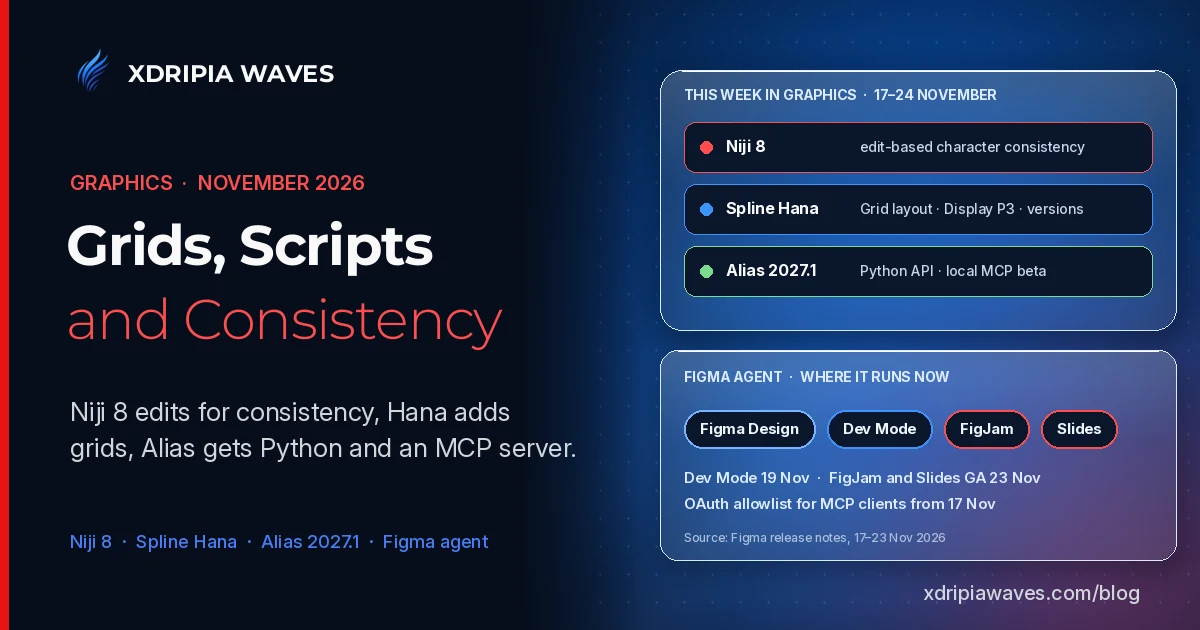
In our last Graphics edition the news was about bigger images, fewer sampling steps and Canva opening its tools to outside agents. The releases of the past ten days continue the second thread more than the first. An anime image model rebuilt its character consistency around editing, a design tool added the layout and vector basics that working designers expect, an industrial design application got a Python API and a local MCP server, and Figma moved its agent into whiteboards and slides.
Together they point to where creator tools are putting their effort: repeatable results, and connections to the scripts and assistants around the editor.
Niji 8: variety by default, consistency through editing
Midjourney and Spellbrush released Niji 8 on 24 November, announced on Midjourney's updates page as the latest anime model with "precision prompting, consistent characters" and "a dedicated editing model". It is selected with --niji 8 on Discord or from the version menu on the web.
The design choice worth noting is a reversal. The Niji team writes that Niji 7 kept a character the same as long as the prompt used the same words, and that Niji 8 will not do this. It returns a wider range of options for the same prompt, closer to Niji 6. To limit the effect, the team says it treats prompt length as intent: longer, more specific prompts produce less variety than short ones.
Consistency now comes from a separate step:
- Edit with references: the edit feature replaces the cref option many users missed from Niji 6. You attach a character sheet and a background and ask the model to place the character in the scene.
- Two-image prompts: the team recommends prompts of the form "take the character from image 1 and put it into image 2" for the most control over the result.
- Input quality matters: the post warns that blurry or pixelated inputs lower the quality of the output.
ASCII.jp summarised the release as combining Niji 7's aesthetics with Niji 6's diversity. A week earlier, on 17 November, Midjourney had updated its general edit model so that style references and moodboards apply more strongly to edits.
Spline's Hana fills in the designer's toolbox
On 19 November Spline shipped a large update to its design tool Hana. The headline is a reworked 3D transform: objects now rotate directly on the canvas with three rotation rings, the selection box turns with the object, and 3D Transform has moved to the Effects panel with Rotation, Depth, Perspective, Flatten and Backface controls.
Most of the changelog, though, is about the ordinary tools that decide whether a designer can stay in one application:
Layout
- Grid layout as a fourth auto layout mode next to Row, Column and Wrap, with fixed,
1frandautotracks and children that span rows or columns. It exports to HTML as CSS grid. - Min and max sizes, baseline alignment for mixed text sizes, and a saved aspect ratio lock.
Vectors, fills and output
- Line and arrow tools, variable-width strokes, text on a path, a lasso for points, Simplify Vector and Offset Path.
- Multiple fills and strokes per layer, diamond gradients and a choice of sRGB or Display P3 document profiles.
- Version history with named versions (saving and restoring requires a paid plan), a command palette, find and replace, outline mode and multi-page PDF export.
Established vector editors have had most of these for years; their arrival in a tool that also exports to the web, iOS and Android narrows the gap with conventional layout software.
Alias 2027.1 opens to Python and outside assistants
Autodesk released Alias 2027.1 on 19 November. The point release of the surface modelling tool changes how it can be extended:
- Python wrapper for the API: plugins no longer require C++.
- Alias MCP server (public beta): it runs locally and connects the application to AI assistants such as Claude and Cursor.
- Autodesk Assistant: answers grounded in the Alias documentation, and some tasks run through API calls. Autodesk states it does not yet build curves or surfaces.
- Native .blend import: Blender files open without a Blender installation, with SubD crease weights, layers and colours kept.
- Variable crease for subdivision edges, and material colour sync between the Alias and VRED renderers, with Substance, MaterialX, MDL, X-Rite and OCS materials not yet included.
The .blend import is the detail with the widest reach. Autodesk's own reasoning is that more teams do early concept and SubD work in Blender, and until now moving it into Alias meant FBX or OBJ export followed by cleanup.
Figma's agent moves into FigJam and Slides
Figma made its agent generally available in FigJam and Figma Slides on 23 November, on all paid plans, with connectors and attachments. Figma lists three uses: pulling context from tools such as Hex, Slack and Asana into boards and decks, turning a FigJam board into an organised Spec with a summary and next steps, and building a deck from an attached Spec outline and brand template.
Two related notes appeared in the same week. On 19 November Figma added the agent to Dev Mode, where it can compare versions, write code snippets and provide bulk download links for assets. On 17 November it began rolling out an allowlist of approved OAuth apps, including MCP clients like Cursor and Claude Code, for Organization and Enterprise plans.
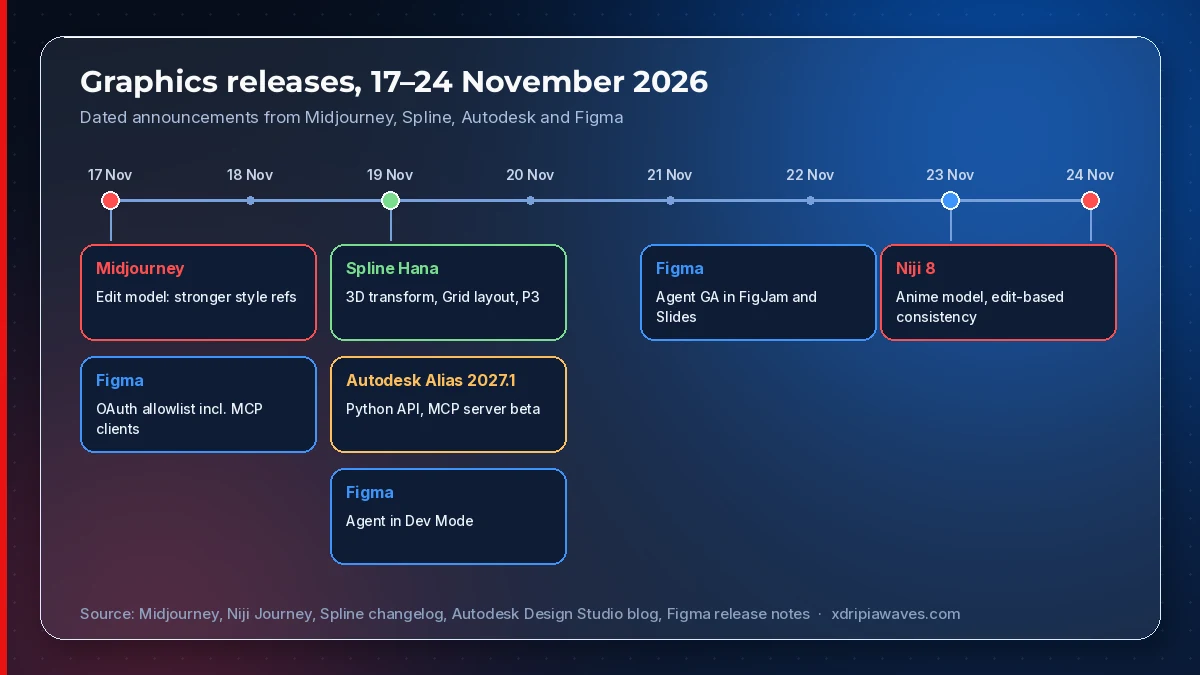
Release timeline compiled from Midjourney, Niji Journey, Spline, Autodesk and Figma announcements, 17–24 November 2026.
The allowlist is the counterpart: once outside agents can act inside design files, organisations need to decide which clients may do so.
What to watch
- Autodesk's follow-up posts on the Alias Python API, the MCP server and Autodesk Assistant, all announced as coming soon.
- Niji 8 in production, since the team itself warns that existing prompts will behave differently.
- Hana's CSS grid export in real handoff work.
- Admin controls for agents in other design suites, following Figma's OAuth allowlist.
Sources
- Niji Journey: Welcome to Niji 8! (24 November 2026)
- Midjourney: Latest updates (17 and 24 November 2026)
- ASCII.jp: Midjourney Unveils 'Niji V8' (25 November 2026)
- Spline changelog: Hana 3D transform tools, Grid layout and Version history (19 November 2026)
- Autodesk Design Studio blog: Alias 2027.1 (19 November 2026)
- Figma release notes (17, 19 and 23 November 2026)