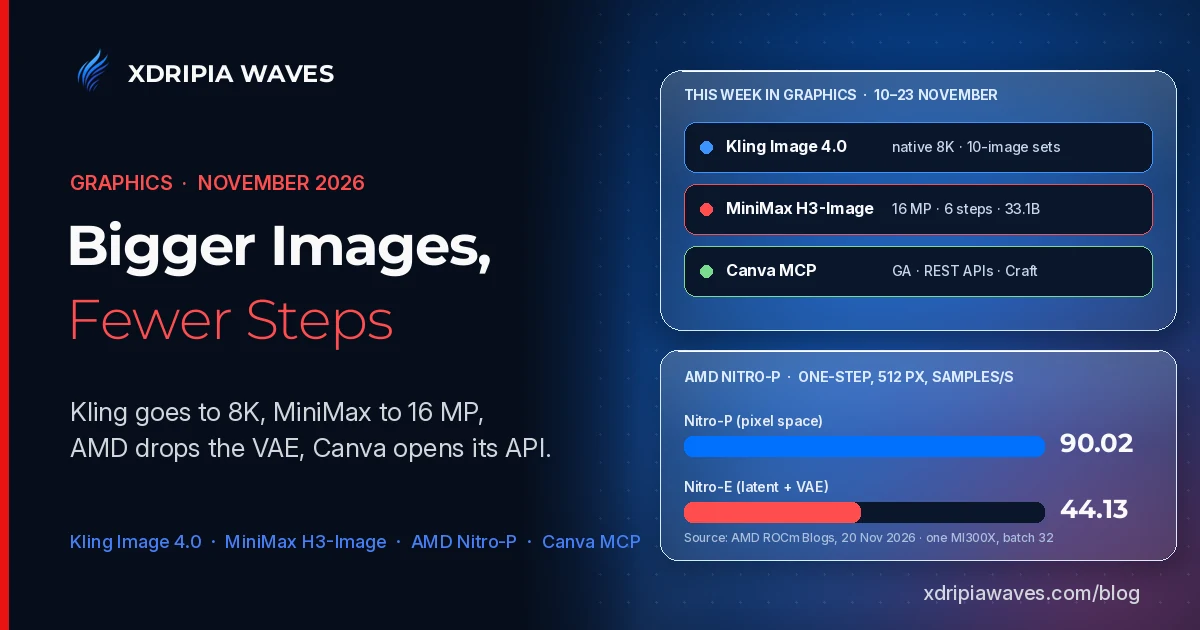
In our last Graphics edition we covered Ideogram 4.6, Figma's multi-model image prompts and Canva's switch for its generative tools. This week the news is less about features inside one editor and more about the image models and plumbing underneath them: two models that push output size well past 4K, one research model that trades a component for speed, and Canva turning its design tools into something other products can call.
Kling Image 4.0: native 8K and sets of ten
Kling AI announced Kling Image 4.0 on 23 November. The launch release lists four headline capabilities:
- Native 8K output. Kling describes this as an industry first for AI image generation.
- Text in the image. Up to 2,000 characters in a single image, a built-in library of more than 70 preset fonts, the option to upload font reference images, and text generation in seven languages including Japanese, Korean and both forms of Chinese.
- Sets from one prompt. Up to 10 related images per prompt, planned as a set with a consistent style and subject while framing and angles change.
- Separate layers. For long-form product pages and brand visuals, text and images can be edited on separate layers.
The release also cites the Artificial Analysis image leaderboard, where it says the Kling Image 4.0 Preview holds a leading position in text-to-image and image editing and ranks third for UI/UX design scenarios. Two cautions apply. The ranking refers to the preview, not necessarily the shipping model, and the release gives no pixel dimensions for "8K", no pricing and no detail on how the layered output is exported. Until those appear, the set and layer features are the more concrete part of the announcement for design teams.
MiniMax H3-Image: 16 megapixels, with a territorial licence
MiniMax published MiniMax-H3-Image as an open-weight model for generation and editing; its licence is dated 10 November. According to the model card:
- Output size. About 16 megapixels at every aspect ratio, from 4096 x 4096 (1:1) to 6272 x 2688 (21:9), generated directly without an upscaler.
- Speed settings. The checkpoint is distilled to 6 sampling steps without classifier-free guidance; negative prompts are rejected.
- Scale. A 33.1B-parameter diffusion transformer. The transformer weights alone are 66.28 GB, and the text encoder, loaded from the MiniMax-H3 repository, adds 66.7 GB.
- References. Editing accepts up to 16 reference images.
The licence is the part to read before downloading. The MiniMax-H3-Image Community License grants rights only outside its "Excluded Territories", defined as the European Union, the United Kingdom, South Korea and the United States. In a licence Q&A on Hugging Face, MiniMax says the limit "means 'not yet', not 'not ever'", that organisations in those regions can apply for a formal licence, and that the hosted API remains globally available because MiniMax controls the safeguards there. For a studio in Europe, in other words, the weights are visible on Hugging Face but local use requires written authorisation; the API is the default route.
AMD Nitro-P: removing the VAE to gain speed at few steps
Most image models generate in a compressed latent space and use a VAE decoder to turn the result into pixels at the end. On 20 November AMD's research team published Nitro-P, a text-to-image model that works directly in pixel space and drops that decoder. The main facts from the post:
- Small model. The main network has 679 million parameters and was trained from scratch on 25 million public image-text pairs, a mix of real and synthetic images.
- Quality. A GenEval score of 0.88 at 512 x 512 and 0.87 at 1024 x 1024; the one-step distilled version scores 0.85 at 512 x 512.
- Release. AMD says it is releasing weights and training code; the weights are listed on Hugging Face under amd/Nitro-P.
The most useful table compares Nitro-P with AMD's earlier latent-space model, Nitro-E, on the same GPU:
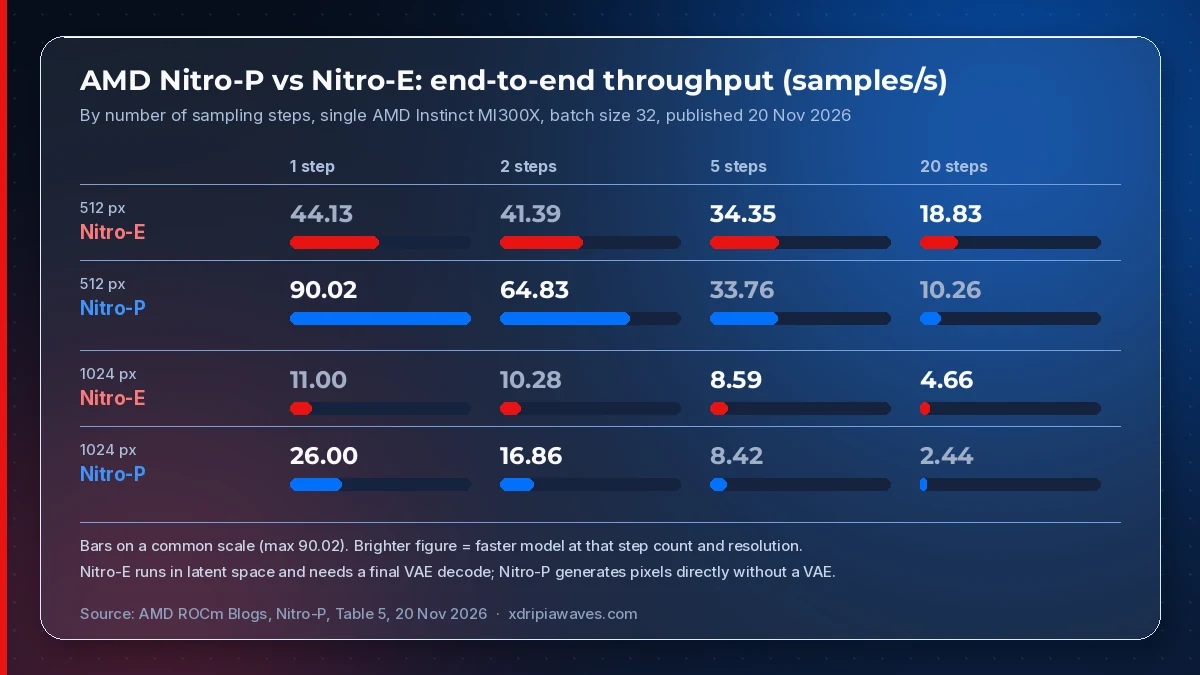
Source: AMD ROCm Blogs, Nitro-P, Table 5, 20 November 2026. Single AMD Instinct MI300X GPU, batch size 32.
The figures make AMD's own point clearly. At one step, Nitro-P roughly doubles throughput, 90.02 versus 44.13 samples per second at 512 px and 26.00 versus 11.00 at 1024 px. By five steps the two are level, and at 20 steps Nitro-E is faster, 18.83 versus 10.26, because the denoising network dominates the run time and each step is cheaper in latent space. AMD describes Nitro-P as suited to "low-NFE, high-throughput serving". All numbers are AMD's own measurements on its own hardware.
Canva opens its design tools to other products
On 23 November Canva made Canva MCP generally available, with no waitlist. The update covers more than the MCP server:
- Agent tools. Through MCP, agents can generate an editable design, image or video, remove a background, turn a flat image into a layered design, resize and export.
- REST APIs. Design generation, image generation, background removal and Magic Layers are now callable directly, for teams that want predictable control rather than letting an agent choose tools.
- Service accounts and API billing. Automated workflows can run without an employee's session, and end users of a product built on Canva do not each need a Canva account.
- Canva Craft. Canva's in-house image model is available through MCP and the API for the first time.
Canva also published usage figures: nearly 500,000 sign-ups through MCP since October, MCP usage up 93% from September to October, and 72% of Canva CLI commands in October typed by agents. The Next Web notes that a design requested in a chat comes back as an editable Canva file in the brand's colours and fonts, so a wrong headline is fixed by hand rather than by another prompt. These are company figures and have not been independently verified.
What to take from the week
- Resolution is no longer the bottleneck. Kling claims native 8K and MiniMax 16 MP; the open questions are price, export formats and licence terms.
- Open weights do not mean open everywhere. H3-Image's licence excludes the EU, UK, South Korea and US; check territory before building on any model.
- Speed claims depend on step count. Nitro-P doubles throughput at one step and loses at 20. Ask which setting a benchmark uses.
- Design tools are becoming services. Canva's REST APIs and service accounts put its editor inside other products, with the output still editable by a person.