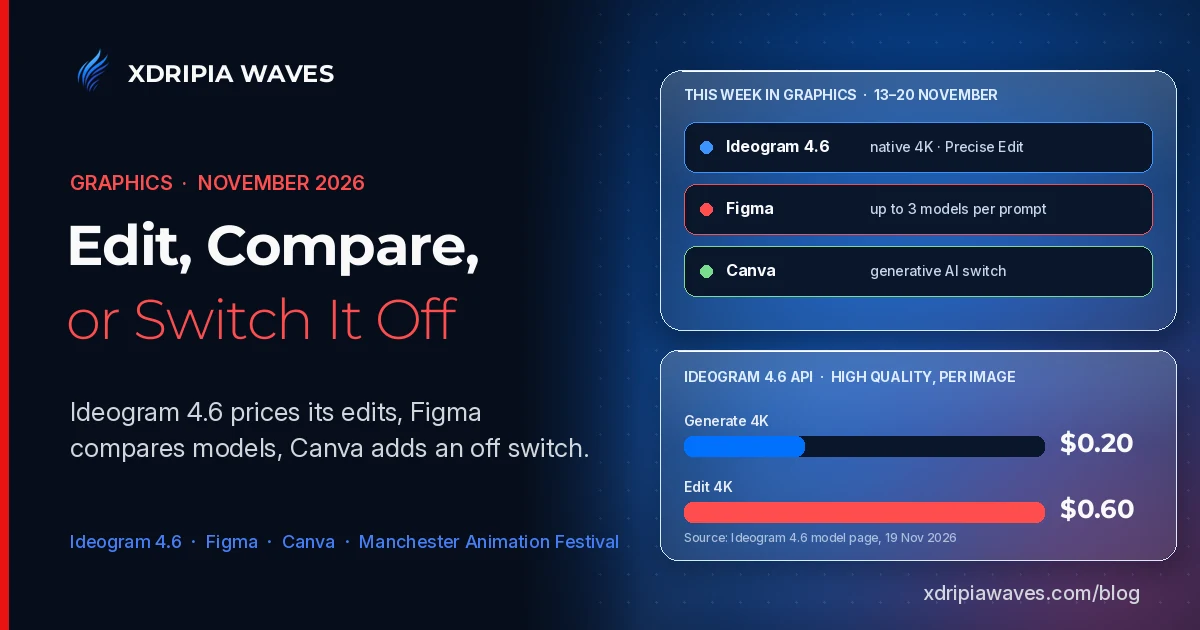
In our last Graphics edition we covered MAI Image 2.7, Framer's shader generation and Krita's HDR work. This week has a new image model with a detailed price list, Figma letting designers compare several image models in one go, Canva adding a switch that hides its generative tools, and an animation festival that will no longer accept generative AI films. Two of these push generation further into the workflow; two give people a way to keep it out.
Ideogram 4.6: precise edits, native 4K and a price per image
Ideogram released Ideogram 4.6 on 19 November. The company describes it as an image generation and editing model built for focused, multi-turn changes, with output up to 4K. The main points from the model page:
- Two API endpoints. Generate, for new images or edits with up to five reference images, and Precise Edit, which accepts an optional mask to limit a change to a painted area.
- Four quality modes. Very low, Low, Medium and High. Very low is limited to 2K; the other modes can output up to 4096 by 4096 pixels.
- Benchmark claim. Ideogram cites a 17 November snapshot of Rapidata's Multi-step Image Edit leaderboard, where 4.6 scores 1,892 ±32, ahead of Ideogram 4.5 at 1,866 ±30 and Seedream 5.5 at 1,805 ±29.
- Internal task scores. On Ideogram's own requests at High quality, recolouring an object to a brand hex code produced a usable result 83% of the time, up from 46% on 4.5; masked edits reached 90%, up from 82%.
The pricing is published per image and depends on quality, resolution and whether the request is a generation or an edit:
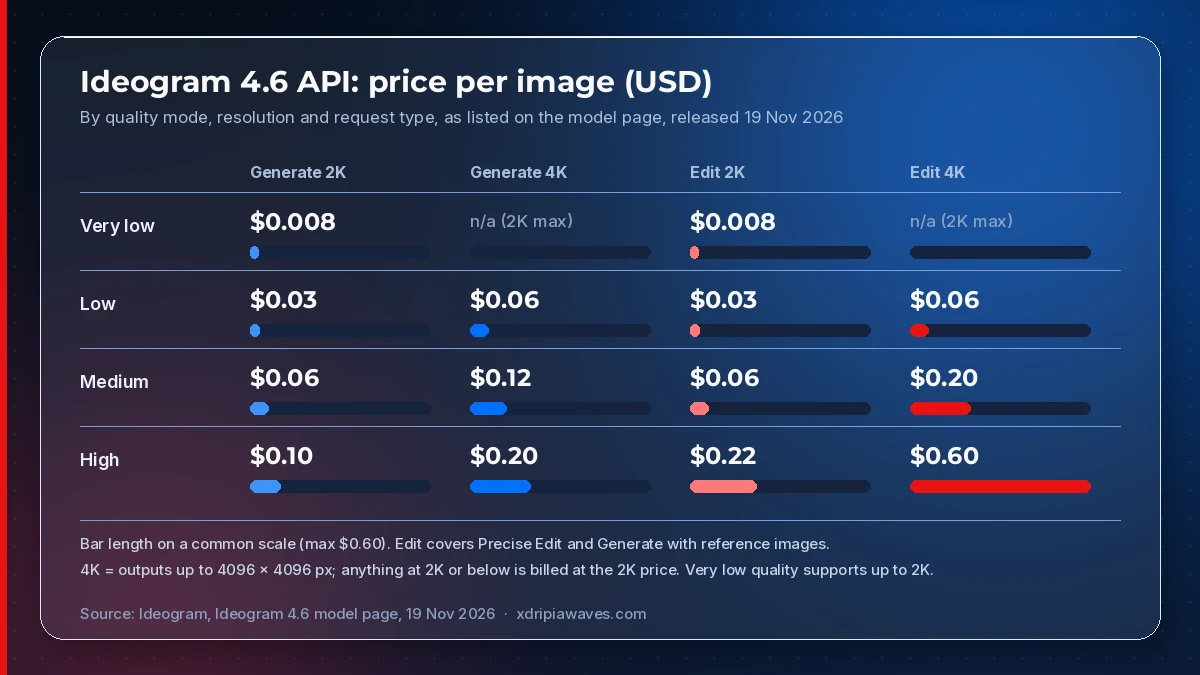
Source: Ideogram, Ideogram 4.6 model page, 19 November 2026. Prices in USD; edit pricing covers Precise Edit and Generate with reference images.
Two readings matter for studios. First, the spread is wide: a High quality 4K edit costs $0.60, 75 times the $0.008 floor, so the quality setting in an automated pipeline is a budget decision, not a default. Second, the leaderboard lead is narrow. As i10X News noted, the gap between 4.6 and 4.5 is 26 points with overlapping error ranges, and the task percentages come from Ideogram's own requests rather than an independent test. Ideogram's page itself recommends comparing 4.6 against 4.5 on your own images before migrating a working integration.
Figma: several images, or several models, per prompt
Figma's release notes list two changes this week that affect design teams.
On 18 November, Make image and Edit image gained multiple outputs:
- One model, multiple images. A single image model can return two, four or six images from one prompt.
- Multiple models, one image each. The same prompt can be run across up to three image models at once, with the results shown side by side.
The second option is the more useful one. Model choice has usually been hidden behind a default, and comparing outputs meant switching tools. Putting three interpretations next to each other on the canvas makes the model a visible, reviewable choice. Note that Figma AI image tools draw on a shared credit system, so six variations are not free.
On 17 November, Figma also added an allowlist for approved OAuth apps, including MCP clients, for Organization and Enterprise plans. Admins can review app requests and manage approved apps in a new Extensions tab. According to UX News, the default still allows all apps, and turning on approval blocks unlisted apps from organisation resources, including connections members had already authorised. Teams that rely on external agents should list what they use before switching the policy on.
Canva adds a switch for its generative tools
On 19 November, The Verge reported that Canva now lets users turn off its generative AI features. The setting sits under Profile > Settings > Permission, as Enable generative AI features, and covers tools including Magic Write, Magic Design, Magic Layers, Magic Edit, Dream Lab, Canva Code and AI Shapes.
A few details define the scope:
- Assistive tools stay. Background Remover and Magic Grab remain available, because Canva says they "make everyday tasks faster without generating anything new."
- See less AI content. A separate option under Profile > Your account > AI personalization puts human-created templates and design elements first in library search and recommendations. It does not remove AI content entirely.
- Labelling. Canva says AI-generated material is a "small portion" of its library, and designs that use such elements carry an AI label in their metadata.
- Availability. Both switches are available to free and paid users.
Creative Bloq called it possibly the first time a major AI-forward creative software company has acknowledged that a sizeable part of its users does not want these tools. The practical line Canva draws, generative versus assistive, is one other vendors will likely be asked to define too.
Manchester Animation Festival closes its competition to genAI films
On 13 November, Manchester Animation Festival announced that films created using generative AI will not be accepted from 2027. As Cartoon Brew explained on 20 November, a film is ineligible if a genAI model creates or alters any part of its final moving image; filmmakers can submit evidence if they dispute a decision.
Other festivals are not following yet. Annecy's artistic director Marcel Jean said whether a film counts as animation depends on how it uses AI, and that he wants more time before setting a policy. Ottawa's Chris Robinson described filmmakers who tick "3D" on submission forms when generative tools were clearly used. MAF director Steve Henderson said this year's call received more genAI films than ever.
What to take from the week
- Read the price table, not the leaderboard. Ideogram's per-image prices are precise and checkable; its benchmark lead is within the margin of error.
- Model choice is moving onto the canvas. Figma's side-by-side comparison treats the image model as a design decision, and its new allowlist treats external agents as an admin one.
- Opt-out is becoming a feature. Canva's switch separates generative from assistive tools and gives users control over both the tools and the library.
- Disclosure is the weak point. Festival programmers say self-reporting is unreliable, which is why Manchester chose a clear rule over a case-by-case one.