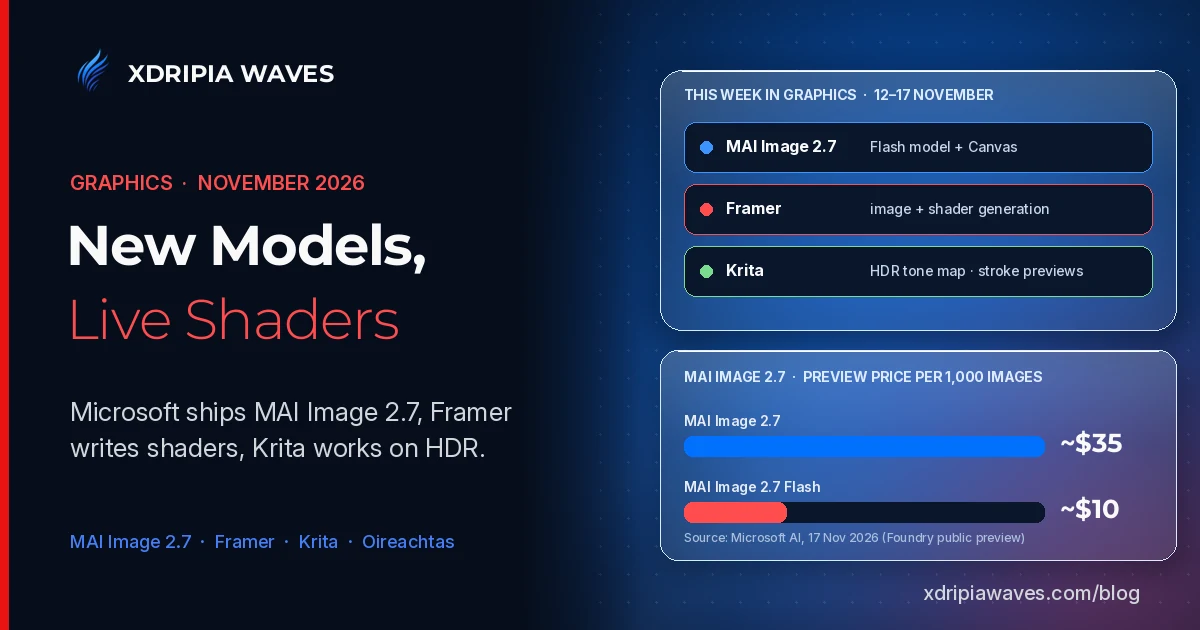
In our last Graphics edition we covered Figma's 3D transforms, ArtStation's generative AI declarations and Seedream 5.5. This week brings a new image model with published prices, an agent in a website builder that now writes shaders, steady work on HDR painting in Krita, and a parliamentary hearing in Ireland where visual artists described what generative AI is doing to their fees. Four different layers of the same trade: the model, the layout tool, the paint program and the policy.
Microsoft releases MAI Image 2.7 and Canvas
On 17 November, Microsoft AI introduced MAI Image 2.7 and MAI Image 2.7 Flash, two image generation and editing models, together with Canvas, an interactive workspace in MAI Labs that runs on the Flash model. Canvas starts from a prompt or a sketch; users can then select any part of an image to replace, move or restyle it.
The points that matter for working designers, as Microsoft states them:
- Localized edits. The company says MAI Image 2.7 can change an object's colour, material or position without disturbing the rest of the image, and keeps visual consistency across successive edits.
- Transparent backgrounds. Both models can output images with transparent backgrounds, aimed at product images, logos, icons and illustrations that would otherwise need manual cutouts.
- Published preview prices. In public preview on Microsoft Foundry, MAI Image 2.7 costs about $35 per 1,000 images and Flash about $10 per 1,000 images. Both are also offered through fal, Genspark, OpenRouter and Vercel.
- Benchmark claim. Microsoft's footnote states that, as of 16 November, MAI Image 2.7 ranked first on Artificial Analysis' AA-Image-Editing v2.1 with 1,215 Elo across 5,478 votes, 4 Elo ahead of GPT Image 2.6 Sunburst (max). The company adds that results vary by workload and methodology.
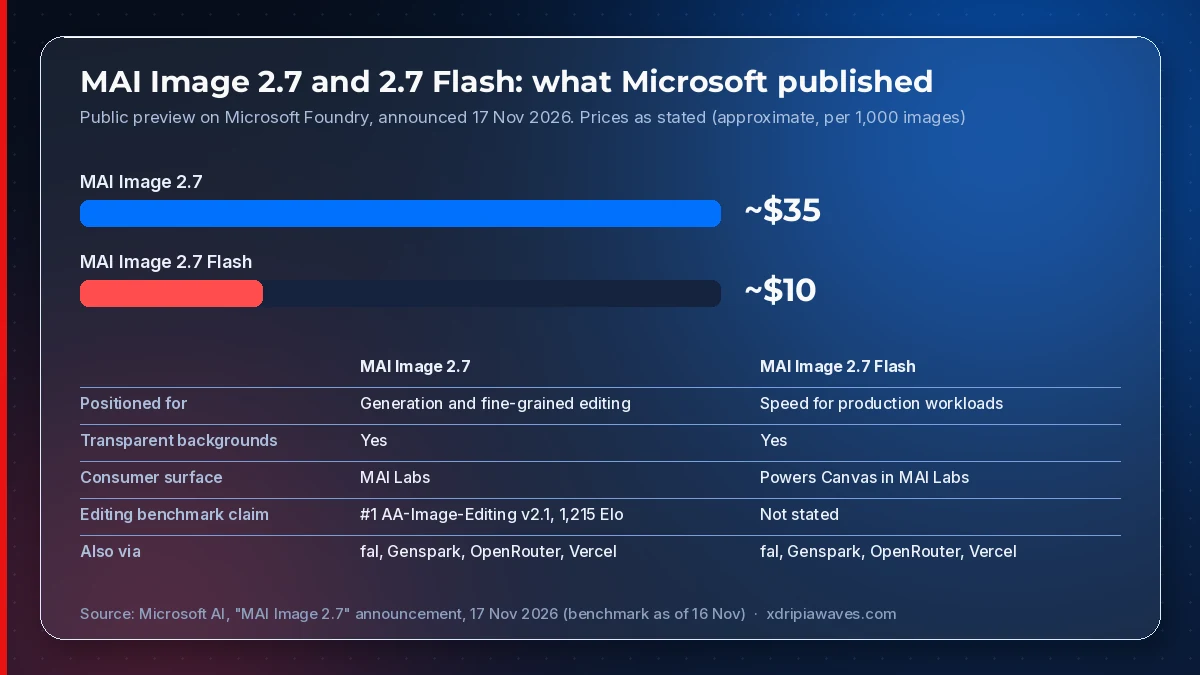
Source: Microsoft AI, MAI Image 2.7 announcement, 17 November 2026 (benchmark position as of 16 November).
MAI Image is already the default model family behind Bing Image Creator, and the announcement lists Adobe, Figma Weave, Minute (Sports Illustrated), Wirestock and Manus among the platforms working with it. For studios that buy image generation through an API, the useful part is the price list: a published per-image cost makes it possible to compare model spend against stock licensing or retouching hours, rather than guessing. A four-point Elo lead on a single leaderboard is a much thinner basis for a decision, and it can change with the next release.
Framer: the agent now generates images and shaders
Framer published Image and Shader Generation on 12 November. The Framer Agent can now:
- generate a custom image, texture or illustration for a site;
- take an image dropped into the chat or selected on the canvas and swap the subject, remove the background or restyle it;
- write shaders on request, with examples such as halftone, bokeh blur, CRT and pencil effects, or an effect described in plain words, such as "smudge an image on pointer drag";
- adjust a Framer shader that is already on the canvas.
The two features can be chained: the agent can generate an image and set it as the input of an image shader, for example one that turns it into a pen drawing with an ink smudge on mouse move. In practice this moves a class of interactive effects, which used to need a developer comfortable with GLSL, into a prompt. The design question shifts from "can we build it" to "should this page move at all", along with the usual checks on performance and on motion for users who prefer reduced animation.
Krita: brushstroke previews and HDR tone mapping
Krita's November 2026 monthly report, dated 15 November, covers work in the development branch (Krita Next, 5.4.0/6.1.0-prealpha) and in the stable Krita Plus builds. The items most relevant to illustrators:
In Krita Next
- Brushstroke previews. The Brush Preset docker and the "Choose brush preset" dropdown can show a sample stroke instead of, or in addition to, the preset thumbnail.
- HDR colour management. Work continues with a new Tone/Gamut Map filter and OCIO LUT baking.
- Focused timelapse recording. An option to record only the visible part of the image, for zoomed-in timelapses.
- 3-Point ellipse mode and a perspective brush sensor for the Two Point and Curvilinear Perspective assistants.
In Krita Plus
- A fix for a random crash in Krita 5, via a backported Qt QML fix.
- Closer adherence to GIMP's standard when loading .gpl palettes, and fixes for crashes on malformed palette files.
These are nightly pre-release builds, not a stable release, so studios should test before depending on them. The direction is still clear: an open-source painting program is adding the HDR tooling and colour pipeline controls that are usually associated with compositing software.
Ireland: artists tell lawmakers AI training is "theft"
On 17 November, the Oireachtas committee on artificial intelligence heard from representatives of the arts community, as reported by the Irish Examiner. Robbie Kitt, chair of Praxis: The Artists' Union of Ireland, told the committee: "What is happening is theft," and asked the State to ensure the law "can be enforced to protect cultural workers".
Noel Kelly, chief executive of Visual Artists Ireland, said artists "are not here to smash the machines", but that generative AI adds pressure "particularly in illustration, photography, design, and commissioned work", pointing to fees, lost opportunities and the value placed on creative labour. The committee also heard from Caroline Frederickson of the International Labour Organisation, who said one in four workers globally is in an occupation with some exposure to generative AI, and that only 3.3% of global employment falls in the highest exposure category.
What to take from the week
- Cost is now part of the spec sheet. Microsoft published per-1,000-image prices next to its quality claims. That makes model choice a budget line that can be checked.
- Effects are becoming promptable. Framer's shader generation puts interactive image treatment inside the layout tool, which raises the bar for restraint rather than for skill.
- Open tools keep closing gaps. Krita's HDR and preview work is in nightly builds, not shipped, but it is moving in the direction professional colour pipelines need.
- The labour argument has reached parliaments. The Irish hearing puts illustration, photography and commissioned design on the record as the areas artists say are under the most pressure.