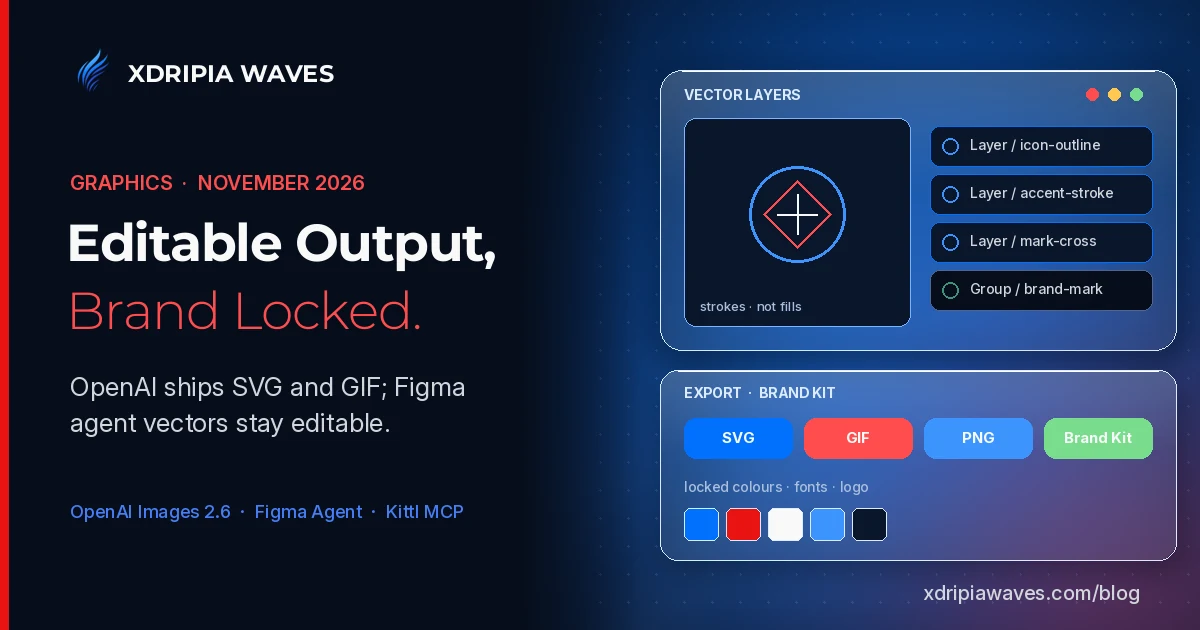
In our last Graphics edition Figma and Wix put running code on the canvas. This week the story is what leaves that canvas: vectors you can still edit, SVG you can ship, GIFs you can loop, and brand kits that travel into the chat where briefs are written. Between November 3 and 5, OpenAI, Figma and Kittl each shipped a piece of that pipeline.
OpenAI Images 2.6: faster generation, motion and SVG
On November 4, OpenAI introduced Images 2.6 in ChatGPT, Codex and the API. The post frames the release around speed and editing control rather than a new aesthetic.
What the post actually lists
According to OpenAI:
- Speed: Images 2.6 generates images 50% faster than before.
- API models: GPT‑Image‑2.6 Flare and GPT‑Image‑2.6 Sunburst. When quality is set to low, Flare can generate images in as little as six seconds; Sunburst is positioned for higher-quality generation and greater consistency across edits at medium or high quality.
- GIFs: motion from a prompt, including brand mascots, social reactions and animated storyboards before video production.
- API controls: image markup (already in ChatGPT) comes to the API; SVG exports are available for websites, apps and print; a new complexity parameter adjusts how much planning the model does; quality still controls visual detail and fidelity.
- Availability: Images 2.6 is available globally in ChatGPT and Codex across all subscription tiers on desktop, mobile and web; Flare and Sunburst are available in the API, with pricing linked from the post.
OpenAI also states that people create 4 billion images per week across ChatGPT, Codex and the API. We report that as OpenAI's own claim, not an independent measurement.
Why SVG and markup matter for designers
Raster generations that die as PNGs force a redraw when a client changes a stroke weight or a colour token. SVG export and point-level markup shrink that loop: the same generation can land closer to a production asset, and edits can be aimed at a region instead of a full re-prompt. OpenAI's post pairs low complexity with faster edits and recommends medium or high complexity for scenes with many elements or constraints. Figma Weave's creative director is quoted in the same post on adding the model to Weave for creative production inside a reusable workflow—another sign that image models are being wired into design systems, not only chat UIs.
Figma agent: vectors built to stay editable
On November 5, Figma's release notes listed improvements to agent-generated vector illustrations and icons. The note is short and specific.
Four concrete changes
Figma says the agent now generates polished vector illustrations and icons that are easy to edit, match to a style, or animate:
- Functional layer grouping: independent layers grouped for iteration.
- Attach references: feed the agent existing illustrations as a style reference to generate additional components or on-brand icons at scale.
- Strokes, not fills, for line work: stroke weight and end caps can change without redrawing.
- Ready for Figma Motion: clean layer structure so you or the agent can animate the vectors.
That last point connects to the November 3 note: when you create a code layer from design frames, the agent now reads prototype connections between them. Code layers remain in open beta. Together, the vector and code-layer notes push the same idea—generated output should remain a first-class object on the canvas, not a flattened picture.
Continuity with the code-layers edition
We already tracked Figma's shaders going generally available, higher-resolution export (up to 4096px) and shaders inside code layers in the November 3 Graphics post. The November 5 vector update is the illustration counterpart: stroke-based vectors keep line work alive the way code layers keep interaction logic alive.
Kittl: Brand Kit inside ChatGPT and Claude
On November 3, Kittl announced that its design tools now work inside ChatGPT and Claude through an MCP connection. Co-founder and CPO Tobias Saul's post is product copy, so we stick to what it states.
What Kittl says the connection does
- Connect once from kittl.com/mcp, then ask for product shots, mockups, social content and video in the same chat where you plan.
- Brand Kit carries colours, fonts and logo through results.
- Named capabilities include AI workflows for product shots and packaging, real product mockups, background removal, upscaling, vectorising, video inside ChatGPT and Claude, and access to "20+ of the newest AI models" selected for the job.
- Results return in chat and are saved to the Kittl workspace; fine-tuning can continue in Kittl.
- A promo: connect Kittl to ChatGPT or Claude and get 300 free images on any paid plan, based on 1,500 tokens with ChatGPT 2.5 Flare; other models use more tokens per image; bonus tokens expire 7 days after you connect; terms apply.
- A live demo is scheduled for November 10.
Kittl also lists Claude Code, Codex and apps that support remote MCP servers. The user approves the connection and can disconnect anytime.
Brand lock as the product claim
The post's core argument is familiar to anyone who has asked a general assistant for product visuals: the assistant drifts off-brand and the mockups do not look real enough to sell with. Kittl's answer is to put the Brand Kit and designer-built workflows behind the same chat that already holds the brief. We are not endorsing the promo economics; we are noting the architecture—brand tokens travel with the generation request instead of being re-applied after the fact.
What to watch
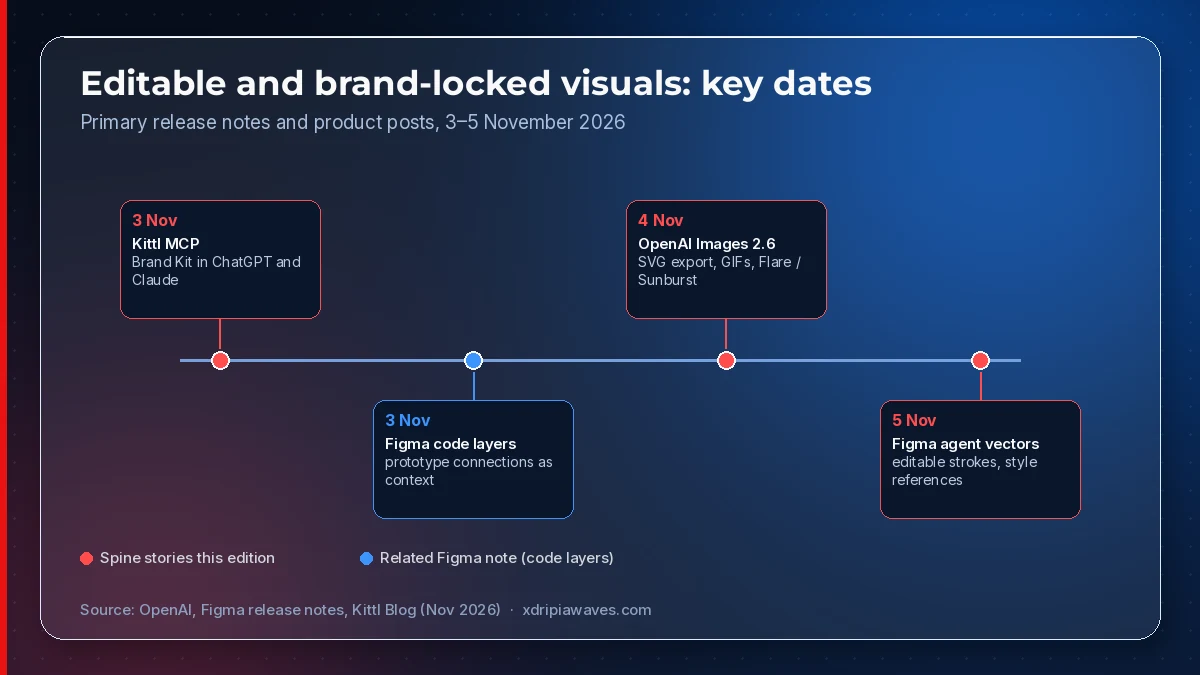
Source: OpenAI, Figma release notes, Kittl Blog (Nov 2026).
- SVG and stroke-based vectors: watch whether export paths stay editable after they leave the generating app, or whether they flatten on round-trip.
- Brand kits in assistants: Kittl's MCP pattern will matter if more design tools expose the same controls inside ChatGPT, Claude and Codex.
- Complexity vs quality: OpenAI's split between complexity (planning) and quality (detail) is a useful mental model for prompt budgets; expect similar dials elsewhere.
Editable output and brand-locked output are the same demand stated two ways: keep the file structure, keep the brand tokens. This week OpenAI, Figma and Kittl each moved a step toward that, on dates we can cite from their own pages.