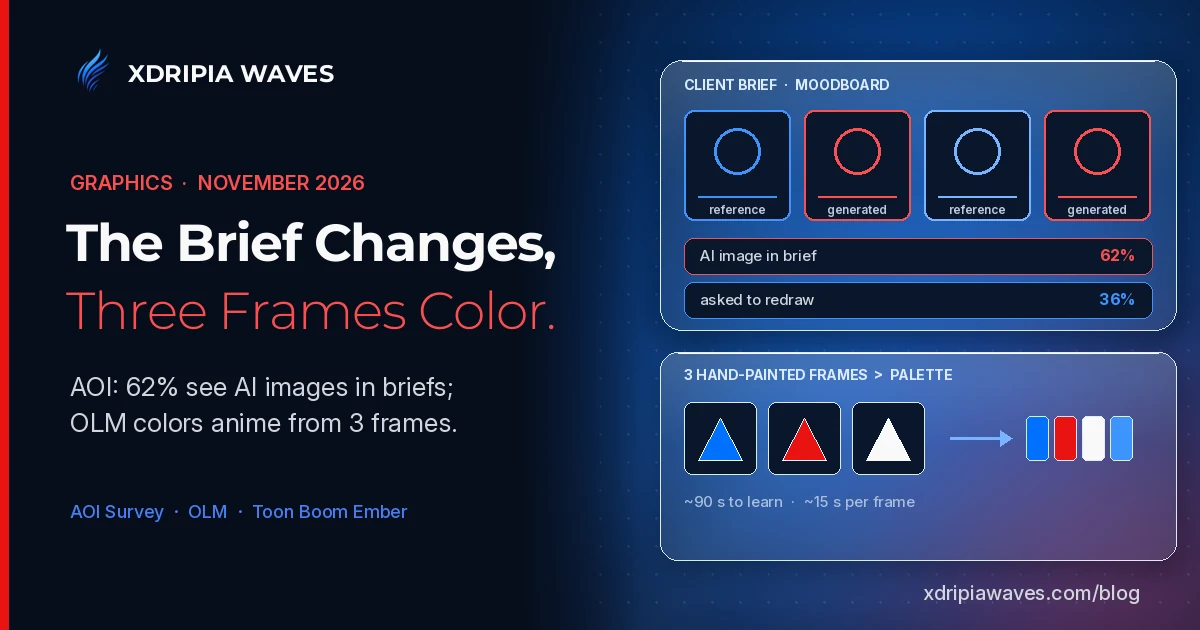
In our last Graphics edition the story was about tools: editable vectors, SVG exports and brand kits that travel into chat. This week the focus moves from the software to the people using it. A new survey from the Association of Illustrators shows how generated images are reshaping the brief before an illustrator draws a line, while an animation studio and a software maker show a narrower kind of automation, trained on a production's own frames.
The AOI survey: AI arrives before the commission
The Association of Illustrators (AOI) has published AI and the Future of Illustration, drawing on 549 responses in 2026 alongside its 2025 survey of 5,000 respondents. The headline figure: 46% of respondents say they know they have lost work because a client chose generative AI instead, up from 32% in 2025.
As Tomorrow's Publisher points out, these were separate samples, not the same illustrators followed over time, and the figures describe respondents' experience rather than the share of all commissions displaced. The AOI itself notes that wider economic conditions also contribute to the income pressure it records.
What changes inside a commission
The more useful part of the report looks at illustrators who are still being hired. According to the AOI:
- 62% had encountered AI-generated images in briefs or moodboards.
- 36% had been asked to copy, refine or redraw AI-generated images.
- 31% reported clients expecting lower fees because AI tools exist.
- 27% reported expectations of faster turnaround.
- Only 7% said they had noticed no AI-related changes to commissioning.
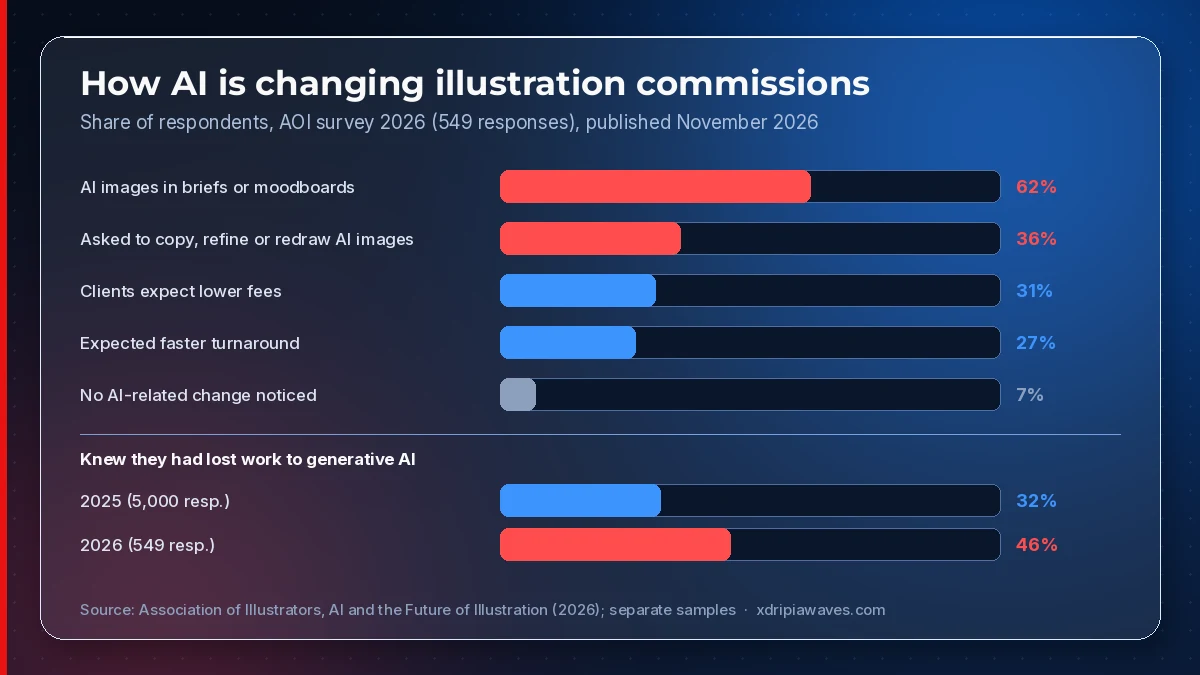
Source: Association of Illustrators, AI and the Future of Illustration (549 respondents in 2026; 2025 figure from a separate survey of 5,000).
One respondent quoted in the report summed up the shift: "I'm basically stripped out of the concept and research work to be left only with an execution role." The illustrator still delivers the final image, but the research and visual direction, the part that sets the value of a commission, may already have been decided by a generated reference.
Where the pressure is highest
The AOI breaks results down across areas of practice. In games and interactive media, 80% had encountered AI-generated material in briefs and 57% had been asked to redraw or refine generated images. In visual development and concept art, 64% reported clients using AI instead of commissioning illustration. Animation showed the highest deadline pressure, with 41% reporting expectations of faster turnaround. Children's books showed comparatively lower pressure, although 42% of respondents there still reported clients using AI instead of commissioning.
On rights, the answers are close to unanimous: 98% believe AI companies should need permission before training on copyright-protected illustration, 99% support clear labelling of AI-generated images, and 86% said they would not license their work for AI training at all.
The same pattern among freelancers
The trend is not limited to the UK. Franceinfo reported on November 8 that, according to an August 2026 Upwork study, job offers asking freelancers to correct, improve or finish AI-generated work rose by 70% in a year. A motion designer interviewed by the broadcaster said close to a quarter of his orders now put him in the role of fixing material clients had generated themselves.
OLM: a coloring model trained on three frames
At the Taiwan Creative Content Fest in Taipei, OLM Digital board director Yotsukura Tatsuo described a coloring tool from OLM, the studio behind the Pokemon anime, as reported by Variety. An artist colors three frames by hand; the system learns that production's line shapes and palette in about 90 seconds, then colors each remaining frame in around 15 seconds. Painting more frames by hand makes it more accurate.
Why it is built this way
The tool came out of ANIMINS, a 15-month research project under GENIAC, a generative AI program overseen by Japan's Ministry of Economy, Trade and Industry, which wrapped in February. "Strictly speaking, it isn't generative AI," Yotsukura said. Because it trains only on the production's own frames, he said, no other works are affected, and it can adapt when a new character appears.
OLM's research group documents the underlying approach on its anime-style colorization project page: a patch-based method that trains on a few colored line drawings from the target sequence. At proof-of-concept stage, Yotsukura estimated the tool cut painting workload by around 30%, while the checkers who review every colored frame have somewhat more to do. No product, price or release date was announced.
Toon Boom Ember: coloring and in-betweening in beta
Toon Boom Animation, maker of Harmony and Storyboard Pro, is working on the same bottleneck. In the same Variety report, product marketing director Harry Ravelomanantsoa said the beta of the coloring tool in Ember, the company's AI suite, is wrapping up, and in-betweening is expected to enter beta within a couple of weeks. One Manila studio that tested the coloring tool cut painting time on a 90-second to two-minute scene from 15 hours to two or three.
Toon Boom describes Ember as an optional add-on built into its existing software rather than a separate download, and says the features rely only on service providers that do not store user data or use projects to train AI models.
What this means for visual creators
Taken together, these stories show two different uses of AI in visual work:
- AI in the brief. A generated image arrives first and the illustrator is asked to execute it. The AOI data suggests this shifts fees, deadlines and creative control away from the artist.
- AI inside the pipeline. A model trained on the production's own hand-painted frames takes over repetitive coloring, while artists set the look and checkers review every frame.
For freelancers, the practical step from the AOI material is to clarify early whether a generated reference is exploratory or a direction to reproduce, and to price concept work separately from execution. For studios, the OLM and Toon Boom examples show that the most defensible automation starts from work the team already owns.