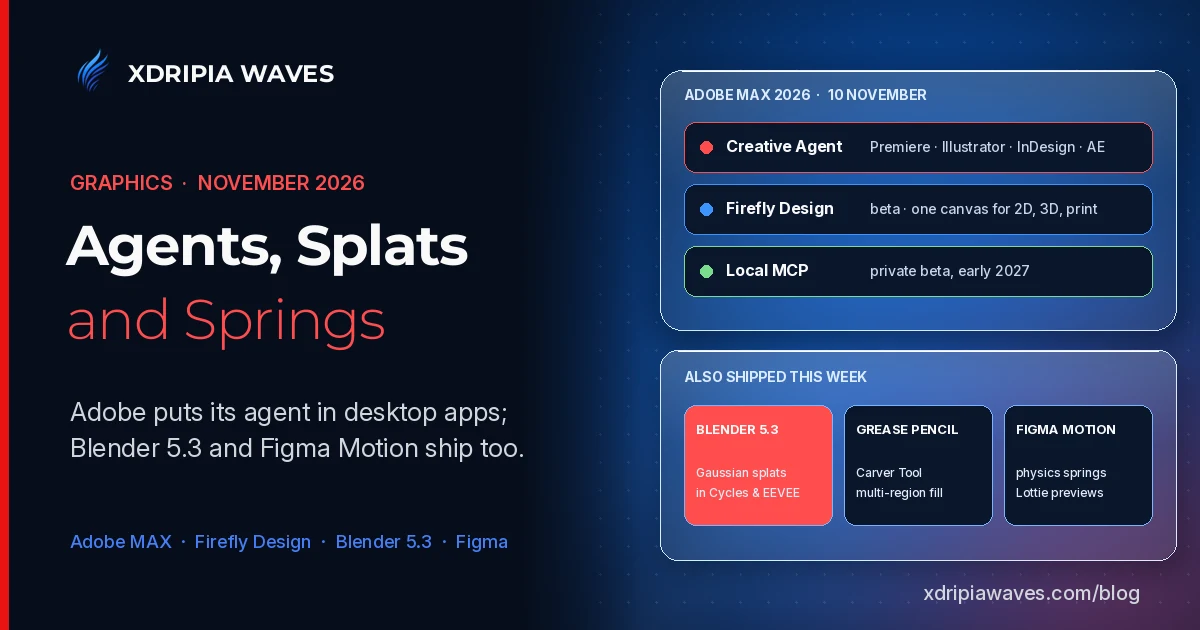
In our last Graphics edition we looked at how generated images are changing the illustrator's brief. This week the news comes from the tools themselves. On 10 November Adobe used its MAX conference to put its Creative Agent inside more desktop apps, the Blender Foundation shipped Blender 5.3, and Figma updated its Motion features. The three releases point in different directions, and the release notes are worth reading for what is available now and what is still a preview.
Adobe MAX: agents move into the desktop apps
Adobe's Creative Cloud announcement says the Adobe Creative Agent is now available in Premiere, Illustrator, InDesign, After Effects and Frame.io. Adobe describes it as an assistant that runs multi-step workflows, with the creative professional choosing when to delegate and when to work by hand. In Premiere, the examples given are applying effects across every clip in a sequence, tracking masked subjects and adjusting colour and exposure across a whole sequence at once.
The longer-term change is a preview. Adobe says local MCP integrations will let third-party agents work directly in Photoshop, Illustrator, Premiere and After Effects, making changes in native project files on the user's computer while layers, vectors, bins and sequences stay editable. According to the same release, these integrations arrive in private beta in early 2027, so they are not something designers can use today.
Firefly Design and the single canvas
In the companion Firefly announcement, Adobe introduced Firefly Design (beta), a design editing space that combines illustration, image editing, animation, 3D and print on one canvas. Two related tools sit beside it:
- Firefly Graph (beta) for building repeatable workflows that combine AI models with Adobe's production tools.
- Firefly Builder (private beta) for turning a natural-language description into an interactive, on-brand prototype such as a website, presentation or app.
What ships today
The flagship updates are less dramatic but more immediately useful. Photoshop gains Relight and Generative Restyle, which turns prompt-based edits into adjustable sliders. Illustrator gets refreshed content libraries and new on-canvas Blend controls. InDesign adds Flex Layout for text frames that resize dynamically, plus real-time Co-editing in beta. Adobe states that new Creative Cloud capabilities are generally available from 10 November, while the AI Assistants powered by the Creative Agent are in beta.
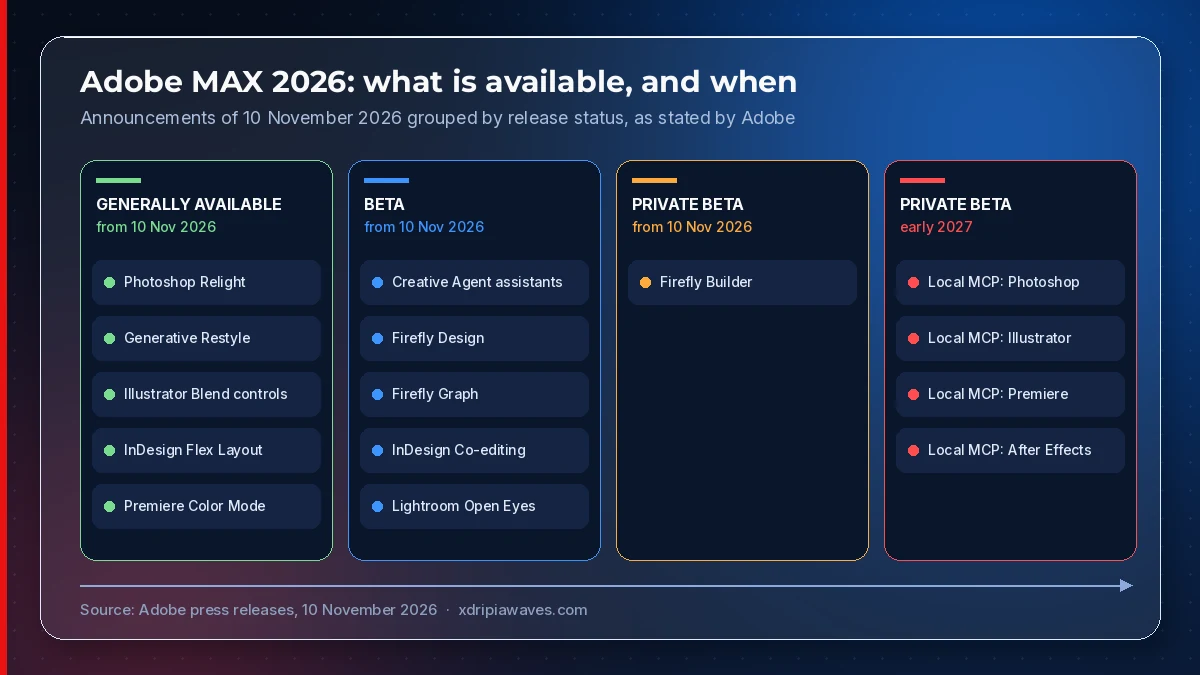
Source: Adobe press releases, 10 November 2026.
The pattern matters for anyone planning work around these tools. Most of the agent features carry a beta label, and the integration that would let outside agents edit native files is still months away.
Blender 5.3: splats, glass and Grease Pencil
The Blender 5.3 release, also dated 10 November, closes the year with native support for 3D Gaussian Splats. Splats can be imported from PLY and SPZ files as point clouds, edited and processed with Geometry Nodes, then relit and rendered in Workbench, EEVEE and Cycles. For artists who capture real places or objects as splats, that means they can be placed in a regular Blender scene instead of a separate viewer.
Other changes relevant to visual work:
- Cycles adds dispersion and anisotropic roughness for glass and transmissive materials, reproducing the rainbow effect seen in glass and gemstones.
- EEVEE introduces Material Lighting Nodes for control over how materials react to light, which the release notes describe as useful for non-photorealistic styles and effects like iridescence.
- Grease Pencil gains selection tools in Draw Mode, a Carver Tool for cutting shapes with boolean subtraction, and a Fill tool that can fill many regions at once.
- Asset Libraries can now be shared as extensions, and the Extensions platform accepts libraries of Public Domain (CC0) assets.
On NVIDIA GPUs, a new DLSS denoiser speeds up the viewport, and Vulkan is now the default backend on Windows (except ARM) and Linux. The full list is in the developer release notes, which also flag a compatibility change: the Grease Pencil "Frame Duration" feature has been disabled, with end frames converted when older files are opened.
Figma Motion: springs and Lottie previews
Figma's release notes list a Motion update on 10 November aimed at designers who hand animations to developers:
- Style previews play each preset animation in the list and on the canvas before it is applied.
- Physics-based springs let designers set mass, stiffness and damping for iOS and Android, with the duration updating to match. Springs can be saved in a design system.
- Lottie export previews show how an animation will play as a Lottie file before export.
Five days earlier, on 5 November, Figma also said its agent now produces vector illustrations and icons with grouped, editable layers, using strokes rather than fills for line work so stroke weight and end caps can be changed without redrawing.
What this means for visual creators
Read together, the three releases show different ideas of where automation belongs:
- Adobe is putting agents in charge of multi-step tasks across its apps, with most of that work labelled beta and the open MCP route scheduled for 2027.
- Blender is widening what an artist can bring into a scene, from captured splats to shared asset libraries, without adding a generative layer.
- Figma is focusing on handoff: animations that behave the same way in design files and in the shipped app.
For studios evaluating upgrades, the practical step is to separate the generally available features from the betas before changing a production pipeline, and to test Blender 5.3 files against the Grease Pencil compatibility note before moving active projects.