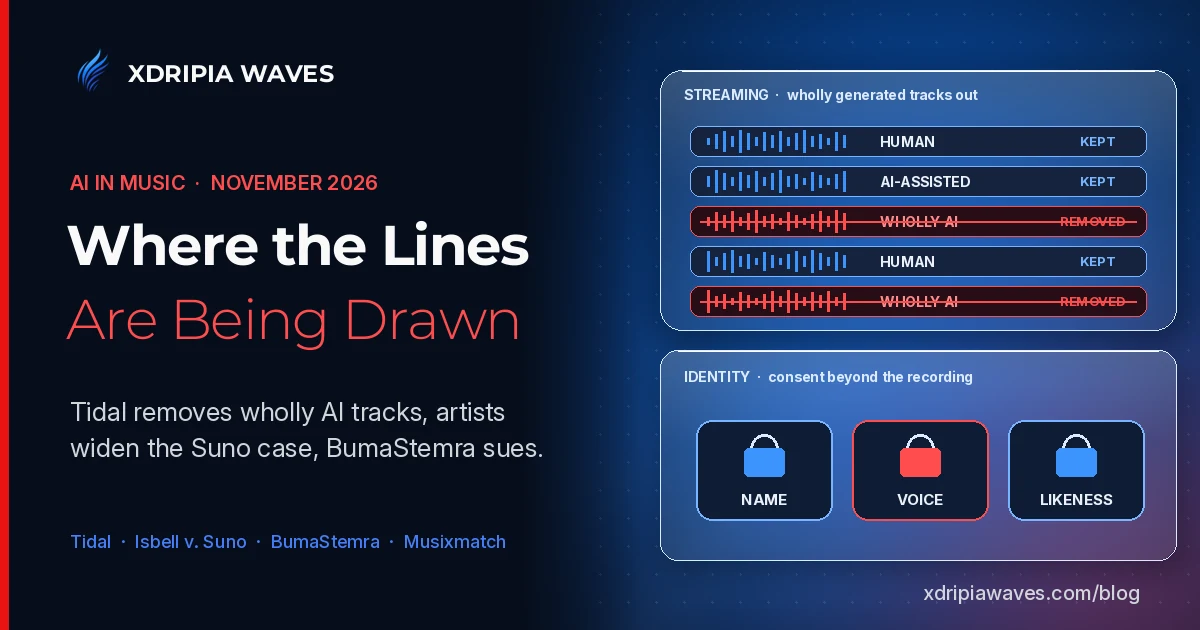
In our last AI edition, the argument was about training data and who gets paid for it. This week it moved to distribution and identity. A streaming service said it will delete fully generated tracks outright. A group of artists widened its case over what an AI model does with their names. A Dutch collecting society went to court over AI background music sold to shops and gyms. And a lyrics company announced an opt-in route for licensing words to AI platforms.
Tidal removes fully AI-generated tracks
On 24 November, Tidal announced that it will remove every track it determines to be 100% AI-generated. Earlier this year the service began labelling such tracks and taking them out of the royalty pool. Robert Anderson, who leads Tidal Music, wrote on X that "something more drastic needs to be done".
The rules from 9 December
- Removal: according to TechCrunch, removals start on 9 December, and Tidal expects more than 29 million songs to be deleted by the end of the year.
- Distributors: distributors may no longer deliver wholly AI-generated tracks, and Tidal will reject deliveries whose metadata says they were made solely with AI tools.
- Assisted work stays: tracks made with the help of AI tools, but not generated entirely by them, remain allowed.
- Detection: Billboard reports that Tidal will use its partnership with Ircam Amplify, a French detection provider, to enforce the policy.
The numbers behind the decision
Tidal says 43% of all tracks delivered to it over the past 90 days were detected as wholly AI-generated. On 6 November, more than 60% of the day's deliveries fell into that category. About 27 million tracks, or 6.3% of the catalogue, are now tagged as fully generated, and 96% of them received no streams in the last three months. Tidal also says it has taken down more than 65,000 tracks flagged for suspected impersonation of an artist's name.
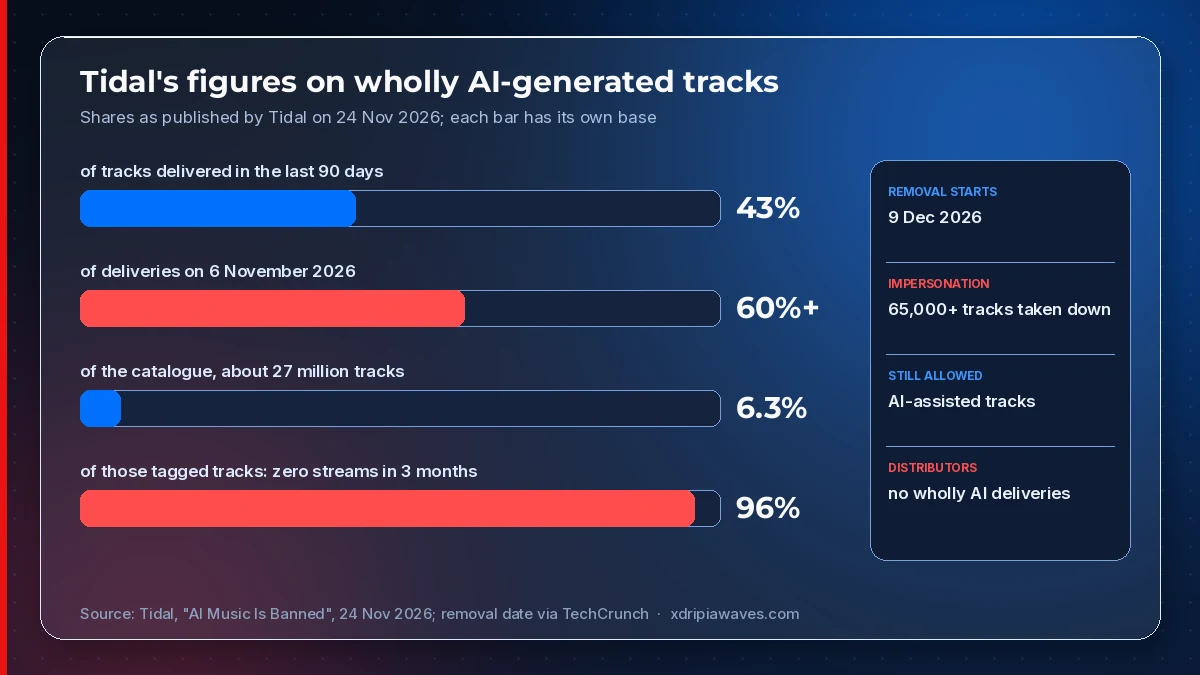
Figures as published by Tidal, 24 Nov 2026; removal date and volume as reported by TechCrunch.
TechCrunch reports that Tidal expects to reject roughly 80,000 to 85,000 tracks per day under the new rules. Billboard notes that Bandcamp and iHeartRadio already prohibit fully AI works, while Spotify, Deezer and Apple Music have chosen labelling, anti-spam measures or reduced recommendation instead of a ban. In a post on X cited by Billboard, Tidal said 94% of its AI-badged tracks came from Suno.
The Suno identity case grows
On 24 November, Jason Isbell and David Lowery filed an amended class action complaint against Suno in Boston federal court. It is not a copyright case. It accuses Suno of encoding musicians' identities into its models and answering their names with songs, descriptions and cover images that evoke them, without consent.
What changed
- More plaintiffs: 16 new names, including The Chicks, Carl Craig, Phil Elverum, Ezra Furman, David Longstreth and the surviving spouses of Willie Colón and Sam Moore, according to Music Business Worldwide.
- Wider coverage: claims under right-of-publicity laws in 14 US states and Puerto Rico, plus Illinois' Biometric Information Privacy Act, now with plaintiffs in most of those jurisdictions.
- v6 in scope: the filing adds demonstrations run on Suno's v6 models, launched in September. Suno has said v6 was trained on licensed music from partners including Warner, BMG and Believe. The complaint argues that Franz Nicolay never gave consent, and that a prompt with his name alone produced songs in his style.
Digital Music News reported on 25 November that Judge Angel Kelley had denied Suno's earlier motion to dismiss, with the decision referring to the amended complaint. The full order had not been released at the time of publication, so the reasoning is not yet public. A Suno spokeswoman told Billboard the claims are without merit, according to The AI Musicpreneur. No class has been certified.
The legal point to watch is in the complaint itself: a label licence for a recording, the plaintiffs argue, does not by itself license the performer's name, voice or likeness.
BumaStemra takes an AI background music supplier to court
On 24 November, Dutch collecting society BumaStemra gave YourNeuroTune until noon on 25 November to stop commercially supplying music made with Suno. The company sells background music to businesses and, according to BumaStemra, tells customers they no longer need a BumaStemra licence.
NU.nl reported on 25 November that YourNeuroTune's lawyer said the company would not stop, and that BumaStemra is starting legal proceedings. Music Business Worldwide cites an October interview with Dutch outlet IO+ in which co-founder Sam Jansen said the company works "only with models under commercial license", and that the European principle that copyright requires a human author puts its music outside collecting society repertoire. Jansen did not name the models. MBW also notes that BumaStemra opted its repertoire out of text and data mining in March 2024.
This is a different angle from the label suits: the target is not the model developer but a business that resells generated output as a cheaper alternative to licensed music.
Musixmatch plans opt-in lyric licensing
On 25 November, Musixmatch relaunched Musixmatch Pro for Artists, which it says is used by more than 1.5 million artists. The update adds lyric merchandise, an analytics dashboard and a Wallet for earnings. The company says optional AI licensing is "coming soon" to the Wallet, so artists can earn from the authorized use of their lyrics by AI platforms.
No platforms, rates or launch date have been announced. Nothing changes for lyrics already on the service until the option exists and an artist chooses it.
What this means for creators
- Declare AI use accurately. Tidal separates assisted from wholly generated work and reads distributor metadata. Check how your distributor labels your releases before 9 December.
- Identity is its own right. The Isbell case tests whether licensing recordings is enough to use a performer's name and voice. Keep consent for those separate in any contract.
- Output resale is a target. BumaStemra's case is about generated music sold to venues, not training alone.
- Opt-in offers need terms. Before enabling any AI licensing option, look for the buyer, the rate and how to withdraw.