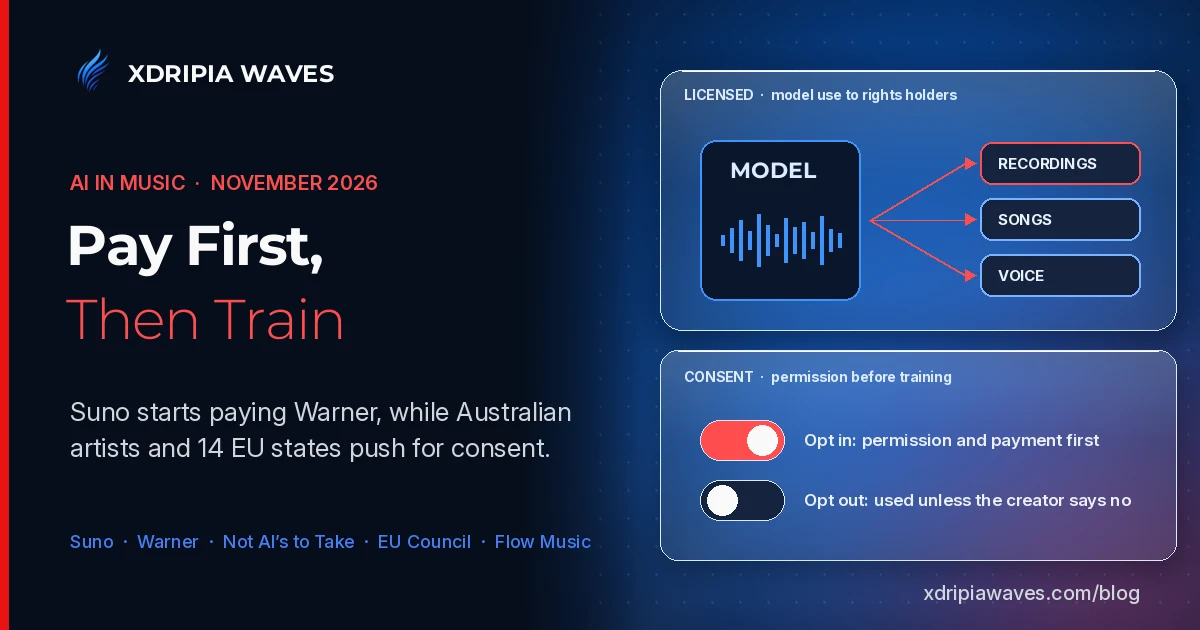
In our last AI edition, platforms were tightening the rules on whose name a track carries. This week the question moved upstream, to the training data behind the models. A major label told investors that a generative AI company is now paying it royalties. On the same days, Australia's music industry and 14 EU governments made the case that permission and payment should be the rule rather than the exception. Google, meanwhile, showed what artists build when AI is treated as a tool inside the studio.
Suno's first royalty payments reach Warner
Warner Music Group reported its fiscal fourth quarter, the three months to 30 September 2026, on 19 November. On the earnings call, CEO Robert Kyncl said that following the launch of its latest model in September, Suno "became the first of what will be many generative AI companies paying revenue to rights holders."
What Warner disclosed
- Timing: Kyncl said the impact in the quarter was "immaterial because it launched halfway through September," and that Warner expects "material revenue contribution in fiscal '27", the year that began on 1 October.
- Scale of the partner: he said Suno has "well over 2 million paying subscribers."
- Audio and video: "Just like with YouTube, we're now getting paid for audio and video," Kyncl said, linking the deal to the video tool Suno launched that week.
- No amounts: Warner did not share revenue figures for the Suno deal.
Permissions and artists
Kyncl said Warner cannot manage permissions for songs, name, image, likeness and voice "in spreadsheets", which is why it bought Sureel.ai in June. Asked how he approaches artists who oppose AI, he answered: "rule number one, you can't force anyone to do anything." He described the opportunity as "UGC on steroids."
What Warner has not said is how much of the AI licensing income reaches artists and songwriters. The AI Musicpreneur notes that neither Warner nor Suno has published the split between label and artists. For anyone signed to Warner, that is the question to put to the label in writing.
Australia: Not AI's to Take
On 18 November, the ARIA Awards in Sydney became the launch stage for Not AI's to Take, a campaign asking the federal government to keep copyright protections intact, so that AI companies must get permission and agree payment before training on Australian work.
- Who is behind it: according to Mumbrella, the campaign was devised by APRA and is backed by 38 organisations, including ARIA, Live Performance Australia, the Australian Writers' Guild and several media companies.
- On stage: The Guardian reports that Elton John appeared in a pre-recorded message: "Don't let AI use any Australian artist's work without full permission." Jack River, Dobby, Josh Pyke and KLP addressed the room for the campaign.
- The policy gap: the campaign site says the government ruled out a free-use exception in 2025, but an opt-out model, where work could be used unless a creator says no, is still among the options. The Guardian reports that Anthropic has put forward such an opt-out model.
The Guardian adds that the government is expected to present an AI legislative package, including copyright, in late 2026 or early 2027. Mumbrella cites AFR reporting that music is likely to be carved out of the licensing regime under development. That is a report, not a decision.
14 EU states ask Brussels for a law
In Europe, the same week produced a formal note. Ahead of the Education, Youth, Culture and Sport Council on 19 and 20 November, a group of member states asked the Commission to "present a corresponding legislative proposal as soon as possible" (Council document 15839/1/26 REV 1, dated 18 November).
Three demands
- An opt-out that works: improve "the enforceability of reservation of rights", the mechanism in the existing Copyright Directive that lets creators exclude their works from training.
- Transparency on training data: enforce the obligations that already apply to general-purpose AI model providers now, and have the AI Office examine whether its current template creates enough "licensing pressure on AI developers."
- Remuneration: "adequate remuneration for all creators across the board."
How the group grew
Euronews reported the note on 17 November with 11 signatories. According to Hispasonic, the revised version added Bulgaria, Hungary and the Netherlands. In May, a similar note had come from eight countries.
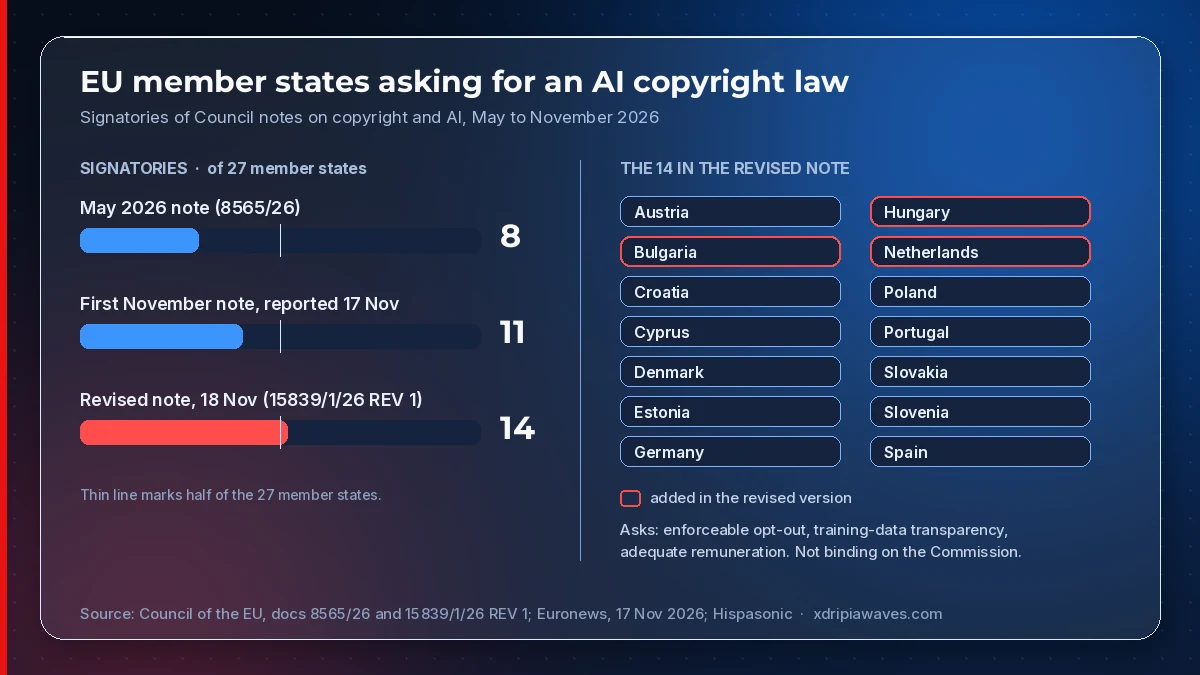
Signatories as listed in Council documents 8565/26 and 15839/1/26 REV 1; first November count as reported by Euronews, 17 Nov 2026.
The note is political pressure, not a Council decision, and it does not bind the Commission. Euronews reports that the Commission's legislative package on digital transformation, simplification and copyright is scheduled for the second quarter of 2027.
Google pitches AI as a studio tool
While governments argued over training, Google published work from its Flow Music Sessions residency on 19 November. Musicians and producers used Spaces, a feature in Google Flow Music, to build their own tools: a vocal plugin that shifts the voice based on hand gestures seen through a webcam, a track arranger that turns loops into verse and chorus structures, and a sampler for flipping dragged-in audio into new instruments.
Semafor frames this as Google's attempt to present AI as a tool along the lines of Auto-Tune or MIDI. It also notes that independent musicians sued Google in March, alleging its Lyria 3 model was trained on YouTube recordings without permission. Google has moved to dismiss the case.
What this means for creators
- Licensed money is starting to flow, but so far only to rights holders. Check how your contract treats AI licensing income before the first statements arrive.
- Opt-out is the fault line. Australia's campaign rejects it as a default, while the EU note wants the existing opt-out made enforceable. Keep track of which regime applies to your catalogue.
- Training transparency matters. Without public data on what was used, neither payment nor opt-out can be checked.
- Tools versus generators. Plugins built with AI raise different questions from full-song generation, and residencies like Google's are designed to show that difference.