In our last AI edition, a Deezer and Ipsos survey found that 80% of respondents want AI music labeled. In the days around that release, the platforms moved on two fronts. Suno pushed further away from audio-only generation, while Spotify and SoundCloud tightened the rules on who a track says it comes from. A licensing deal and a court filing round out the week.
Suno adds video with Visuals
On 17 November, Suno chief product officer Jack Brody introduced Visuals, a tool that generates images and short videos from songs in a user's Suno library. It follows Speech, the spoken-audio feature Suno launched in October.
How it works
- Clips of up to 15 seconds, built from a section of a song, which can then be extended, edited and re-prompted with text.
- Lip sync and structure: Suno says clips follow the song's structure, pick up on the lyrics and can lip sync to the vocals.
- Three starting points: according to The Verge, the reference image can be a Suno preset character, an uploaded photo or artwork, or an image generated on Suno. It can be set as the first or last frame, which makes it easier to join clips.
- Editing timeline: The Verge also describes a timeline for assembling clips into longer videos and adding lyric text.
- Platforms: web, iOS and Android from launch day.
The Verge reports that Visuals runs on a model called H3 Move, based on MiniMax's H3. Visuals uses its own credits, bought separately from song credits, so generating video costs extra on top of a music plan.
Guardrails Suno lists
Suno says it added text and visual filters meant to block prompts and uploads that try to depict specific artists, public figures, copyrighted works or IP. Generated output is checked against its Community Guidelines before the user sees it. Audio uploads are still screened with Audible Magic, ACRCloud and Musixmatch, and Visuals will carry embedded watermarks before they can be shared off the platform.
For creators, the practical point is that cover art and a short promotional clip can now come from the same account that produced the track. That also means the visual side of a release inherits the same disclosure questions as the audio.
Spotify opens Artist Profile Protection to everyone
Also on 17 November, Spotify made Artist Profile Protection available to all artists. It first went into beta in March. The tool targets releases that land on the wrong profile, whether through metadata errors, shared artist names or deliberate impersonation, a problem Spotify said easy-to-produce AI tracks had made worse.
Two modes
Artists opt in through Spotify for Artists and get an email when music is delivered with their name attached. Music Business Worldwide sets out the details from Spotify's help centre:
- Review releases (default): music goes live as scheduled unless the artist acts. Artists have up to 28 days after release to remove themselves.
- Block releases (advanced): releases cannot list the artist until approved. Trusted distributors can be given a unique artist key that marks their deliveries as pre-approved.
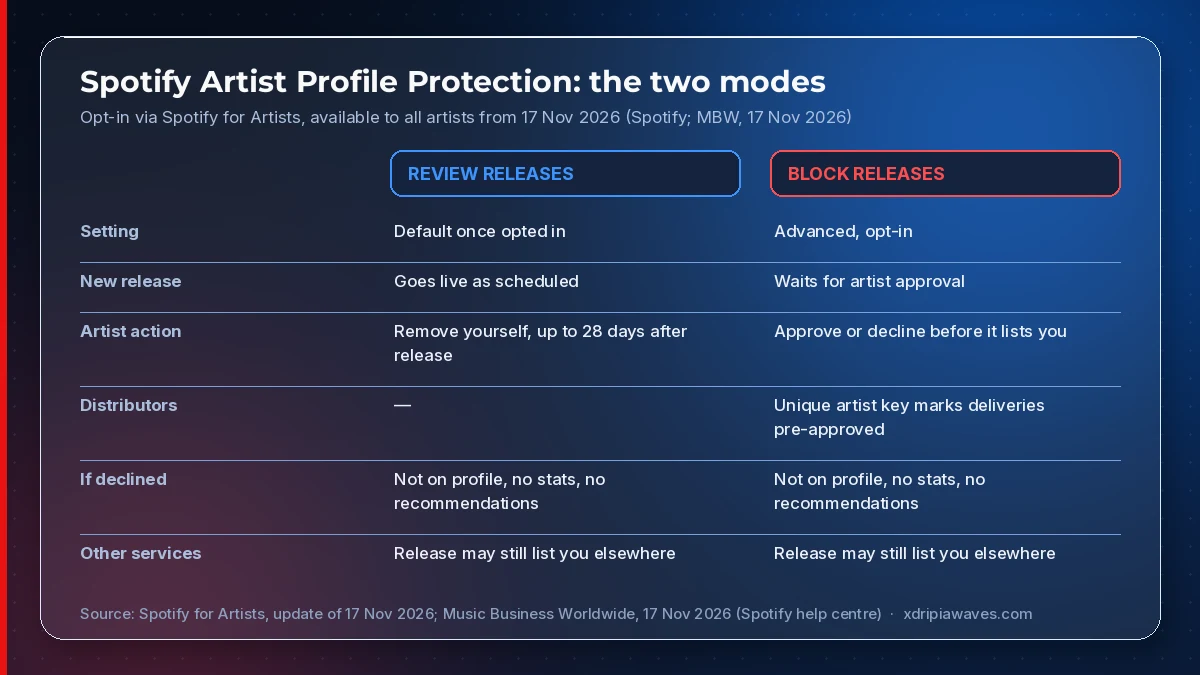
Source: Spotify for Artists, Artist Profile Protection update of 17 November 2026; Music Business Worldwide, 17 November 2026, citing Spotify's help centre.
The default has changed since the beta: MBW notes that in March, releases an artist ignored were blocked by default. A declined release does not appear on the profile, count toward stats or get recommended to listeners. Spotify itself warns that the release may still list the artist on other services, so the label or distributor should still be told.
SoundCloud writes "AI Abuse" into its rules
SoundCloud CEO Eliah Seton announced updated Community Guidelines and Terms of Use on 17 November in an open letter published by Billboard. AI music stays allowed. Two things are now targeted explicitly:
- Excessive uploads: accounts that upload too much, as SoundCloud defines it, may face upload limits and additional review (Digital Music News).
- AI Abuse: the new section of the Community Guidelines covers mass-producing near-duplicate tracks to inflate earnings, using AI or automation to inflate plays or engagement, uploading work that copies protected material or uses someone's voice or likeness without permission, and presenting AI-generated work or personas as human.
Penalties include content removal, withheld or reversed payouts, and account suspension or termination. Seton also wrote that SoundCloud works with more than 10 approved AI partners and shows identification information those partners supply.
Licensed training: Sonilo and Symphonic
On 18 November, video-to-music startup Sonilo and independent distributor Symphonic announced a deal that lets Sonilo train on Symphonic recordings, but only from artists and labels that opt in, according to Music Business Worldwide. Sonilo promises attribution reporting, licensing fees and a share of revenue. Its October partner Musical AI measures how much licensed material contributes to each output. Financial terms and the number of opted-in artists were not disclosed.
The Suno case: DistroKid documents
In the labels' original lawsuit against Suno, UMG and Sony told a Manhattan court on 16 November that they were withdrawing their subpoena motion against DistroKid. The distributor had produced the documents on its AI-detection tool that were still in dispute (MBW). The notice does not say what the documents show. The Suno case itself continues.
What to check this week
- On Spotify: turn on Artist Profile Protection. If you have a common name, consider Block releases plus an artist key for your distributor.
- On SoundCloud: review upload volume and how AI use is described in titles, bios and credits. Misrepresenting AI work as human is now an explicit violation.
- On Suno: budget Visuals credits separately, and confirm you hold the rights to any image you upload.
- On training deals: opt-in programmes are spreading among distributors. Read the terms for attribution and revenue share before enrolling.