In our last AI edition a Suno-generated vocal topped Korea's Melon chart and Suno moved onto the Ableton timeline. This week the question shifted from what AI music can do to what listeners want to be told about it. A new Deezer and Ipsos survey puts numbers on that, while two tool updates push generation deeper into ordinary production work and the labels' second case against Suno turns into a fight over timing.
Deezer and Ipsos: most listeners want labels
On 17 November, Deezer published the second edition of its yearly AI and music barometer, run by Ipsos with 9,000 people in eight countries: the United States, Canada, Brazil, the UK, France, the Netherlands, Germany and Japan.
The headline numbers
- 80% agree that both fully AI-generated and AI-assisted music should be clearly labeled.
- 72% of streaming users want to know when a service recommends fully AI-generated music.
- 69% believe fully AI-generated music threatens the livelihood of current and future artists.
- 67% think AI could lead to a loss of creativity in music production, up 3 points on 2025.
- 60% say fully AI-generated songs should not sit in the main charts next to human-made songs, up 8 points. Only 7% want them treated equally.
The chart question is no longer theoretical. The Melon No. 1 we covered last week is exactly the case those respondents were asked about.
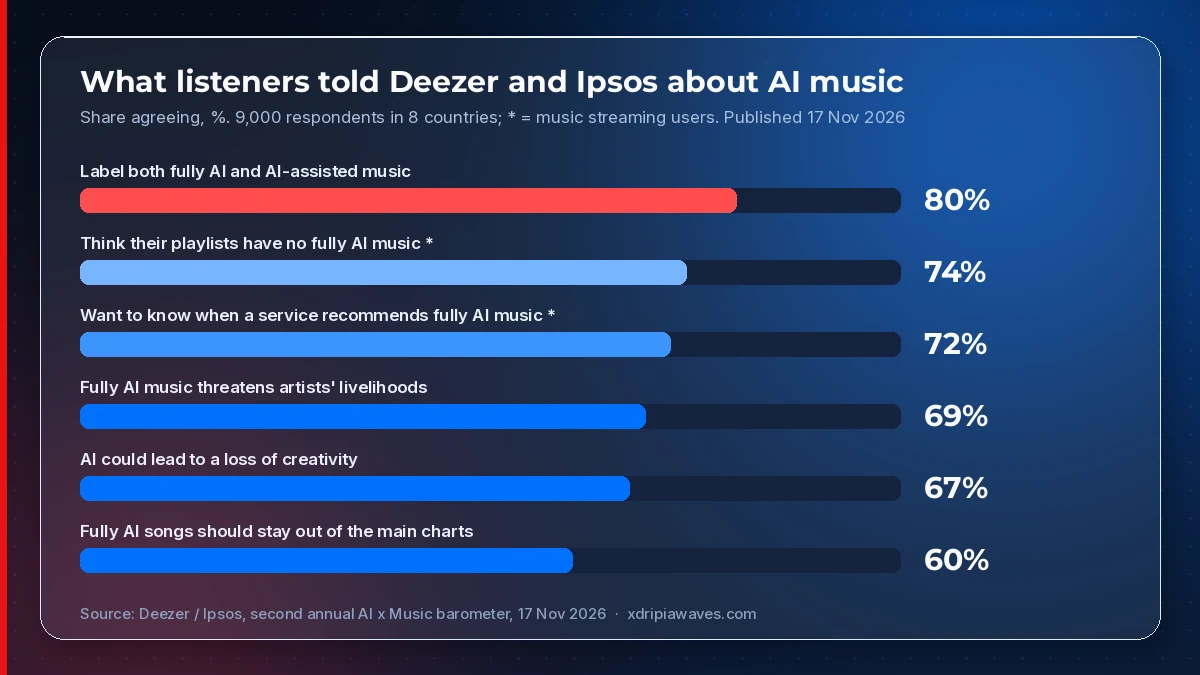
Source: Deezer and Ipsos, second annual AI and music barometer, 9,000 respondents in 8 countries, published 17 November 2026.
The gap between belief and playlists
The most useful finding for creators is a mismatch. According to Deezer, 74% of streaming users think their playlists contain no fully AI-generated music. Yet Deezer's internal data shows that nearly 57% of more than 53,000 people who joined from other platforms in October already had at least one fully AI-generated track in their playlists. Deezer notes that its detection tool can produce false positives.
Deezer also says it receives nearly 90,000 fully AI-generated tracks a day, more than half of daily deliveries on peak days. Those tracks are removed from algorithmic recommendations and editorial playlists, and an on/off toggle to exclude AI-generated content from search is due before the end of 2026.
Where opinions differ
The press release points to clear national differences:
- United States: attitudes turned more negative. 37% now see AI as a valuable tool for musicians, down 17 points from 2025.
- France: 88% want labels on fully AI-generated music, rising to 90% for AI-assisted music.
- Brazil: the most positive market, with 61% calling AI a valuable creative tool against 35% globally.
For producers, one more pair of numbers matters: 45% find it acceptable for a favourite artist to use AI to produce, mix or master, while 54% find a full track with little human involvement unacceptable. Listeners draw a line between assistance and replacement.
Tools: remixing and MIDI move into the session
Mureka Remix V9.5
On 16 November, Mureka released Remix V9.5, a model that takes an a cappella take, a vocal with one instrument, an instrumental or a full song, keeps the melody, and rebuilds the arrangement in another style. What changed against V8:
- Inputs: V8 accepted only full songs; V9.5 also takes vocals alone, vocal plus instrument, and instrumentals.
- Length: uploads of 10 to 480 seconds, up from 350.
- Lyrics: optional, and can be rewritten in the prompt.
Mureka publishes pass rates in which V9.5 beats Suno V6 on every metric listed, but the evaluation was carried out by hand by Mureka itself, so treat it as a vendor claim. The company also states a limit worth knowing: results do not keep the original singer's timbre, and using a specific singer's voice as a reference is not supported. Through the API, a V9.5 remix costs $0.50 per track.
Difro Melody AI 2.5
Initial Audio's Difro Melody AI 2.5 works at the note level rather than the audio level. The update adds:
- Audio-to-MIDI: drag a melodic loop of up to 16 bars into the piano roll and it is converted locally, velocity included.
- A VST3 and AU plugin that syncs to the host and outputs MIDI, audio or both in real time.
- Key triggering from MIDI notes, with a latch option.
The base version is free with a monthly generation limit; a Pro version removes it. Because conversion runs on your machine, the loop you transcribe does not have to leave it, a useful contrast with cloud tools that upload your session.
Courts: a fight over timing in UMG v. Suno II
The legal news this week is about the calendar. Suno has asked the court in Massachusetts to stay the second label case, over roughly 60,000 recordings and its v6 models, until the fair use question is decided in the first. In a filing reported by Digital Music News on 16 November, Universal Music and Sony accept pausing work-specific discovery into ownership of those recordings, but oppose freezing the whole case for a period that could, in their words, "realistically extend into 2028".
Their argument is practical: by the time discovery into v6 began, the engineers who built the models may have moved on and the training pipelines may have changed. The labels propose a partial stay, with discovery from the first case usable in the second.
Separately, Elvis Presley Enterprises has amended its complaint against Suno, adding at least 42 further examples of allegedly infringing output. The core claims, filed on 6 November, are unchanged.
What this means for creators
- Disclose before you are detected. With 80% of respondents wanting labels for AI-assisted work too, and platforms tagging content themselves, declaring your own use is the safer path.
- Know where your audio goes. Local tools such as Difro keep material on your machine; hosted remix and stem tools do not. Read the upload terms before feeding them unreleased work.
- Expect no quick legal answer. If Suno's stay is granted, the central questions in UMG v. Suno II may not be tested for years.
We will keep following the barometer, the tools and the dockets in the next AI edition.