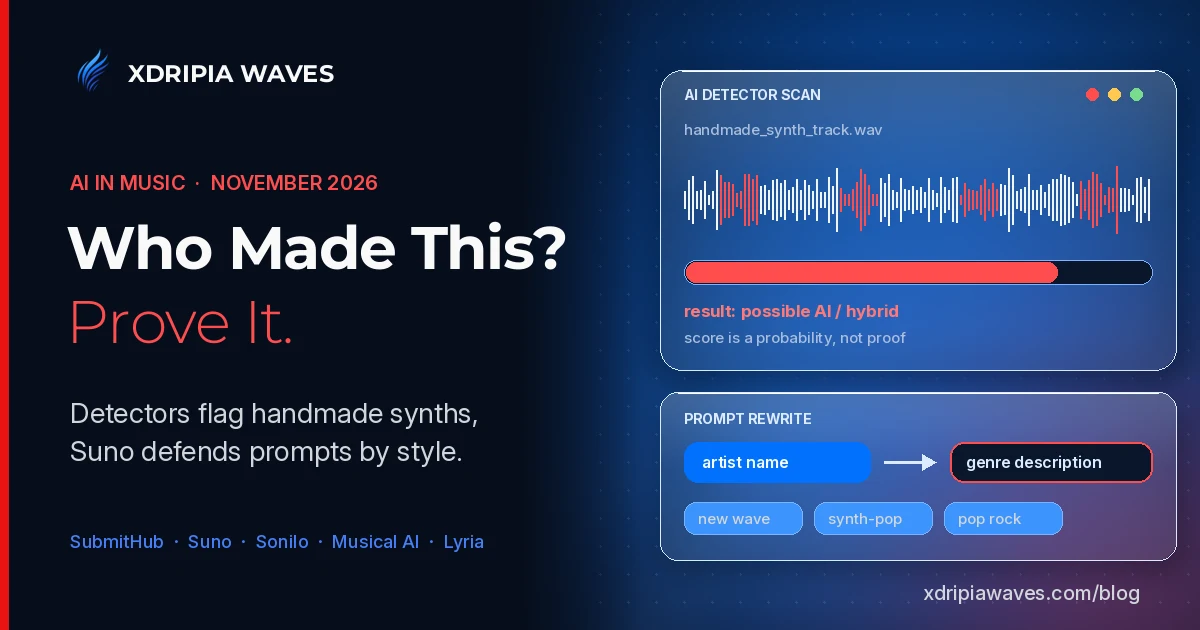
In our last AI edition the generators moved into chat windows and Spotify put a price on fan remixes. This week the questions are about recognition: who can tell whether a track was made by a machine, whose name a prompt may use, and whose recordings shaped a generated song. A handmade synth album flagged as AI, a new motion from Suno, an attribution partnership and a shareholder suit against Alphabet's leadership all landed between October 30 and November 4.
When the detector hears a synth and says "AI"
On November 4, Digital Music News reported a case that should concern anyone working with sequencers and machine drums.
The album that tripped the filters
In June 2026, Hamburg-based musician André Grafert, who records as Coloured Tears, released DECAY / TIME — A Tribute to Twice a Man, a double album of 23 covers of the Swedish post-punk band. According to DMN, he played, programmed, sang and produced it himself without generative AI, and soon faced public accusations of AI use.
Ines Weidemann of International Artist Marketing (IAM) then ran the tracks through detection tools. DMN reports:
- SubmitHub rated all 23 tracks as potentially AI-generated, and the other detectors she spot-checked mostly rated them as AI.
- The originals failed too: seven recordings by Twice a Man, made four decades ago, were rated "possible AI/hybrid" by SubmitHub.
- Named culprits: the 1984 song "Across the Ocean" was attributed to "Treblo_v3" and the 1982 song "In My Mind" to "ElevenLabs Music".
DMN lists SubmitHub, Let's Submit, TrackVerifier and ACRCloud among detectors that have labeled tracks with machine drums, precise sequencing, synthetic textures and processed vocals as "possibly artificially generated".
Why it matters for electronic music
The tools estimate statistical probabilities; they do not examine how a piece was made. DMN cites a recent study warning that detectors may also rely on incidental features such as sample rate and bitrate. Grafert says his sound is programmed note by note in Cubase and run through a Sequential Prophet X, Prophet 12, Pro 3 and Rev2, plus NI Kontakt and his own vocals.
The context raises the stakes. DMN cites Deezer's figure that AI-generated tracks made up more than half of the music newly delivered each day for the first time in June 2026, and notes that Bandcamp bans music generated wholly or in substantial part with AI. In IAM's assessment, blocked accounts, blocked releases and withheld royalties fall mainly on independent artists using DIY distributors, while the industry's voluntary labeling standard relies on self-disclosure by labels and distributors. We covered that standard and the first detector rollouts in our October 18 edition.
Practical takeaway: if you release synth-heavy work through a DIY distributor, keep project files, stems and session screenshots. A score is not proof, but neither is your word alone when an appeal is reviewed.
Suno: an artist's name is "shorthand" for a genre
On November 3, Suno filed a motion to dismiss the proposed class action by Jason Isbell, David Lowery, Guy Forsyth and Eduardo Calle, as reported by Music Business Worldwide. The suit, filed on August 31, contains no copyright claim; it argues that Suno exploits musicians' names and identities.
How Suno says prompts work
According to the motion, as summarised by MBW:
- Name replacement: when a user types an artist's name, Suno replaces it with a genre description before the instruction reaches the model. The filing's example turns "Duran Duran" into "New wave, Synth-pop, Pop rock".
- No name field: Suno says it does not train the model to recognize artist names and that its training material has no "artist name" metadata field.
- Who uses the name: a name typed into a prompt is, Suno argues, at most a use by the user, not by Suno.
- Style is not property: Suno says the theory would give musicians ownership of a style, which federal copyright law deliberately does not protect, and also raises First Amendment and preemption arguments.
The plaintiffs' complaint alleged that the name filter could be bypassed by spacing out letters; Suno calls these imperfect responses to atypical requests. MBW also notes that in its October 20 answer to the labels' second suit, Suno admitted that users may include artist names in prompts as of January 2026. The plaintiffs' opposition is due December 1 and Suno's reply December 15.
Attribution built in from the start
Also on November 3, generative audio company Sonilo announced a partnership with Musical AI, an attribution and rights management company, reported by BroadwayWorld.
- What Sonilo makes: music and sound effects generated from video footage, text or both, using models built on licensed source material.
- What Musical AI adds: analysis of Sonilo's outputs to measure how licensed recordings and compositions contributed to each one.
- Who gets the data: Sonilo's licensing partners, to account for usage and support compensation for songwriters, artists and rights holders.
The announcement says Sonilo is finalizing master recording and publishing agreements and preparing a new music model update. It gives no partner names, payout terms or launch date.
Lyria reaches the boardroom
MBW reports that Alphabet shareholder Phil Rosen filed a complaint on October 30 in federal court in Chicago against Sundar Pichai, Larry Page, Sergey Brin and ten other directors and executives. It alleges an "unlawful business strategy" of building Google's AI on copyrighted works, including recordings, compositions and lyrics allegedly used to train Lyria, Lyria 2, Lyria 3, Mulan and MusicLM. The complaint says MusicLM was trained on five million audio clips totaling 280,000 hours of music, without identifying the recordings or rights holders. These are allegations; no court has ruled on them.
What to watch
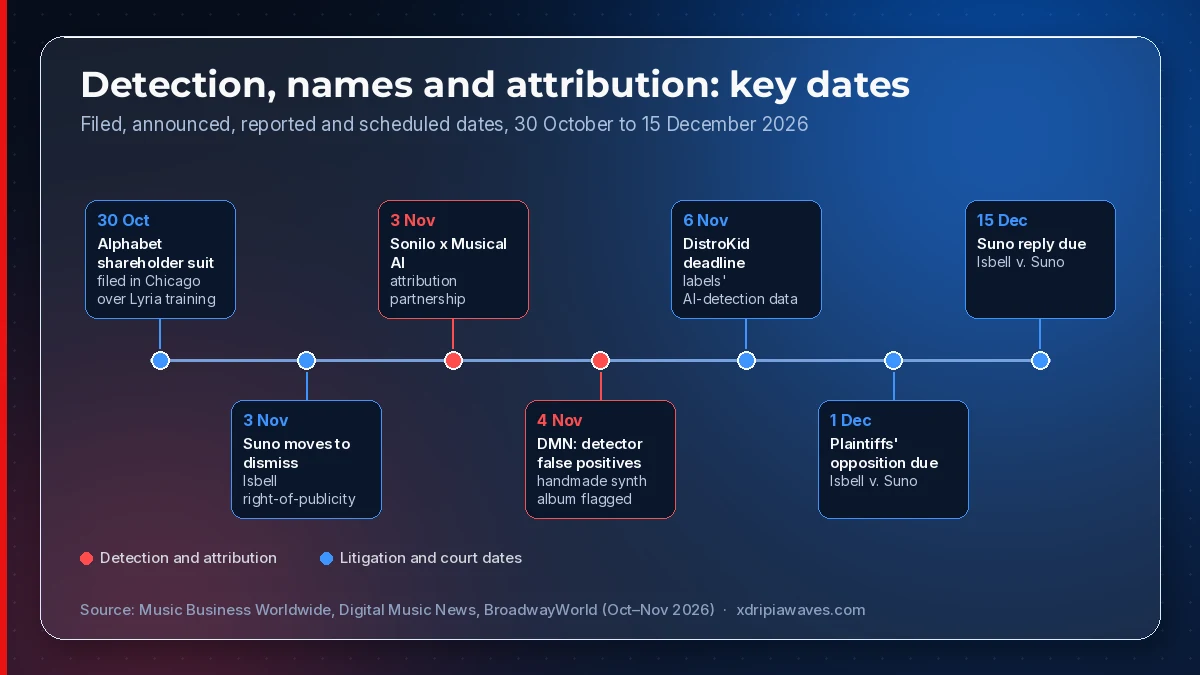
Source: Music Business Worldwide, Digital Music News, BroadwayWorld (Oct–Nov 2026).
- November 6: DistroKid's deadline to respond to UMG and Sony, who want monthly counts of uploads its detection model scores as likely AI and how many it attributes to Suno; the parties told the court they are working on a resolution (MBW).
- December 1 and 15: the Isbell plaintiffs' opposition and Suno's reply.
Detection, naming and attribution are the same question asked three ways: what is inside a track, and who can prove it. For now, the answers come from probability scores, court filings and partnership announcements, not settled rules.